


Crypto robo advisors are automated investing accounts that add crypto to a managed portfolio. In the US, the mainstream ones do it with spot Bitcoin and Ether ETFs, not coins, and charge between 0.25% and 0.65% a year. Trading bots such as Coinrule and 3Commas are a different product: you keep the coins on your own exchange account and pay a monthly subscription for rule-based trading.
Pick the type first. The provider comes second. Every fee below was checked on the provider’s own pricing page on October 6, 2026.
This is not financial advice. Crypto can lose most of its value quickly. Only invest money you can afford to lose.
Key takeaways
- Wealthfront, Betterment and Titan give you crypto exposure through Bitcoin and Ether ETFs inside a normal investing account.
- Wealthfront charges 0.25% a year and caps crypto at 10% of your portfolio.
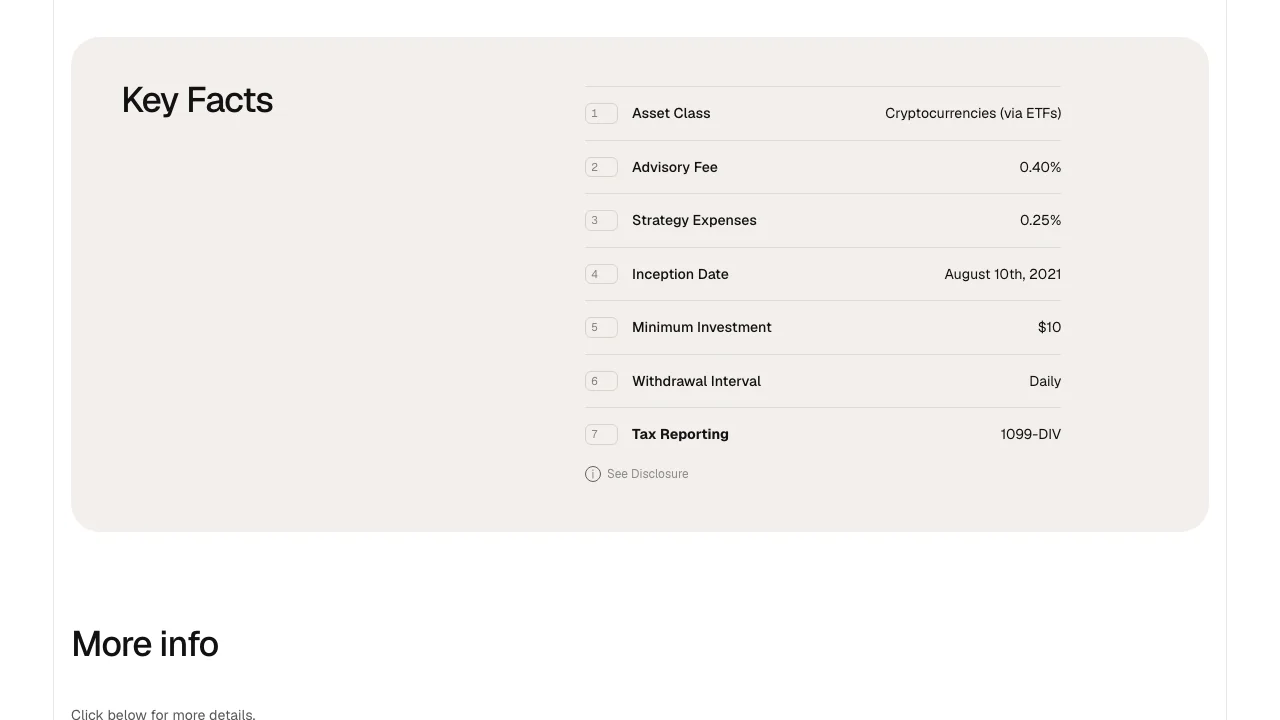
- Titan Crypto costs 0.40% in advisory fees plus 0.25% in strategy expenses, with a $10 minimum.
- Trading bots charge a flat subscription. Coinrule runs from free to $749 a month. 3Commas runs from $20 to $140 a month.
- On a small balance, a bot subscription can cost far more than a robo advisor’s percentage fee.
Crypto robo advisors compared
| Service | Type | What you hold | Fee | Minimum |
|---|---|---|---|---|
| Wealthfront | Robo advisor | iShares Bitcoin Trust (IBIT) and iShares Ethereum Trust (ETHA), up to 10% of the portfolio | 0.25% a year | $500 |
| Betterment | Robo advisor | Crypto ETF portfolio of Bitcoin and Ethereum ETFs | $5 a month, or 0.25% a year once you qualify | Not listed on the pricing page |
| Titan Crypto | Managed strategy | Bitcoin and Ethereum ETFs | 0.40% advisory fee plus 0.25% strategy expenses | $10 |
| Coinrule | Trading bot | Your own coins, on your own exchange | Free, $29.99, $59.99 or $749 a month | None |
| 3Commas | Trading bot | Your own coins, on your own exchange | $20, $50 or $140 a month | None |
What is a crypto robo advisor?
A robo advisor is software that builds a portfolio for you, rebalances it and, at some firms, harvests tax losses. You answer a few questions, deposit money and leave it alone.
The crypto part changed in 2024. US spot Bitcoin ETFs began trading in January 2024 and spot Ether ETFs followed in July 2024. That gave robo advisors a regulated fund they could hold like any other ETF.
Wealthfront shows the shift. It first offered crypto through Grayscale trusts. It switched its Bitcoin holding to the iShares Bitcoin Trust on March 21, 2024, and its Ethereum holding to the iShares Ethereum Trust on September 9, 2024.
So with a robo advisor you own shares of a fund. You do not own coins, you cannot send them to a wallet, and you cannot spend them.
Robo advisor or trading bot: which do you need?
| Robo advisor | Trading bot | |
|---|---|---|
| Goal | Long-term holding | Active trading by rules |
| What it buys | Bitcoin and Ether ETFs | Any coin your exchange lists |
| Where assets sit | Brokerage account at the advisor | Your own exchange account |
| Pricing | Percentage of your balance | Flat monthly subscription |
| Your workload | Set a target and deposit | Design, test and monitor rules |
| Main risk | Crypto prices fall | Crypto prices fall, plus a bad rule keeps trading |
Most people asking about crypto robo advisors want the left column. If you want the right one, our guide to AI crypto trading bots goes deeper.
The robo advisors
Wealthfront: crypto as a slice of a wider portfolio
Wealthfront’s Automated Investing Account costs 0.25% a year and opens with $500. You can add IBIT and ETHA to the portfolio, up to a combined 10% of its value.
The cap is deliberate. Wealthfront says it limits the allocation because these investments can be riskier and more volatile than most ETFs. If you want crypto to be a small, managed part of a diversified account, this is the cleanest setup.
Betterment: a ready-made Bitcoin and Ether portfolio
Betterment offers a Crypto ETF portfolio that holds Bitcoin and Ethereum ETFs and rebalances automatically. Its pitch is plain: no exchanges, no wallet.
Pricing has a catch for small accounts. The base price is $5 a month. You move to 0.25% a year once you set up recurring deposits of $200 or more a month, or reach $24,000 across your Betterment accounts. Premium, with access to human advisors, costs 0.65% a year and needs $100,000.
Titan Crypto: a managed strategy with a low entry point
Titan Crypto is a managed strategy that gets its exposure through Bitcoin and Ethereum ETFs. Titan lists a 0.40% advisory fee, 0.25% in strategy expenses and a $10 minimum. The strategy dates from August 10, 2021.
That makes it the most expensive of the three on fees and the cheapest to start.
The trading bots
Coinrule: build rules without code
Coinrule lets you write if-this-then-that trading rules and run them on a connected exchange. The free Starter plan allows two running strategies, one exchange and $3,000 in monthly volume.
Paid plans are Investor at $29.99 a month, Trader at $59.99 and Pro at $749, all on annual billing. Investor covers 7 live rules and three exchanges. Trader covers 25 live rules and five exchanges.
3Commas: bots for spot and futures
3Commas sells three plans. Starter is $20 a month for spot bots on one exchange. Pro is $50 a month and adds futures. Expert is $140 a month. Annual billing drops those to $15, $38 and $105.
Futures bots use leverage, and leverage can wipe out an account fast. Read our leverage and margin guide before you switch that on.
What do they cost on a $10,000 balance?
Percentage fees and flat subscriptions look similar until you put a balance next to them. Here is one year on $10,000.
| Service and plan | Annual cost | Share of $10,000 |
|---|---|---|
| Wealthfront | $25 | 0.25% |
| Betterment at 0.25% | $25 | 0.25% |
| Betterment at $5 a month | $60 | 0.60% |
| Titan Crypto (advisory plus strategy expenses) | $65 | 0.65% |
| 3Commas Starter, annual billing | $180 | 1.80% |
| Coinrule Investor, annual billing | $359 | 3.59% |
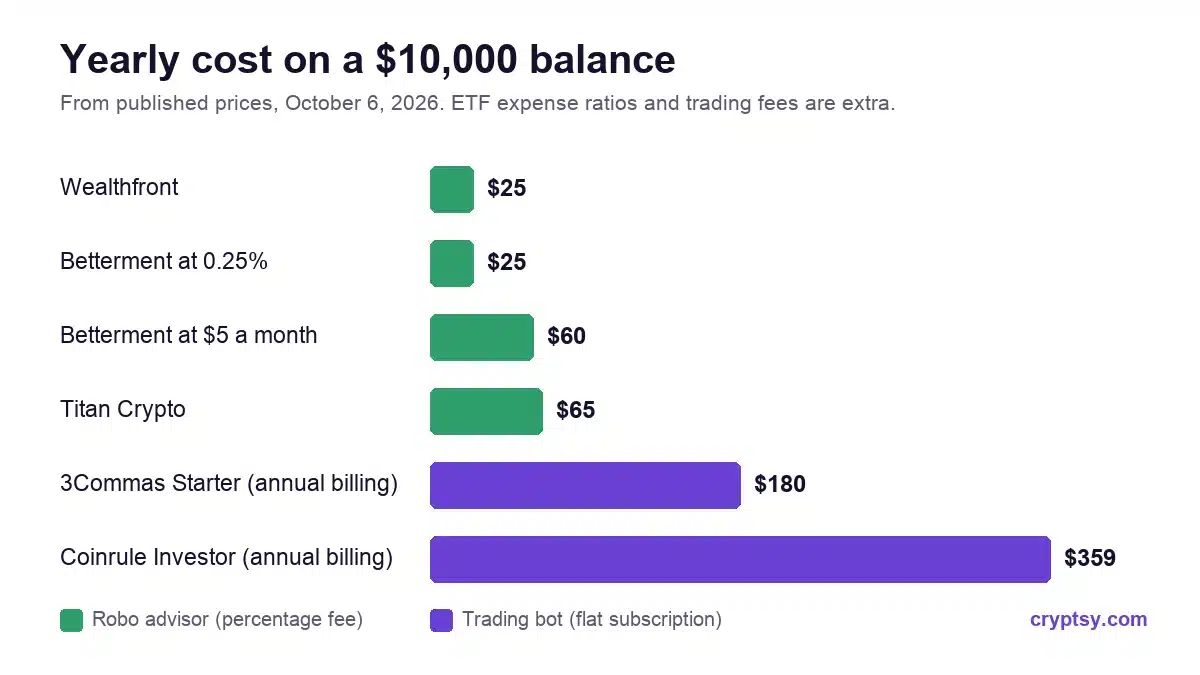
A bot has to beat simply holding by several percent a year just to cover its own subscription. On $100,000 the math changes, because the subscription stays flat while percentage fees scale.
How to choose in five steps
- Decide whether you are investing or trading. Investing points to a robo advisor.
- Decide how much crypto you want. If the answer is under 10% of a wider portfolio, Wealthfront’s cap is not a limit.
- Check the fee on your actual balance, not the headline rate.
- Check what you will own. ETF shares cannot be withdrawn as coins.
- For bots, connect with API keys that can trade but cannot withdraw.
Want to hold real coins instead? Buy on one of the low-fee crypto exchanges and move long-term holdings to cold storage. Our list of the best cryptocurrencies to invest in covers what to buy.
What to watch out for
- Only two assets. All three robo advisors here stick to Bitcoin and Ether. No altcoins.
- Two layers of fees. You pay the advisor and the ETF issuer.
- Bots do not promise profit. A rule that worked last year can lose money this year, and it will keep running until you stop it.
- Small accounts and flat fees. A $5 monthly fee on $1,000 is 6% a year.
- Old reviews. Many articles still describe Grayscale trusts and direct coin portfolios that these firms have replaced.
Frequently Asked Questions
What is a crypto robo advisor?
A crypto robo advisor is an automated investing service that includes crypto in a managed portfolio. In the US, the main ones hold spot Bitcoin and Ether ETFs and rebalance them for you.
Do crypto robo advisors hold real coins?
The mainstream US robo advisors do not. Wealthfront, Betterment and Titan hold Bitcoin and Ethereum ETFs, so you own fund shares that cannot be withdrawn to a wallet.
How much do crypto robo advisors charge?
Wealthfront charges 0.25% a year. Betterment charges $5 a month or 0.25% a year once you qualify. Titan Crypto charges a 0.40% advisory fee plus 0.25% in strategy expenses. ETF expense ratios are extra.
How much crypto can I hold with Wealthfront?
Wealthfront limits its Bitcoin and Ethereum funds to a combined 10% of your portfolio. It says the cap reflects the higher risk and volatility of these investments.
Is a crypto trading bot the same as a robo advisor?
No. A trading bot places trades on your own exchange account according to rules you set, for a flat subscription. A robo advisor manages a long-term portfolio for a percentage of your balance.
What is the minimum to start?
Titan Crypto starts at $10 and Wealthfront at $500. Coinrule and 3Commas have no investment minimum, but you need funds on a connected exchange.
Last updated: October 6, 2026. Fees and plans change. Confirm current pricing on each provider’s site before you open an account.




















