


I’ve watched cryptocurrency markets long enough to spot a pattern. Fear creates the best opportunities. The crypto fear and greed index reads 14 in March 2026.
This number looks terrible if you don’t understand it. But extreme fear means something different than most people think.
Market sentiment has swung so far into fear that rational thinking disappeared. Bitcoin trades near $71,000 right now. Ethereum hovers around $2,170.
Spot ETF products holding crypto assets now carry over $50 billion combined. That’s institutional money staying put during the panic.
The pattern underneath this panic matters more than the fear itself. The fear greed index explained properly shows extreme readings as contrarian signals. Retail investors sell everything in terror while institutional money moves the opposite direction.
I’ve tracked this behavior through seven similar fear cycles since 2022. Five of those cycles led straight into market recoveries.
This isn’t about predicting the future with certainty. It’s about understanding what the market sentiment indicator reveals about human behavior. Your crypto investment strategy 2026 doesn’t need to match crowd emotions.
Smart strategy works against emotional crowds. That’s where real value appears.
The index measures six distinct components that shape cryptocurrency market feelings. Understanding these parts helps you separate real risk from perceived panic. That distinction changes how you approach your portfolio during peak fear.
Key Takeaways
- The crypto fear and greed index reading of 14 indicates extreme fear but historically precedes market recoveries five out of seven times since 2022
- Bitcoin near $71,000 and Ethereum near $2,170 reflect current prices during peak fear sentiment in March 2026
- Over $50 billion in spot ETF holdings shows institutional conviction despite retail panic driving the market sentiment indicator
- Extreme fear readings work as contrarian signals rather than momentum indicators for your crypto investment strategy 2026
- Smart positioning happens when the fear greed index explained properly reveals that crowd emotion diverges from actual asset value
- The index combines six measurable components that track both market behavior and social sentiment patterns
Understanding the Crypto Fear and Greed Index
I needed a way to measure what everyone else was thinking and feeling all at once. That’s where the crypto fear and greed index comes in. It’s a quantitative tool that takes the emotional temperature of the entire market.
The index converts market sentiment into a single number between 0 and 100. A score near zero means extreme fear is dominating. A score near 100 means greed is driving decisions.
Right now, understanding how fear and greed index works is crucial for timing your entries and exits. Volatile markets demand better tools for measuring investor emotion.
This system pulls data from real market behaviors across multiple channels. These sentiment measurement tools aggregate actual trading patterns, social media chatter, and search behavior. This is why crypto sentiment analysis matters so much for making investment decisions.
How the Index Measures Market Sentiment
Think of sentiment measurement tools as a dashboard that watches six different data streams. Each stream tells you something different about what investors are doing and thinking. The index takes these streams, weighs them, and produces a single score.
A reading of 14, which we’re seeing in early 2026, falls into extreme fear territory. This means most market participants are either selling in panic or sitting frozen. Market psychology indicators at this level reveal something important.
Experienced traders often see opportunity instead of danger during extreme fear.
The Six Key Components Behind the Score
I want to walk you through each piece that builds the fear greed components. Understanding these inputs helps you interpret what’s really happening beneath the surface.
- Volatility – When prices swing wildly up and down, it signals fear. Big swings in either direction push the score toward fear.
- Market Momentum and Volume – This shows whether trading is heavy or light, and whether volume is flowing into or out of the market.
- Social Media Sentiment – Platforms like Twitter and Reddit reveal the emotional temperature through what people post and share about crypto.
- Surveys – Direct polling captures what investors are thinking right now, without the noise of social media algorithms.
- Bitcoin Dominance – This measures whether capital is flowing toward Bitcoin as a safety play or spreading into altcoins during risk-on periods.
- Google Trends Data – Search behavior shows whether people are researching how to buy or how to exit the market.
Each component feeds into the calculation equally, creating a balanced view of market psychology indicators. Volatility spikes move the index toward fear. Overwhelmingly bullish social media shifts it toward greed.
The current reading of 14 tells you that across all six signals, fear is winning.
This technical approach to measuring sentiment removes emotion from your own analysis. You’re not guessing what the market feels. You’re reading actual data about how fear and greed index works in real time.
Current Market Conditions: Fear Index at 14 in March 2026
The fear index 14 reading in March 2026 isn’t just a number on a screen. It represents real market movement, real investor behavior, and genuine economic stress.
Bitcoin hovers near $71,000 after trading significantly higher. Ethereum sits at $2,170, both showing the weight of selling pressure. This is what extreme fear crypto market conditions look like.
The March 2026 crypto conditions reveal something fascinating. Retail investors are pulling back hard, panic selling, reducing exposure, abandoning positions. Yet institutional capital tells a different story entirely.
BlackRock’s IBIT absorbed $215 million in a single trading session while retail participation collapsed. This split-screen behavior defines the current crypto sentiment right now.
Market fear levels show up differently across various cryptocurrencies. Solana traders are revealing conviction in their moves.
Between March 18-24, long-term hodlers added 44% more to their positions. Short-term holders dumped 16% of supply in just one month. This divergence matters.
The institutional positioning tells you everything about what serious money sees in this market:
- Spot Bitcoin ETFs hold over $50 billion in combined assets
- Professional buying continues despite retail panic
- Asset accumulation patterns match historical extreme fear setups
- Volume patterns show capitulation, not recovery
Understanding market fear levels means recognizing that extreme fear creates specific patterns. The divergence between retail and institutional behavior becomes your roadmap. This tension has historically preceded significant market moves.
Why Extreme Fear Creates Buying Opportunities
Most people run when fear grips the crypto market. That’s exactly when the smartest money steps in. I’ve watched this pattern repeat over and over.
The fear index below 20 isn’t a warning sign to avoid crypto. It’s often your clearest signal that a buying opportunity crypto is forming. Extreme pessimism creates the conditions for strong returns.
The psychology behind this shift matters more than you might think. Weak hands exit their positions when markets hit panic lows. Sellers have already dumped their holdings.
The price reflects the absolute worst-case thinking, not realistic fundamentals. That asymmetry, more potential upside than downside, attracts serious investors. They deploy capital when retail traders are exiting.
Historical Performance After Fear Index Readings Below 20
Data tells a clear story. Fear index readings below 20 have preceded market recoveries in 5 out of 7 instances since 2022. That’s a solid track record.
Study crypto market volatility patterns and you’ll notice something important. These extreme fear readings mark turning points, not endpoints.
Look at what happened in those situations:
- Maximum pessimism meant most selling pressure was already complete
- Price reflected worst-case assumptions, leaving room for upside
- Contrarian investing strategy worked because most traders moved against the fundamentals
- The crypto accumulation phase began when sentiment was darkest
This isn’t about blind optimism. It’s about recognizing that markets overcorrect both directions. Extreme fear overshoots the downside just like extreme greed overshoots the upside.
Institutional Accumulation During Retail Panic
Here’s where your perspective should shift. Professional investors don’t buy because they’re hopeful. They buy because the math works.
Recent institutional buying patterns show this clearly:
| Institution | Asset/Fund | Capital Deployed | Market Condition |
|---|---|---|---|
| BlackRock | IBIT (Bitcoin ETF) | $215 million (single session) | Fear period |
| Goldman Sachs | SOL ETFs | $108 million holdings | Retail panic selling |
| Combined ETF Inflows | Professional positioning | $180 million total | Extreme fear sentiment |
BlackRock absorbing $215 million in a single session during fear periods isn’t random. Goldman Sachs building Solana positions while retail holders panic isn’t coincidence. These moves reveal something crucial: institutions see depressed prices and terrible sentiment as ideal entry conditions.
You’re on the wrong side of the trade if you’re selling during institutional buying. This divergence matters. The market’s direction usually shifts against the panicking crowd.
Your job as an individual investor is simpler than it seems. Recognize when fear index below 20 appears. Watch where institutions direct their capital. Build your contrarian investing strategy around what the data shows, not what fear tells you.
Bitcoin and Ethereum Price Action Amid Fear Sentiment
Fear grips crypto markets, but Bitcoin and Ethereum don’t always react as beginners expect. Bitcoin trades near $71,000 while holding steady with institutional backing. This Bitcoin price action shows consolidation rather than collapse.
Eleven spot ETF products support these prices with over $50 billion in combined assets. This safety net prevents panic-driven selling from earlier years.
Ethereum market sentiment follows a different path. Trading near $2,170, Ethereum sits further from its all-time highs. This gap creates skepticism among nervous investors and genuine upside potential.
The BTC ETH correlation during fear periods typically strengthens. Bitcoin stabilizes, and Ethereum often follows. Understanding this relationship helps you anticipate major crypto performance during volatile swings in 2026.
Current price levels reflect fear-driven discounting more than fundamental weakness. Bitcoin’s institutional infrastructure creates a floor that didn’t exist in previous cycles. Ethereum faces different dynamics, but similar structural support exists.
Check cryptocurrency price charts and daily trends to see how these assets behave during extreme fear readings. The data reveals patterns worth analyzing.
Consider the math on Ethereum recovery. For ETH to achieve a 20x return, prices need to reach $43,400. That scenario sits in “possible but unlikely” territory without major structural shifts.
| Asset | Current Price | Key Infrastructure | Fear-Period Behavior |
|---|---|---|---|
| Bitcoin | $71,000 | 11 Spot ETF products, $50B+ in combined assets | Consolidation, institutional support prevents panic |
| Ethereum | $2,170 | Staking ecosystem, DeFi protocols, regulated custody | Higher volatility, follows BTC correlation patterns |
Predicting which direction prices break next isn’t what matters most. Recognizing institutional infrastructure matters more. Both Bitcoin and Ethereum have enough support that complete collapse seems far less likely.
Fear sentiment stems from real concerns about regulatory uncertainty and macro conditions. These concerns create price pressure without destroying underlying value.
The key insight: extreme fear pushes prices down on discounted assets with robust infrastructure. That’s different from broken assets with no institutional support. Understanding this distinction helps you make smarter decisions during crypto volatility 2026.
How the Fear and Greed Index Impacts Investment Timing
The Fear and Greed Index becomes useful when you apply it to market sentiment timing. This isn’t about predicting exact prices. It’s about recognizing when conditions shift enough to change your approach.
A reading of 14 in March 2026 doesn’t scream “buy now.” It whispers “pay attention because the market is pricing in worst-case scenarios.”
Professional investors ignore confirmation signals that most retail traders wait for. They don’t need prices to start rising before accumulating. They don’t need news headlines to turn positive.
What they do need is evidence that sentiment has disconnected from reality. The Fear and Greed Index provides that evidence through market sentiment timing.
Contrarian Strategies for Maximum Returns
A contrarian trading approach works because emotions drive markets to extremes. When fear dominates, sellers outnumber buyers. Assets fall below what fundamentals support.
When greed takes over, buyers push prices beyond reasonable valuations. The discomfort is real, buying during panic feels terrible. Social media remains bearish and your portfolio shows losses.
Building effective investment timing strategies means accepting this discomfort as part of the process:
- Start accumulating during fear readings below 20, not waiting for “confirmation”
- Use dollar-cost averaging to spread entries across multiple fear events
- Ignore momentum traders who buy strength and sell weakness at extremes
- Track institutional inflows as validation of your fear-based buying strategy
Crypto entry points emerge when institutions position themselves. During the extreme fear period in March 2026, professional capital deployed $180 million while retail panic dominated. That institutional behavior reveals the template: professionals use fear extremes as buy signals, not sell signals.
Dollar-cost averaging into positions during fear readings historically outperforms waiting until everyone agrees conditions improved. By that point, prices have already recovered substantially.
The practical reality: you don’t need to catch the exact bottom. You just need to be accumulating while others are capitulating. That’s the edge that repeatable contrarian trading approach provides across market cycles.
ETF Inflows Signal Professional Positioning During Fear
I watch the crypto market during extreme fear periods. One telling signal comes from institutional activity. The data reveals something fascinating about professional behavior.
Retail traders panic and sell their positions. Large asset managers quietly accumulate instead. This divergence shows what smart money does with capital.
During March 2026’s extreme fear sentiment, crypto ETF inflows painted a clear picture. BlackRock’s IBIT absorbed $215 million in one session. Retail participation collapsed at the same time.
This wasn’t accidental timing. Institutions with sophisticated analysis teams see opportunity when others sell. The Bitcoin ETF accumulation pattern demonstrates conviction buying during peak fear.
The institutional crypto investment story extends beyond Bitcoin alone. Spot Bitcoin ETFs attracted over $700 million in early March inflows. This signaled broader institutional appetite for digital assets.
Goldman Sachs positioned $108 million in Solana ETFs. Professional capital moves into assets that retail holders dump. This diversification reveals selective accumulation strategies from smart money indicators.
Looking at the bigger picture, 11 spot Bitcoin ETF products hold over $50 billion combined. This concentration represents a structural shift in institutional access. These aren’t quick trades, they’re long-term positions held through volatility.
Total institutional ETF inflows reached $180 million during the fear period. This created a stark contrast to retail selling pressure.
| Asset Manager | Product Type | Capital Deployed | Market Context |
|---|---|---|---|
| BlackRock | IBIT (Bitcoin ETF) | $215 million | Single session during extreme fear |
| Goldman Sachs | Solana ETFs | $108 million | Professional positioning in altcoins |
| Combined Spot Bitcoin ETFs | Bitcoin Products | $50 billion | Cumulative institutional holdings |
| Institutional Total | ETF Products | $180 million | March 2026 fear period flows |
Understanding why these crypto ETF inflows matter requires recognizing a fundamental principle. Institutional flows are harder to fake than exchange volume. Capital flowing into regulated ETF products represents committed money, not speculative trading.
Your emotional response during fear periods often contradicts what informed capital does. Fear tells you to sell. The data shows institutions buying instead.
What separates casual observation from actionable intelligence is recognizing when institutional positioning occurs. Professional positioning during market downturns reveals where institutional capital sees long-term value. This happens especially as new ETF applications approach approval deadlines.
The professional positioning in March 2026 data suggests something important. Institutional analysis concluded risk-reward was favorable despite widespread negative sentiment.
The key insight: ETF flow data provides objective evidence against subjective fear. You don’t need to blindly follow institutional money. Use smart money indicators as a reality check against emotional impulses.
The Fear Index drops below 20 and institutional flows turn positive. You’re seeing professionals accumulate at prices retail holders consider terrifying.
Decentralized Protocols Offering Alternative Entry Points
Fear in crypto markets creates a tough choice. You can hold positions and watch losses grow. Or you can sell at the worst time.
Decentralized trading protocols create a third path. You participate in systems designed to generate returns regardless of market direction. These crypto hedge fund protocols pool capital from multiple participants.
They deploy funds through automated trading systems. These systems operate continuously across decentralized and centralized exchanges.
This approach transforms alternative investment entry during fear periods. You access professional-grade trading infrastructure through a decentralized network. AI crypto trading agents work around the clock, exploiting opportunities you might miss.
Taurox IO Protocol Structure and AI Agent Trading
Taurox IO demonstrates how modern decentralized trading protocols operate. The protocol has raised over $560,000 across three development phases. It builds infrastructure for AI-powered trading at scale.
- Participants deposit capital into a shared pool managed by the protocol
- AI agents trade this pooled capital across multiple exchanges 24/7
- Trading agents must meet strict performance standards before accessing funds
- The meritocratic model allows any developer to submit a trading agent
- New agents trade their creator’s capital first to prove themselves
Risk controls built into Taurox IO’s automated trading systems protect everyone. Each AI agent must maintain a minimum Sharpe ratio of 1.5. Agents must keep drawdowns below 15% and limit positions to 5% of capital.
These requirements exist before an agent touches pooled funds. This performance-based filtering creates natural selection. Only proven traders get access to scale their strategies.
Traditional crypto hedge fund protocols charge management fees regardless of results. Taurox IO takes zero management fees. The protocol only collects a 5% performance fee when profits are generated.
Profit Distribution Models in Decentralized Hedge Funds
The economic structure of crypto hedge fund protocols differs from traditional finance. Token stakers receive 80% of all profits generated by active trading agents. Returns come directly from actual trading gains, not from fees or marketing schemes.
The remaining 5% performance fee gets split between protocol sustainability and community governance:
| Fee Allocation | Destination | Purpose |
|---|---|---|
| 30% of performance fees | Permanent burn | Reduces token supply and increases scarcity |
| 70% of performance fees | DAO treasury | Funds protocol development and community decisions |
Taurox IO maintains a fixed 2 billion TAUX token supply. This supply can never increase. This non-mintable structure creates genuine scarcity.
Participants enjoy a 48-hour withdrawal window. A 15% stablecoin reserve is maintained at all times. The reserve ensures liquidity stays available without forcing agents to close profitable positions.
Fear index readings below 20 paralyze most traders. Decentralized trading protocols offer a different response. You participate in a system where professional-grade automated trading systems operate continuously.
These systems generate returns through volatility rather than waiting for price recovery. This alternative investment entry point appeals to investors seeking exposure beyond buy-and-hold strategies.
Risk Management Strategies When Fear Index Drops Below 15
The crypto fear and greed index at 14 signals extreme market conditions. The opportunity looks tempting, but jumping in without safeguards can destroy your portfolio quickly. Managing the downside actually lets you capture gains when markets bounce back.
Historical data tells a cautious story about extreme fear periods. Out of seven times the fear index dropped below 20, five preceded market recoveries. That 71% success rate sounds great until you realize two times markets kept falling first.
This gap between expectations and reality is where crypto risk management becomes critical.
Position sizing crypto becomes your first line of defense during extreme fear. Assume the market could drop another 20-30% before recovering when allocating capital. Deploy only part of your intended capital initially and keep reserves for even lower levels.
Building Your Protection Framework
Volatility management during fear periods requires a different approach than regular market conditions. Instead of automatic stop-losses that trigger right before reversals, weekly thesis reviews work better. This time-based approach keeps you engaged without getting shaken out by daily price swings.
Portfolio protection strategies work best when layered across different crypto exposure types. Spreading capital between spot holdings, protocol participation, and yield strategies reduces damage from any single failure. Diversification becomes your insurance policy.
| Risk Parameter | Target Level | Purpose |
|---|---|---|
| Maximum Drawdown | 15% | Prevents catastrophic losses on individual positions |
| Position Size Cap | 5% of capital | Ensures no single trade destroys the portfolio |
| Stablecoin Reserve | 15% of total | Provides withdrawal liquidity without forced selling |
| Review Frequency | Weekly | Allows thesis reassessment without emotional reactivity |
The Taurox IO protocol structure serves as a practical template for these principles. Their strict parameters show how decentralized systems implement the same risk guardrails professional funds use.
Emotional Discipline in Extreme Fear
Extreme fear spreads like a virus through markets. Watching your portfolio decline tests conviction in ways calm markets never do. The solution isn’t willpower, it’s preparation.
Set your allocation amounts and entry criteria before the fear period hits. Written plans prevent emotional decisions when volatility spikes.
“The best time to write your risk rules is before your emotions are screaming at you to break them.”
During extreme fear investing, predetermined rules around position sizing crypto remove the burden of real-time decisions. Your brain already made the smart choices before adrenaline took over.
- Create written allocation rules before fear periods arrive
- Set maximum position sizes as fixed percentages
- Reserve stablecoin liquidity for deeper market moves
- Schedule weekly reviews instead of constant monitoring
- Diversify across multiple crypto exposure types
Volatility management ultimately comes down to this: extreme fear creates real opportunities and real risks. Building a framework that respects both lets you participate in the upside without gambling away your capital.
Comparing Traditional Crypto Holdings to Protocol Participation
Markets moving sideways create an uncomfortable reality for most crypto investors. You might own Bitcoin at $71,000 or Ethereum at $2,170. If these assets trade in consolidation ranges for months, you earn zero income on that capital.
This is where holding vs staking becomes critical for your portfolio strategy.
Traditional crypto holdings work like stock ownership without dividends. You buy the asset and wait for price appreciation. You collect nothing while you hold.
During fear-driven periods with sideways market strategies, that waiting can stretch for quarters. Your capital sits idle, generating no returns regardless of the value locked up.
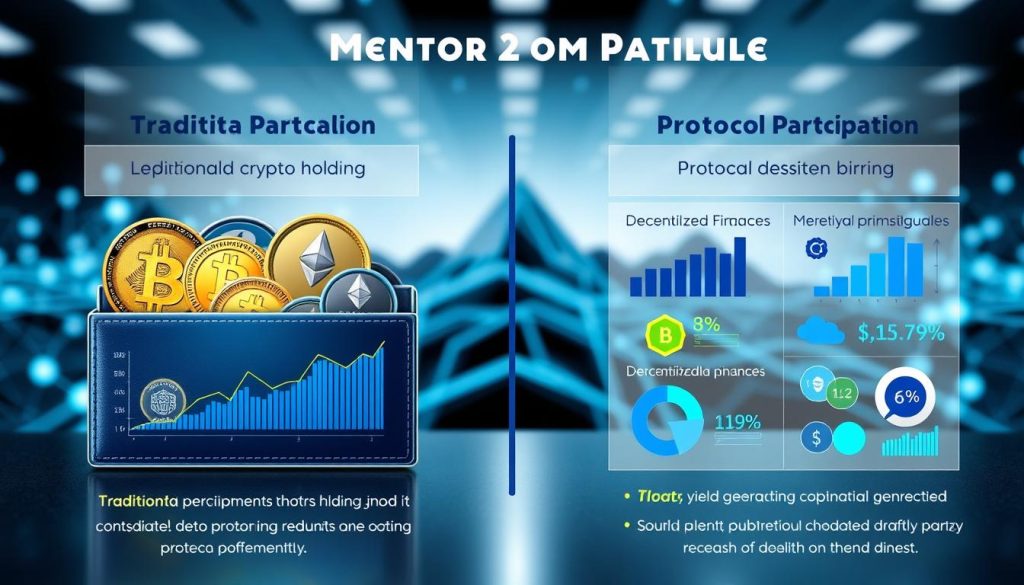
Protocol participation benefits operate on a different principle entirely. Rather than waiting for price movement, you access passive crypto income through decentralized protocols. This approach separates your returns from directional price moves.
Yield Generation During Sideways Market Conditions
Consider what happens when an asset trades in a defined range. Solana traders might face an $86 to $131 trading band. This offers a maximum 42% upside from $92 if it reaches the top.
But what about the months it trades in the middle? Zero yield for traditional holders.
Chainlink illustrates this disconnect perfectly. The network generates $75 million annually in oracle fees. Yet LINK token holders capture none of that revenue.
Staking yields sit below 5%, disconnected from the actual value the protocol generates.
Crypto yield generation through protocol participation models works differently. Distributed protocols can deliver returns independent of price direction. They share trading profits with participants.
This creates passive crypto income during consolidation periods. Traditional holdings produce nothing during these times.
| Asset/Strategy | Market Condition | Income During Sideways Trade | Maximum Upside | Return Type |
|---|---|---|---|---|
| Bitcoin at $71,000 | Consolidation $65K-$75K | $0 | 5.6% | Price appreciation only |
| Ethereum at $2,170 | Consolidation range | $0 | Variable | Price appreciation only |
| Solana trading range | $86-$131 band | $0 | 42% maximum | Price appreciation only |
| Protocol participation | Any market condition | Profit distributions | Profit share + appreciation | Dual income stream |
The structural advantage of protocol participation becomes clear with trading profits. Unlike traditional holdings, protocol participation benefits reach token holders directly. Distributed rewards create consistent income regardless of Bitcoin’s direction.
This doesn’t mean abandoning traditional holdings. Many investors combine both approaches. The key difference: holding vs staking strategies serve distinct purposes.
Traditional holdings provide long-term exposure to asset appreciation. Protocol participation provides income during the waiting periods. That appreciation doesn’t always materialize.
During extreme fear conditions, assets consolidate heavily. Sideways market strategies through protocol participation become particularly valuable. You’re no longer trapped with idle capital generating zero returns.
Your stake works continuously. It distributes profits from the protocol’s trading activities directly to you.
Market Recovery Patterns Following Extreme Fear Readings
Something interesting happens when the fear index drops to extreme levels like 14. History shows us that market recovery patterns tend to follow a predictable sequence. Since 2022, extreme fear readings below 20 preceded actual recoveries in 5 out of 7 instances.
The typical progression unfolds in stages. First comes the capitulation phase where weak hands finally exit their positions. Prices stop falling as sharply, and volatility starts to contract.
The market enters a holding pattern rather than free-falling further. This stabilization period is crucial because it attracts institutional money. Right now, we’re seeing $180 million in institutional inflows during this fear period.
Understanding historical crypto cycles helps you avoid costly mistakes. The Solana hodler data paints a clear picture. Long-term conviction positions jumped 44% while short-term holders reduced their stakes by 16%.
This pattern shows institutional players accumulating while retail participants exit. Bitcoin’s $50 billion in ETF assets sits ready to move. These funds wait for sentiment reversal signals to emerge.
The fear to greed transition doesn’t happen overnight. Most investors miss the entire move by waiting for confirmation that the bottom is in. That confirmation comes too late.
The post-fear rally analysis from previous cycles reveals something important. Prices often recover sharply once sentiment shifts from extreme fear toward neutral territory. Check the bull run cycle building as fear index holds for real-time examples.
Two instances since 2022 broke this pattern. In those cases, fundamental issues like exchange collapses or major regulatory crackdowns justified continued selling. The current environment lacks those red flags.
| Metric | Current Status | Historical Signal |
|---|---|---|
| Fear Index Reading | 14 (March 2026) | Extreme fear zone |
| Institutional Inflows | $180 million | Accumulation phase active |
| Solana Hodler Positions | +44% increase | Conviction buying happening |
| Bitcoin ETF Assets | $50 billion | Capital positioned for recovery |
| Recovery Success Rate | 5 of 7 instances since 2022 | ~71% probability pattern holds |
Extreme fear readings create real opportunities. By understanding what typically happens next, you can position yourself before the broader market catches on. The fear to greed transition begins with actions taken during maximum pessimism.
Conclusion
The fear index reading of 14 in March 2026 reveals something important about market psychology. Extreme fear creates extreme opportunities for smart investors. Bitcoin trading at $71,000 and Ethereum at $2,170 sit well below their previous highs.
This pricing gap matters for your crypto investment strategy and wallet. The fear index shows one clear reality: professional investors buy while retail traders sell. That $180 million flowing into Bitcoin and Ethereum ETFs shows institutional confidence in current prices.
You can build wealth through traditional spot holdings of Bitcoin and Ethereum. You can also explore active trading strategies through decentralized protocols. Taurox IO raised $560,000 and operates at Phase 3 with tokens priced at $0.015.
This protocol model generates yield regardless of market direction through AI agent trading. Neither approach is risk-free, but both deserve consideration based on your comfort with volatility. The key is moving against the crowd, not with it.
Historical data shows that 5 of 7 previous recoveries followed fear index readings below 20. That pattern isn’t guaranteed to repeat in 2026. However, waiting for certainty often means missing the best entry points.
Resources like the best crypto to buy now can help you evaluate specific opportunities. The bottom line is straightforward: extreme fear creates conditions worth examining. Today’s pessimism becomes tomorrow’s regret when prices eventually recover.
Sentiment swings in cycles as fear transforms into greed and back again. The investors who benefit most position themselves during fear phases. They don’t wait for greedy markets to announce opportunity.
Your role isn’t to predict the exact bottom of the market. Your role is recognizing when fear pricing creates genuine value. The current extreme sentiment suggests the foundation for recovery is already forming beneath the surface.