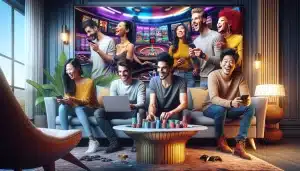


Video games have been a leading example of tech innovation throughout the years, a trend that can be seen in the online multiplayer games model, adoption of virtual reality, and cloud gaming. Currently, blockchains are altering the interactions among the three leading players in the game industry: gamers, developers, and publishers.
With the evolution of digital ownership, decentralized economies, and tokenized ecosystems, there is less and less talk of blockchain as just a speculative hype in the gaming industry and more of its actual use. The subsequent wave of blockchain breakthroughs is not just an instrumental enhancement of games but a complete redefinition of them.
From Play-to-Earn to True Player Ownership
Play-to-Earn (P2E) was the face of blockchain gaming in the early 2020s. The idea of game participation being rewarded with tokens or NFTs is called an in-game economy, and players are the primary beneficiaries. However, most of these projects have since collapsed due to unsustainable models. The successor version of this idea is now less about earning and more about owning.
How about truly owning an in-game sword whose existence is as a verified blockchain asset? The sword can be exchanged, enhanced, or even carried over to another compatible game. This approach, known as interoperable digital ownership, enables users to retain the real value of the game for a longer period, rather than just as a temporary financial incentive. Besides, game developers also get to profit as royalties from the secondary market can be a new source of their revenues.
Even the most conventional gaming centers are slowly but surely catching up with this trend. The platform IgnitionCasino.eu, seamlessly combines entertainment with technological innovation, exemplifying how blockchain can transform gaming ecosystems by providing transparency and decentralized player engagement. Although it is mainly a casino platform, its eagerness towards blockchain integration is indicative of the big industry-wide move to verifiable fairness, ownership, and digital asset interoperability.
Layer-2 Solutions and the Rise of Scalable Gaming

Scalability has been one of the most significant issues for blockchain technology. In the case of games, fast and cost-efficient transactions are a must, which early blockchains were not able to provide. Unfortunately, high gas fees and slow confirmation times made blockchain gaming far from a viable option for the mainstream audience. This is precisely the point where Layer-2 solutions make a difference.
Layer-2 blockchains such as Polygon, Arbitrum, and Immutable X are tailored to handle massive transaction throughput efficiently. At the same time, they do not compromise the security of the leading network. From the perspective of gaming, this is very close to zero-time asset transfers, microtransactions, and very cheap fees. Developers are now free to interweave blockchain mechanics with gameplay without any compromises in performance.
Decentralized Autonomous Worlds
Decentralized Autonomous Worlds (DAWs) is a concept that escalates the idea of open worlds far beyond the usual scope. Instead of a maker’s team figuring out every element, DAWs mature as per player governance, smart contracts, and decentralized decision-making. Users become the co-creators of the universe.
These games use Decentralized Autonomous Organizations (DAOs) for decision-making, allowing members to vote on changes, new content, or rule alterations. This way, the community obtains real power over the evolution of the game. Besides, the model entices players to commit to a game in the long run, both monetarily and creatively.
Where the future looks bright, for instance, are games in which territories, items, and even NPCs receive the green light from the community for the course to be taken. Gamers thus are no longer merely end-users; instead, they become shareholders in a living, evolving ecosystem. This setup has the potential to keep the players engaged for a time span exceeding that of a typical game lifecycle.
Cross-Game Economies and Metaverse Integration
While the excitement for the metaverse has diminished, the core idea of interconnected virtual economies remains very important. In fact, the next wave of blockchain games might turn into one big universe of cross-game compatibilities where items, achievements, and player identities would be shared among various platforms.
In theory, a player can transfer the skin or the weapon of their choice across all games that use the same blockchain protocol. Such a union forms an everlasting digital identity and economy. For example, NFTs earned in a racing game can also be used as tokens in a metaverse social space or marketplace.
On one hand, brands and studios are considering models of partnerships that would enable the activation of limited-edition assets for fans who cross over between different franchises. Besides that, mutual agreements between brands lead to the development of ecosystems, providing players with real and tangible reasons to stay loyal to the community.
Tokenomics 2.0: Sustainable Economies Over Speculation
Most of the time, the very first blockchain games had to shut down because their tokenomics were based on the assumption that there would always be an increase in players. Without newcomers, the in-game economy would fall apart. The new generation is still thinking; they primarily focus on tokens used for their utility rather than those meant to be objects of speculation.
Now, tokens are being thought out to be able to have real value in the game world, for instance, as voting rights, staking, or crafting in-game. These features not only guarantee the system’s stability but also attract users to the platform, converting them into active participants rather than passive holders.
Besides that, game creators are also using two-token economies as an experimental model, where they separate utility tokens from governance ones to stop both inflation and speculation. This method not only stabilizes prices but also ensures that tokens have a long-term future.