

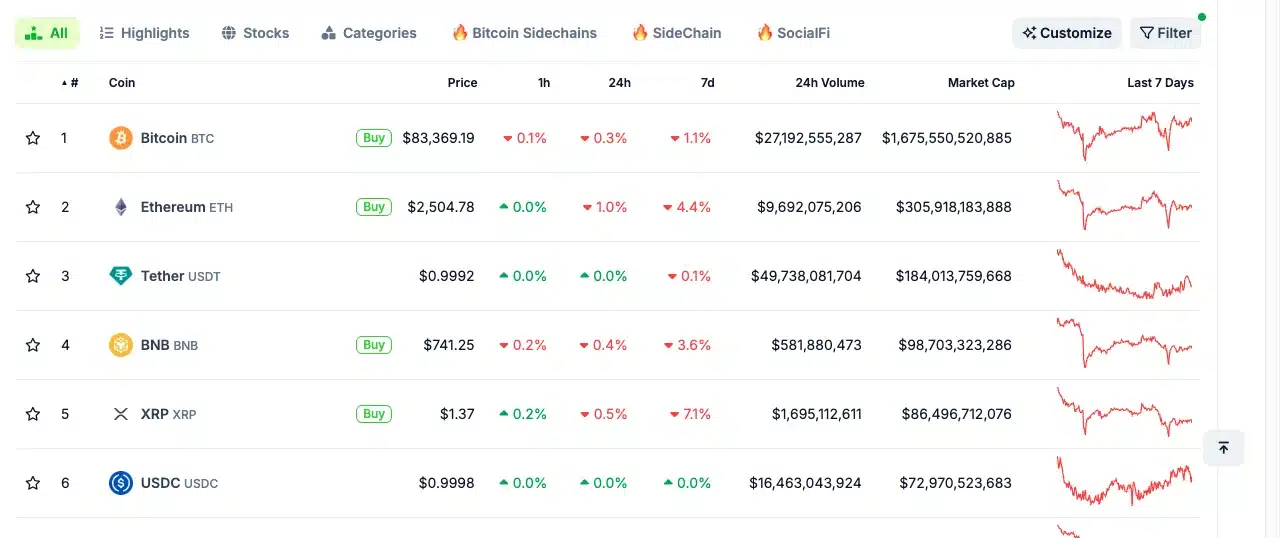
The best cryptocurrencies to invest in for most people are still Bitcoin and Ethereum, with a smaller slice in large, liquid altcoins such as Solana, XRP and BNB. Everything further down the list is a higher-risk bet. Prices below are from CoinGecko on October 14, 2026.
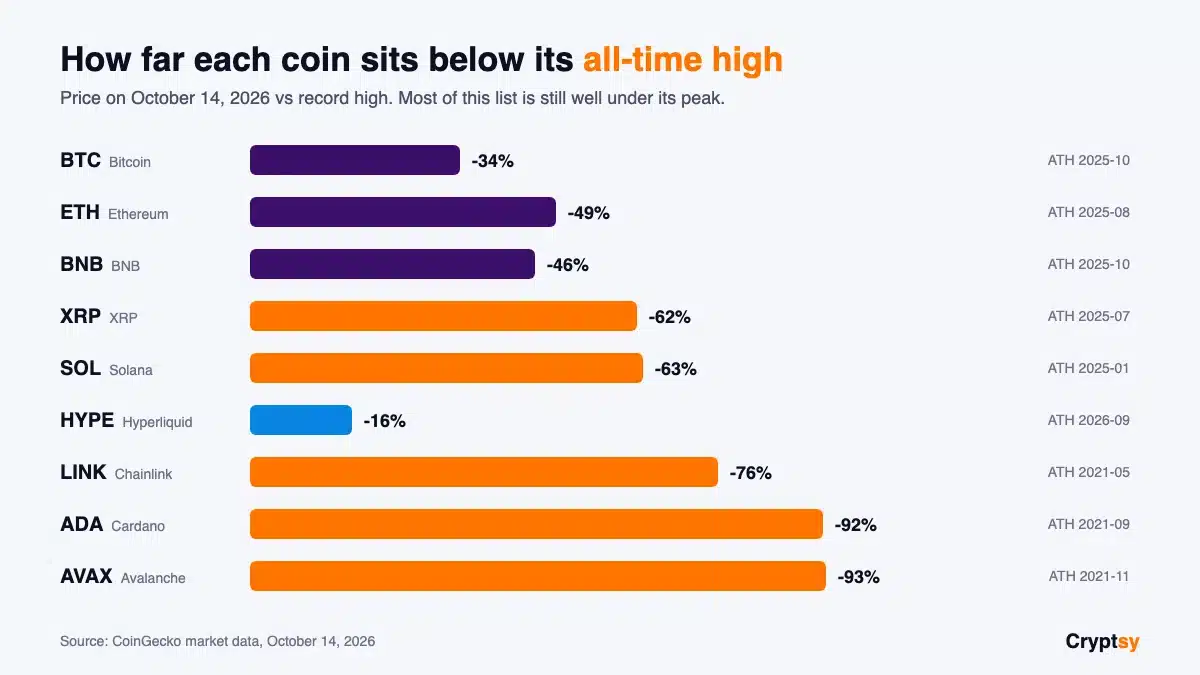
One number frames the whole market right now: Bitcoin is about 34% below its October 2025 record and down 26% over twelve months. Most altcoins have fallen further.
This is not financial advice. Crypto can lose most of its value quickly. Only invest money you can afford to lose.
Key takeaways
- Bitcoin ($83,361) and Ethereum ($2,504) make up the core. Bitcoin alone is 59% of the whole crypto market by value.
- Large caps (BNB, XRP, Solana, TRON) add more upside and more risk.
- Higher-risk picks (Hyperliquid, Chainlink, Cardano, Avalanche) can move 50% or more in a month, up or down.
- Eight of the ten coins below are lower than a year ago. The exceptions are TRON (+4%) and Hyperliquid (+104%).
- Buy on a regulated exchange, then move long-term holdings to a wallet you control.
The 10 cryptocurrencies at a glance
| Coin | Risk tier | Price | Market cap | Rank | 1 year | From all-time high |
|---|---|---|---|---|---|---|
| Bitcoin (BTC) | Core | $83,361 | $1,675B | #1 | -26% | -34% |
| Ethereum (ETH) | Core | $2,504 | $306B | #2 | -39% | -49% |
| BNB (BNB) | Large cap | $741 | $99B | #4 | -40% | -46% |
| XRP (XRP) | Large cap | $1.37 | $86B | #5 | -46% | -62% |
| Solana (SOL) | Large cap | $107 | $63B | #7 | -47% | -63% |
| TRON (TRX) | Large cap | $0.332 | $32B | #8 | +4% | -23% |
| Hyperliquid (HYPE) | Higher risk | $81.84 | $18B | #11 | +104% | -16% |
| Chainlink (LINK) | Higher risk | $12.89 | $9.9B | #15 | -33% | -76% |
| Cardano (ADA) | Higher risk | $0.235 | $8.8B | #17 | -66% | -92% |
| Avalanche (AVAX) | Higher risk | $10.18 | $4.5B | #28 | -56% | -93% |
Core holdings: Bitcoin and Ethereum
1. Bitcoin (BTC): $83,361
Bitcoin is the default first position for a reason. Supply is capped at 21 million coins, and the April 2024 halving cut new issuance to 3.125 BTC per block. US spot Bitcoin ETFs have traded since January 2024, so the same asset you buy on an exchange is held by funds and public companies.
The case for buying now is simple: it is about 34% below its October 2025 high of $126,080. The case against is that it has been lower over the past year, and nothing guarantees it returns to the record.
2. Ethereum (ETH): $2,504
Ethereum is the largest smart-contract network, home to most DeFi activity and a big share of stablecoin settlement. US spot Ether ETFs launched in July 2024. You can also stake ETH for a yield on top of price exposure, although liquid staking rates are low single digits.
ETH has had a harder year than Bitcoin, down 39%, and sits 49% under its August 2025 peak. Some investors see that gap as value. Others see a network losing activity to cheaper chains.
Large caps: more upside, more risk
3. BNB (BNB): $741
BNB powers BNB Chain and gives fee discounts on Binance. Its value is tied closely to Binance’s business. US residents cannot use the main Binance exchange; Binance.US is a separate company and is not available in every state.
4. XRP (XRP): $1.37
XRP is built for fast payments, settling in seconds for a fraction of a cent. Ripple’s long legal fight with the SEC ended in 2025, and the company also issues the RLUSD stablecoin. XRP is still 62% below its July 2025 high and down 46% over the year, so the market has not yet rewarded the legal win.
5. Solana (SOL): $107
Solana is the busiest high-speed chain for trading and consumer apps, with very low fees. It is also one of the most volatile large caps: up 6% in the past 30 days but down 47% over the year and 63% from its January 2025 record.
6. TRON (TRX): $0.332
TRON is the least exciting coin on this list and that is partly the point. It carries more USDT than any other blockchain, which makes it core plumbing for stablecoin payments. TRX is nearly flat over twelve months (+4%), far steadier than most large caps.
Higher-risk picks
7. Hyperliquid (HYPE): $81.84
Hyperliquid runs one of the largest on-chain exchanges for perpetual futures, and the protocol uses trading fees to buy back HYPE. It is the best performer here over the year (+104%), and it set a new high in September 2026. That strength is also the risk: a coin near its peak has further to fall, and its value depends on one exchange keeping its users.
8. Chainlink (LINK): $12.89
Chainlink supplies price feeds and cross-chain messaging to a large share of DeFi apps. The technology is widely used, but the token still trades 76% below its 2021 high.
9. Cardano (ADA): $0.235
Cardano has a loyal community and a research-led approach, but adoption has lagged. ADA is 92% below its 2021 high and down 66% in a year. Buying it today is mostly a recovery bet.
10. Avalanche (AVAX): $10.18
Avalanche lets companies and projects launch their own custom chains. Like Cardano, it is 93% below its 2021 peak, though it jumped 37% in the past month. Big swings in both directions are normal at this size.
Coins that dropped off this list since our earlier version: Polygon (now #77), Arbitrum (#69) and Polkadot (#50) are down 50%, 44% and 64% over the year. For a wider look at the altcoin market, see our top 10 altcoins right now.
How to build a position without overthinking it
- Start with the core. Many investors put most of a crypto allocation in Bitcoin and Ethereum and treat everything else as satellite bets.
- Size each bet so a 90% drop would not hurt you. Cardano and Avalanche show that large, well-known coins can lose that much.
- Buy in stages. Regular fixed purchases (dollar-cost averaging) remove the pressure of picking the bottom.
- Ignore anything that promises returns. Presales and “guaranteed” yields are where most retail losses happen.
Where to buy and how to store it
Use a regulated exchange that serves your state, and check the real fee before you trade. For example, Kraken’s published spot fee for accounts trading under $2,500 a month is 0.40% for makers and 0.80% for takers, falling as volume rises. Simple “buy” buttons in exchange apps usually cost more than the advanced trading screen. Our low-fee exchange comparison covers the main options.
Anything you plan to hold for years belongs in a wallet you control, not on the exchange. Our Bitcoin cold storage guide explains hardware wallets and seed backups step by step.
Taxes
In the US, the IRS treats crypto as property. Selling, swapping one coin for another, or spending crypto can each create a taxable gain or loss. Starting with 2025 transactions, US brokers report crypto sales to the IRS on Form 1099-DA, so keep your own records too. Our crypto tax guide goes deeper.
Frequently Asked Questions
What is the best cryptocurrency to invest in right now?
For most people, Bitcoin, then Ethereum. Bitcoin is the largest and most widely held crypto asset, priced at $83,361 on October 14, 2026. Smaller coins can rise faster but carry much higher risk.
Is it too late to buy Bitcoin?
Nobody knows the future price. On October 14, 2026 Bitcoin traded about 34% below its October 2025 record and 26% lower than a year earlier, so buyers today pay less than at the peak, but there is no guarantee it recovers.
Which altcoin has done best over the past year?
Of the coins on this list, TRON (+4%) and Hyperliquid (+104%) were up over twelve months as of October 14, 2026. Most of the other large altcoins fell between 30% and 70%.
How much of my portfolio should be in crypto?
There is no single right number. A common rule is to keep crypto to an amount you could lose entirely without changing your life, and to hold most of it in Bitcoin and Ethereum.
Are stablecoins a good investment?
Stablecoins such as USDT and USDC are designed to stay at $1, so they do not grow in value. They are useful for moving money and earning interest, not for price gains.
Do I pay tax on crypto gains in the US?
Yes. The IRS treats crypto as property, so selling, swapping or spending it can trigger capital gains tax. Brokers report sales on Form 1099-DA starting with 2025 transactions.