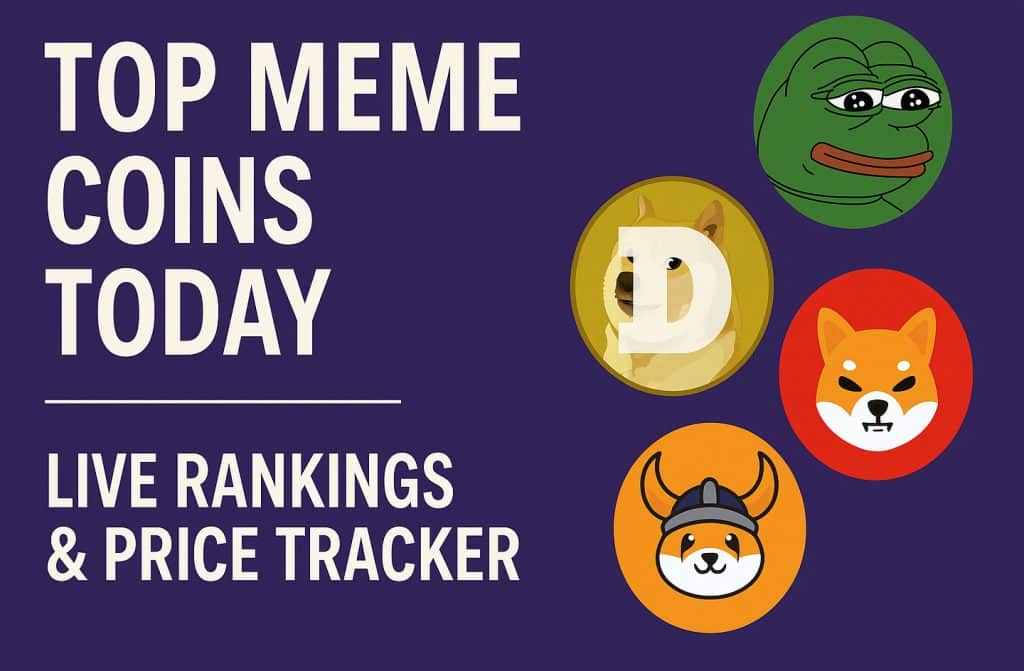
The top meme coins today include Dogecoin (DOGE), Shiba Inu (SHIB), MemeCore (M), Pepe (PEPE), and Pump.fun (PUMP), based on CoinGecko’s meme-token category when checked on November 16, 2026. Dogecoin remains the largest in the category, while the positions of other tokens can change as prices, circulating supplies and market classifications change.
A meme coin is a cryptocurrency or crypto token whose identity, branding or community appeal is closely connected to internet memes, viral culture, characters or online trends. Unlike assets primarily associated with a specific blockchain service, many meme coins derive much of their demand from community interest and speculation.
To compare the top meme coins, look beyond the token price. Market capitalization, trading volume, liquidity, circulating supply, fully diluted valuation (FDV), blockchain activity and holder distribution provide a more useful picture of each asset.
Top 12 Meme Coins by Market Cap
| Rank | Meme coin | Symbol | Approx. price | Market cap | 24h volume |
|---|---|---|---|---|---|
| 1 | Dogecoin | DOGE | $0.05983 | $9.38B | $711M |
| 2 | Shiba Inu | SHIB | $0.000003944 | $2.32B | $50.4M |
| 3 | MemeCore | M | $0.8344 | $1.92B | $1.93M |
| 4 | Pepe | PEPE | $0.000003858 | $1.62B | $323M |
| 5 | Pump.fun | PUMP | $0.002960 | $1.36B | $98.5M |
| 6 | BinanceLife | 币安人生 | $0.4730 | $473M | $4.06M |
| 7 | Pudgy Penguins | PENGU | $0.004949 | $311M | $83.8M |
| 8 | SPX6900 | SPX | $0.3018 | $281M | $4.24M |
| 9 | Official Trump | TRUMP | $0.9485 | $267M | $85.7M |
| 10 | Ape and Pepe | APEPE | $0.000001207 | $254M | $13.2M |
| 11 | Bonk | BONK | $0.000002371 | $209M | $26.4M |
| 12 | Floki | FLOKI | $0.00001870 | $180M | $12.9M |
Source: CoinGecko meme-token category, checked November 16, 2026. This is a dated snapshot, not a guaranteed real-time feed. Category membership and rankings are determined by the data provider. CoinGecko+1
The ranking is based on market capitalization, not the largest percentage gain or social-media popularity. This distinction matters: a token can be trending without being one of the largest meme coins, and a large-cap token can have a negative daily return.
For a second market-data reference, compare the CoinMarketCap meme-token rankings with CoinGecko’s meme-token category. Different providers can classify tokens and calculate market metrics differently.
What Are the Leading Meme Coins?
The leading meme coins have different origins, blockchain networks, token supplies and levels of market activity. Their position in a market-cap ranking does not automatically make them suitable investments.
Dogecoin (DOGE)
Dogecoin is a cryptocurrency created in 2013 around the popular Doge internet meme. It developed into one of the best-known meme-related crypto assets, supported by an established community and broad market recognition.
DOGE operates on its own blockchain rather than as a token issued on Ethereum or Solana. When researching Dogecoin, consider its circulating supply, market capitalization, trading volume, network activity and exchange liquidity.
Its large market capitalization does not remove volatility or guarantee future demand. Readers looking for background on unusual meme projects can also explore Cryptsy’s guide to weird and offbeat meme coins.
Shiba Inu (SHIB)
Shiba Inu is an Ethereum-based token that expanded from a meme-coin identity into a broader project ecosystem. Its associated initiatives include Shibarium and other applications and tokens connected to the SHIB brand.
When evaluating SHIB, separate activity in the wider ecosystem from demand for the SHIB token itself. A new application or ecosystem announcement does not necessarily translate into increased token usage or price appreciation.
MemeCore (M)
MemeCore is a meme-category crypto asset that has moved into the top group by market capitalization. Its position illustrates why rankings should be refreshed rather than relying on older lists that may still show Pepe in third place.
For M, compare circulating supply with fully diluted valuation, examine available trading markets, and check whether reported volume is supported by meaningful liquidity. A relatively high market capitalization alongside low trading volume deserves closer examination before assuming that a token is easy to trade.
Pepe (PEPE)
Pepe is a frog-themed meme token that became widely recognized after its launch in 2023. Its market activity demonstrates how online culture, community attention and speculative demand can influence token prices.
PEPE is not the same as every other token using a similar name or image. Always verify the correct token and contract details before trading. A familiar meme or ticker is not proof that a token is authentic.
Pump.fun (PUMP)
Pump.fun is associated with the Solana meme-coin ecosystem and the creation and trading of tokens. PUMP’s market position should be assessed separately from the popularity of individual tokens launched through the platform.
Research the token’s supply, distribution, trading activity and project documentation. Also distinguish platform usage from demand for the PUMP asset itself.
Other Notable Meme Coins
Other assets in the leading group include BinanceLife, Pudgy Penguins, SPX6900, Official Trump, Ape and Pepe, Bonk and Floki.
- BinanceLife (币安人生): A Chinese-language meme-related asset. Verify the exact token identity and trading network before using its ticker or name to search for a market.
- Pudgy Penguins (PENGU): A token associated with the Pudgy Penguins brand and its broader digital-collectibles community.
- SPX6900 (SPX): A meme-related token whose market demand is closely connected to online culture and community activity.
- Official Trump (TRUMP): A politically themed meme token. Do not assume that a political name or public association guarantees endorsement, utility or regulatory protection.
- Ape and Pepe (APEPE): A separate token from PEPE. Similar names can cause confusion, so contract verification is essential.
- Bonk (BONK): A Solana-based meme coin with an established presence in the Solana ecosystem.
- Floki (FLOKI): A dog-themed crypto project that has expanded its branding into additional products and ecosystem initiatives.
These examples are not investment recommendations. For more project comparisons, see Cryptsy’s meme coins to watch and meme coins to research before buying.
How Are Meme Coins Ranked?
Meme coins can be ranked in several ways, depending on what a reader wants to measure. Market capitalization is useful for comparing the approximate size of tokens, while trading volume, liquidity and price performance help explain current market activity.
| Ranking metric | What it measures | What it does not prove |
|---|---|---|
| Market capitalization | Circulating supply multiplied by token price | That the token is liquid or undervalued |
| Trading volume | Reported trading activity over a period | That all reported volume is organic |
| Liquidity | How easily an asset can be bought or sold with limited price impact | That the token is safe |
| 24-hour change | Short-term price movement | Long-term performance |
| Seven-day change | Weekly price momentum | Sustainable demand |
| Holder distribution | How token ownership is spread across wallets | Whether holders will keep their tokens |
| On-chain activity | Transactions and network usage | That activity creates token value |
| Community engagement | Attention and participation | That the project has strong fundamentals |
Market capitalization is commonly calculated as:
\[ \text{Market Cap} = \text{Price} \times \text{Circulating Supply} \]
For example, if a token trades at $0.01 and has 10 billion circulating tokens, its approximate market capitalization is $100 million.
Fully diluted valuation provides another perspective. It estimates the value of a token if the total or maximum supply specified by the data provider were in circulation. A large difference between market capitalization and FDV can indicate that future token releases or supply expansion deserve attention.
A token with a low unit price is not necessarily cheap. Supply size and valuation matter more than the number of zeros after the decimal point.
What Is Happening in the Meme Coin Market?
The meme-coin sector is a substantial but speculative part of the cryptocurrency market. CoinGecko’s category page showed a total meme-category market capitalization of approximately $22.5 billion and 24-hour trading volume of about $1.6 billion when checked on November 16, 2026. These figures are time-sensitive and should be refreshed before publication or whenever the page’s market data is updated.
The sector includes several overlapping themes:
- Dog-themed meme coins
- Frog-themed tokens
- Solana meme coins
- Bitcoin-related meme tokens
- Cat-themed tokens
- Celebrity- and politics-related tokens
- AI-themed meme projects
- Community and internet-culture tokens
A token can belong to more than one theme. These labels describe branding or market classification, not quality, legitimacy or investment potential. CoinGecko separately lists categories such as Solana meme coins, while Cryptsy’s meme coin trend analysis provides additional context on the sector.
What Makes Meme Coin Prices Move?
Meme coin prices are often influenced by market sentiment, liquidity and speculative trading. Unlike assets whose demand is closely tied to measurable network usage, many meme tokens can be especially sensitive to attention and changing online narratives.
Social Media and Community Attention
Viral posts, online jokes, influencer discussions and community campaigns can increase interest in a token. However, a rise in social-media mentions does not necessarily mean that more people are buying or using the asset.
Check whether increased attention is accompanied by higher trading volume, deeper liquidity and sustained activity rather than relying on social engagement alone.
Exchange Listings
A new exchange listing can make a token easier to access and may increase trading activity. However, a listing is not an endorsement of a token’s quality, safety or future performance. Delistings and regional trading restrictions can also reduce market access.
Trading Volume and Liquidity
Trading volume measures how much of an asset has reportedly traded over a period. Liquidity measures how easily buyers and sellers can trade without causing a large price change.
These are related but different metrics. A token can report high volume while still having limited liquidity in a particular trading pool or exchange.
Whale Activity and Token Concentration
Large holders, often called whales, can influence smaller token markets. Large transfers may signal a change in wallet activity, but they do not automatically mean that a holder is buying or selling.
Review wallet concentration, exchange inflows and outflows, and the context of large transactions before drawing conclusions.
Broader Cryptocurrency Market Conditions
Meme coins are affected by the wider crypto market. Changes in Bitcoin and Ethereum prices, market liquidity, interest rates, regulation and overall risk appetite can influence speculative assets.
For a broader look at how meme coins operate, consider how market sentiment and trading conditions interact rather than treating every price move as a token-specific event.
How to Evaluate a Meme Coin
There is no single metric that identifies the best meme coin. A consistent research process is more useful than choosing a token based on a low price, a viral post or a short-term percentage gain.
1. Market Capitalization and FDV
Market capitalization gives an approximate measure of the current value of circulating tokens. FDV helps show how the valuation might compare with a larger supply.
Compare both metrics. Check whether the circulating supply is likely to increase and whether scheduled unlocks could create additional selling pressure.
2. Trading Volume and Liquidity
Check the token’s 24-hour volume and the liquidity of its main trading pairs. On decentralized exchanges, look at pool liquidity and estimated price impact for the size of trade you are considering.
A high market cap does not guarantee that you can sell a large position at the displayed price.
3. Tokenomics and Supply
Review the circulating supply, total supply, maximum supply, token unlocks, emissions, burns and treasury holdings. Understand who received the tokens at launch and whether large allocations are controlled by a small group.
A burn mechanism or staking feature should not automatically be interpreted as a reason for a token’s price to rise.
4. Holder Distribution
Check whether ownership is broadly distributed or concentrated among a small number of wallets. Blockchain explorers can help identify large holders and transfers, although wallet labels and ownership attribution are not always complete.
Exchange wallets, liquidity pools, bridges and project treasuries should be distinguished from individual holders when interpreting concentration data.
5. Utility and Ecosystem Activity
Some meme projects offer staking, decentralized applications, NFTs, gaming, payments, governance or DeFi integrations.
The important question is whether people actually use these products and whether that usage creates demand for the token. A feature listed on a project website is not proof of meaningful adoption.
For a related look at technology-led meme projects, see Cryptsy’s article on meme AI crypto.
6. Development and Transparency
Look for clear documentation, verifiable contract addresses, public development updates and transparent communication. Review available smart-contract audits, but remember that an audit cannot guarantee that a project is safe or that its token will retain value.
7. Exchange Availability
Confirm where the token trades and whether the venue supports users in your country. Check the actual trading pair, withdrawal availability, network and fees before transferring funds.
A listing on a major exchange does not mean that the exchange guarantees the token’s quality or future performance.
Trending Meme Coins vs. Top Meme Coins by Market Cap
The top meme coins by market capitalization are not necessarily the meme coins trending today. Market-cap rankings measure relative size, while trending lists typically reflect search interest, social attention or recent market activity.
A useful comparison separates three types of rankings:
| Ranking type | Main question it answers | Useful metrics |
|---|---|---|
| Largest by market cap | Which meme coins have the highest circulating market value? | Market cap, circulating supply |
| Top gainers and losers | Which tokens have moved the most over a selected period? | 24h and 7d change, volume, liquidity |
| Trending meme coins | Which tokens are receiving increased attention? | Search interest, platform activity, social mentions |
When reviewing meme coin gainers, do not rely on percentage change alone. A token that rises 100% on very low liquidity is different from a large-cap asset that rises 10% with substantial trading activity.
A more useful gainers table should show:
- Token name, ticker and blockchain
- Current price and percentage change
- Market capitalization
- 24-hour trading volume
- Available liquidity
- Seven-day performance
- Contract address or verified asset page
If a token’s price rises sharply while its volume and liquidity remain weak, the move may be difficult to sustain or trade.
Where Can You Check Live Meme Coin Prices?
Several market-data platforms provide meme coin prices, rankings and trading information. Use more than one source when a token’s identity, volume or market capitalization is unclear.
CoinGecko
CoinGecko’s meme-token category lists meme-related crypto assets and provides market capitalization, price, volume and performance data. It is useful for comparing category rankings and exploring subcategories.
CoinMarketCap
CoinMarketCap’s meme-token page provides a separate ranking of meme-related assets by market capitalization, alongside price, volume and circulating supply information.
Decentralized Exchange Analytics
DEX analytics platforms can help users research tokens traded on decentralized exchanges, particularly newer assets that may not appear on major centralized exchanges.
Check the trading pair, pool liquidity, contract address and token network. Newly created tokens can use names and tickers similar to established projects.
TradingView
TradingView provides charts and technical-analysis tools that can help users study price movements across supported markets. Chart indicators describe historical price behavior; they cannot reliably predict future meme coin prices.
Data comparison tip: Market-data platforms can differ because of their exchange coverage, token classifications, supply calculations and volume methodology. Always check the source and timestamp before comparing figures.
Meme Coins vs. Utility-Focused Cryptocurrencies
Meme coins and utility-focused cryptocurrencies can overlap, but they often have different primary value drivers.
| Factor | Meme coins | Utility-focused crypto assets |
|---|---|---|
| Primary appeal | Internet culture, community and speculation | Network services or applications |
| Demand drivers | Sentiment, narratives and liquidity | Usage, adoption and network activity |
| Volatility | Often very high | Varies by asset |
| Community | Frequently central to the project | Important, but varies |
| Token supply | Highly variable | Highly variable |
| Research focus | Market attention, liquidity and token distribution | Utility, adoption, token economics and network activity |
| Risk | Often highly speculative | Depends on the asset and project |
These are broad distinctions, not universal rules. Some meme coins develop additional applications, while some utility-focused assets also experience substantial speculative trading.
The Investopedia guide to meme coins provides additional background on their characteristics and potential advantages and disadvantages.
Risks of Buying Meme Coins
Meme coins are speculative crypto assets. Their prices can rise quickly, but buyers can also lose a substantial portion or all of the money they put into them.
Important risks include:
- Extreme volatility: Prices can change sharply within minutes or hours.
- Liquidity risk: Thin trading pools or order books can make it difficult to sell at the displayed price.
- Market manipulation: Low-liquidity tokens can be vulnerable to artificial trading activity and coordinated hype.
- Smart-contract vulnerabilities: A token contract may contain flaws or unsafe permissions.
- Holder concentration: Large holders may be able to influence the market through substantial transactions.
- Rug pulls and fraud: Some projects are created to attract buyers before insiders withdraw liquidity or abandon the project.
- Fake tokens: Fraudulent assets may copy the name, logo or ticker of a legitimate meme coin.
- Regulatory uncertainty: Rules and exchange availability differ across jurisdictions and can change.
The U.S. Securities and Exchange Commission’s Division of Corporation Finance published a staff statement on meme coins in February 2025. It describes the characteristics of certain meme coins and discusses how the staff views those assets under federal securities laws. The statement is not a binding rule, does not cover every token or transaction, and does not mean meme coin holders are protected from losses or fraud. Staff Statement on Meme Coins
The statement also notes that fraudulent conduct involving meme coins may still be subject to enforcement under other applicable laws. Readers outside the United States should consult the relevant regulator in their own jurisdiction.
How to Research and Buy a Meme Coin
Before buying a meme coin, verify the asset and assess its market conditions. A familiar name or a trending social-media post is not enough.
Use this research checklist:
- Confirm the token identity. Find the official contract address and blockchain network through the project’s authoritative channels.
- Check the market data. Compare market cap, circulating supply, FDV, trading volume and liquidity.
- Review token distribution. Look for large holders, insider allocations and upcoming unlocks.
- Inspect the contract. Review available contract information and independent security audits.
- Check trading venues. Confirm that the exchange or decentralized exchange supports the exact token.
- Estimate transaction costs. Account for trading fees, network fees, spreads and potential price impact.
- Review project claims. Verify partnerships, integrations, product launches and other announcements independently.
- Understand local rules. Check whether the token and exchange are available in your jurisdiction.
- Set a risk limit. Decide how much you can afford to lose before placing a trade.
The general buying process is:
- Choose a reputable exchange or decentralized exchange that supports your location.
- Complete identity verification if required by the platform.
- Find the exact asset and confirm its ticker, network and contract address.
- If using a decentralized exchange, connect a compatible wallet.
- Hold enough of the network’s native asset to pay transaction fees.
- Check liquidity, slippage and the final amount you expect to receive.
- Review the transaction details before approving the trade.
- Store the asset in a wallet appropriate for your security needs.
A token can share a name or ticker with a legitimate project without being the same asset. Verify the contract address through official project information and a reputable blockchain explorer before swapping.
For more detail on trading mechanics and order considerations, see Cryptsy’s guide to how to trade meme coins.
How to Store Meme Coins Safely
Meme coins can be held in compatible software or hardware wallets, depending on the blockchain and the user’s security requirements. The most important step is protecting private keys and recovery phrases.
Follow these basic precautions:
- Never share a wallet’s seed phrase or private key.
- Do not store recovery phrases in screenshots or unsecured cloud accounts.
- Verify wallet addresses before sending crypto.
- Avoid unknown links, fake airdrops and suspicious token approvals.
- Use official wallet websites and app stores.
- Keep wallet software and devices updated.
- Consider separating funds used for active trading from longer-term holdings.
- Review and revoke unnecessary token approvals where the wallet and network support it.
A hardware wallet can reduce certain online risks, but it cannot prevent every form of phishing, malicious approval or user error. Losing a recovery phrase can also mean permanently losing access to funds.
Are Meme Coins Available in Every Country?
No. Meme coin availability depends on the token, trading platform and the laws of the country where a user lives.
Before trading, check whether cryptocurrency trading is permitted in your jurisdiction, whether the exchange accepts local residents, whether the specific token is supported, and whether tax or reporting obligations apply.
Regulatory treatment can differ between countries. Do not assume that a token available on a global market-data website can also be legally purchased through every exchange.
Frequently Asked Questions About Meme Coins
What are the top meme coins today?
The leading meme coins by market capitalization include Dogecoin (DOGE), Shiba Inu (SHIB), MemeCore (M), Pepe (PEPE) and Pump.fun (PUMP), based on CoinGecko’s category ranking checked on November 16, 2026. Rankings change as market prices and circulating supplies change. CoinGecko
What is the number one meme coin?
Dogecoin is the largest meme coin by market capitalization in the CoinGecko category snapshot checked on November 16, 2026. It had an approximate market capitalization of $9.38 billion at the time of the data check. Other ranking methods, such as trading volume or social popularity, can produce different results. CoinGecko
Which meme coins are trending today?
Trending meme coins change frequently. Check a live market-data platform for its current trending list, then compare the tokens’ price changes with their market capitalization, volume and liquidity. A trending label indicates attention, not investment quality.
What is the best meme coin to buy?
There is no universally best meme coin. The answer depends on the token’s liquidity, market capitalization, tokenomics, security, availability and the buyer’s risk tolerance. A market-cap ranking is a comparison tool, not a recommendation to buy.
Can a meme coin increase 100x or 1,000x?
A meme coin can experience an extreme price increase, but no one can reliably predict which token will achieve a 100x or 1,000x return. Such claims should be treated with skepticism, especially when promoters promise guaranteed profits.
A more useful exercise is to calculate the market capitalization a token would need to reach a particular price and compare that valuation with its supply, liquidity and market conditions.
Does a low meme coin price mean it is cheap?
No. A token’s unit price does not show its overall valuation. Market capitalization depends on both price and circulating supply, so a token priced at a fraction of a cent can still have a large market capitalization.
Why are meme coins so volatile?
Meme coins can be sensitive to online attention, influencer activity, exchange listings, speculative trading, liquidity changes and broader crypto-market sentiment. Smaller tokens with thin liquidity may experience especially sharp price movements.
Can meme coins lose all their value?
Yes. A meme coin can lose most or virtually all of its value if demand disappears, liquidity collapses, a project fails or fraud is discovered. Buyers should only risk money they can afford to lose.
How can I identify a fake meme coin?
Verify the token’s exact contract address and blockchain through official project channels and a reputable blockchain explorer. Check the trading pool, liquidity, contract information and project disclosures. Do not rely on a familiar name, ticker, logo or social-media account alone.
Where can I check live meme coin prices?
CoinGecko, CoinMarketCap, cryptocurrency exchanges and decentralized-exchange analytics platforms provide market data. Compare the sources and check their update timestamps because prices, volumes and token classifications can differ.
Are meme coins legal?
Their legal and regulatory treatment varies by country, token and transaction. Check current guidance from the relevant government or financial regulator and confirm that your chosen exchange supports the asset in your jurisdiction.
Final Thoughts
The top meme coins today should be compared using more than price or short-term gains. Market capitalization, trading volume, liquidity, token supply, FDV, holder concentration, ecosystem activity and contract security all provide useful context.
Dogecoin, Shiba Inu, MemeCore, Pepe and Pump.fun are among the leading assets in the current CoinGecko meme-token category snapshot, but rankings can change quickly. A token’s position on a list does not guarantee that it is safe, undervalued or likely to appreciate.
Use live market data, verify token identities and research the risks before making a decision. For additional comparisons, explore Cryptsy’s guides to meme coins to watch and meme coins to research before buying.
Disclaimer: This article is for educational and informational purposes only. It does not constitute investment, financial, legal or tax advice. Meme coins and other crypto assets can be highly volatile, and you may lose some or all of your money. Regulatory treatment varies by jurisdiction. Conduct independent research and consider consulting an appropriately qualified professional before making financial decisions.