

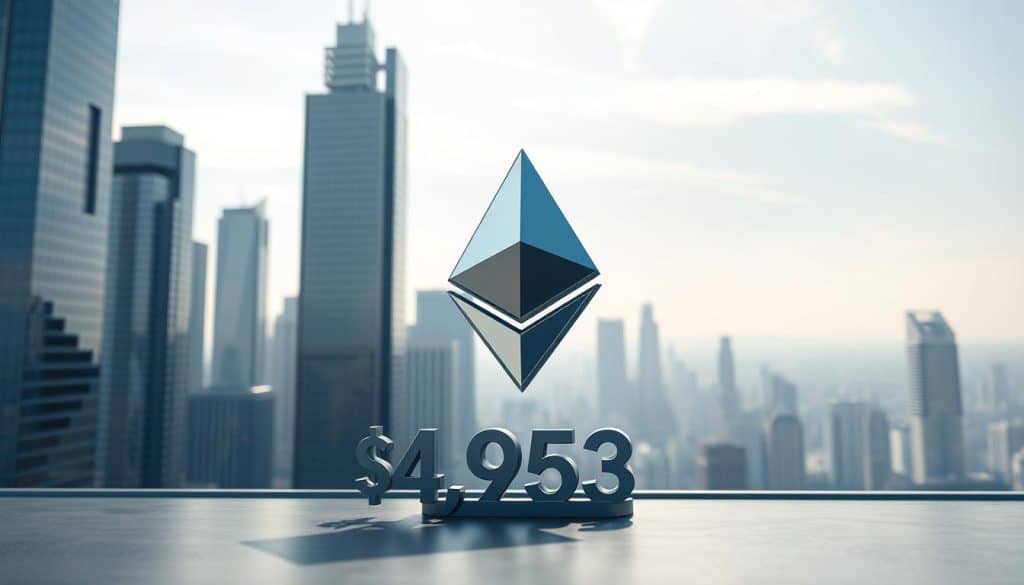
Ethereum reached $4,953 on Sunday, setting a new all-time high. This beat the previous record of $4,867 from November 2021. Analysts say a wave of institutional interest and heavy spot ETF flows lifted liquidity.
The rally was helped by changes in the broader economy. Comments from Federal Reserve Chair Jerome Powell increased the chances of rate cuts. Odds of a September cut jumped, making investors more willing to take risks. This optimism also shone a light on altcoins, with Bitcoin staying strong above $11,300.
Institutional investment and corporate treasuries added more fuel to the rally. On-chain indicators showed an uptick in activity. The next sections will cover ETF flows, DefiLlama TVL trends, and TradingView price patterns. We’ll explore why the ETH all-time high is important for those watching BTC’s price movements.
Key Takeaways
- Ethereum Hits $4,953, surpassing the November 2021 ETH all-time high of $4,867.
- Spot ETF inflows and institutional demand are central drivers behind the rally.
- Macro shifts, including higher Fed rate-cut odds, boosted risk-on sentiment.
- Bitcoin above $11,300 remained steady while capital rotated into Ethereum.
- On-chain activity and TVL gains underpin the bullish case for ETH.
Market Snapshot: Ethereum Hits $4,953
Ethereum’s value shot up, reaching $4,953 on Sunday. It grew from a low of $4,660 over the weekend. This resulted in a nearly 7% increase in one day, showing strong buyer interest.
Price action and record level
Price movements showed confidence as buyers overcame previous highs. The leap over the November 2021 high marked a chart turnaround. It also set a new all-time high (ATH) near $4,953.
Intraday range and volume indicators
Trading volume surged with more futures and options activity. Ethereum’s derivatives saw an open interest hit about $33.8 billion. This signals intense market participation and hints at higher volatility ahead.
Comparison to previous ATH of $4,867 in November 2021
The new high topped the previous $4,867 record from November 2021. This signifies a major trend change. Updates from TradingView and CoinMarketCap further confirm this significant breakout.
| Metric | Value | Source |
|---|---|---|
| Peak price | $4,953 | TradingView / CoinMarketCap (timestamped) |
| Weekend low | $4,660 | CoinMarketCap |
| Intraday advance | ~7% | TradingView price series |
| Derivatives open interest | $33.8 billion | Derivatives market reports |
| Prior ATH (Nov 2021) | $4,867 | Historical TradingView data |
| Key indicator | Elevated intraday volume | Exchange volume aggregates |
Why Ethereum is Surging: Institutional Adoption and ETF Flows
Institutional interest is a big reason for Ethereum’s rise. Spot funds are attracting huge amounts of money. This makes Ethereum ETFs very visible. SoSoValue says there were net inflows of almost $2.9 billion in August. August 11 saw more than $1 billion in one day. These actions are helping Ethereum’s price go up.
Corporate treasuries also play a big role. Companies like BitMine Immersion Technologies and SharpLink Gaming own a lot of Ethereum. Together, their Ethereum makes up about 3% of what’s available. This big holding supports Ethereum’s value over time.
Institutional investors are now interested in Ethereum, just like they were with Bitcoin. They’re using Ethereum for things like DeFi and getting earnings from staking. This shows why Ethereum is attracting so much investment.
Money is moving from Bitcoin to other coins like Ethereum. As Bitcoin’s share dropped, Ethereum got more popular. This shift has brought more money into Ethereum-related products. It also made other coins perform better too.
Good reporting helps us keep track of these changes. We look at custodian reports, ETF filings, and what corporate treasuries say. Tools that summarize this info are very useful. For recent info on ETF inflows, check out this link.
There’s more money in Ethereum now because of spot inflows and big corporate holdings. Bitcoin’s lower share has also helped. All this makes the market stronger and lets buyers hold onto their Ethereum.
| Metric | Recent Value | Relevance |
|---|---|---|
| Spot ETF Net Inflows (Aug) | $2.9 billion | Shows immediate institutional allocation into ETH |
| Record Single-Day ETF Inflow | $1+ billion (Aug 11) | Signals concentrated buying pressure from funds |
| Corporate Treasuries ETH (combined) | ~3% of supply (~$19B) | Indicates long-term balance sheet allocation |
| BitMine Holding | >$7 billion | Large corporate buyer with planned further purchases |
| BTC Dominance | Reflects capital rotation into Ethereum and altcoins |
Network Fundamentals Driving Demand
The recent rise in value shows powerful on-chain signs that attract investors. The increase in activity, DeFi liquidity, and staking habits are changing how supply and demand work together. This shift is influencing how the market acts.
Transaction counts and daily on-chain activity surpassing prior records
Every day, over 1.5 million transactions happen, breaking past records set during the 2021 NFT boom. The rise comes from more stablecoin moves, DeFi exchanges, and bigger use of Layer-2 networks. Vitalik Buterin mentioned a gas limit increase to 45 million in July 2025, aiding in handling more transactions. Watching Ethereum transactions, experts find a strong and steady use of wallets and smart contracts.
Total Value Locked (TVL) growth and DeFi liquidity dominance
The total value locked in Ethereum has soared. DefiLlama shows a 117% increase since April, reaching almost $97 billion in August. Ethereum stays at the top for DeFi liquidity compared to others. Base and other Layer-2 networks help keep Ethereum’s edge in liquidity. They make sure a lot of activity stays with Ethereum.
Staking supply lock-up and its deflationary impact
Staking is taking a big part of Ethereum out of circulation. Over 30% of ETH is staked, according to UltraSound Money. This limits how much ETH is available, which could boost its value when demand goes up. Those keeping an eye on how much ETH is staked see a smaller pool of ETH as important for its future value.
| Metric | Recent Level | Change Since April | Primary Drivers |
|---|---|---|---|
| Daily ETH transactions | 1.5M+ | Up from ~900k | Stablecoins, DeFi swaps, Layer-2 growth |
| TVL (Ethereum DeFi) | $95B | +117% | Inflow to protocols, liquidity mining, institutional use |
| ETH staking supply | >30% of supply | Steady increase | Staking rewards, custody services, institutional staking |
| Layer-2 activity | High growth | Significant rise | Lower fees, faster throughput, Base and others |
Macro Backdrop: Rates, Fed Cuts, and Risk Appetite
Interest rates are crucial for deciding where to put your money this quarter. After Federal Reserve Chair Jerome Powell spoke, people changed their minds about future Fed rate cuts. They moved their investments around in stocks and cryptocurrencies.
Recent data from CME FedWatch showed a big jump in the chances of a rate cut by September, up to 87.3%. This shift made investors more willing to take risks. They began looking for opportunities to make more money, especially in areas sensitive to interest rate changes.
Assets that do well when interest rates go down started to look more attractive. Stocks and cryptocurrencies saw increased interest as regular cash and bonds didn’t seem as appealing. This is why we’re seeing more money going into certain funds and bigger bets on cryptocurrencies like Bitcoin and Ethereum.
Observers have linked changes in interest rate expectations to how much money flows into cryptocurrencies. As people thought it was more likely the Fed would cut rates, they put more money into ETFs and futures for Ethereum. This shows that many believe cryptocurrencies do well when investors are ready to take more risks.
This table helps show how different events affect the market and cryptocurrencies:
| Date | FedWatch Implied Move | Market Reaction | Crypto Signal |
|---|---|---|---|
| Early June | 35% chance of Sep cut | Rangebound equities, muted flows | ETH ETF flows low, stable open interest |
| After Powell comments | 87.3% chance of Sep cut | Risk-on shift; equities rally | Surge in ETF inflows, rising open interest in ETH |
| Following economic data | Probabilities adjust with CPI and jobs | Short-term volatility in stocks | Allocation swings between BTC and ETH |
Investors need to keep an eye on FedWatch and big economic news. Even small changes can lead to big moves in interest rates and the market. This shows the strong connection between rates and Ethereum during times when policies are changing.
Bitcoin Today: Steady Above $11,300
Bitcoin remains strong, staying above $11,300. Meanwhile, Ethereum’s breakthrough and ETF-related moves are catching attention. It’s wise to check real-time BTC prices on sites like TradingView or CoinMarketCap before making decisions.
The daily BTC movement is narrower than ETH’s larger shifts. The trading volume and excitement have lessened, leading to gentle short-term trends. Always look at the latest price updates to stay current.
BTC’s market control has fallen below 60%, a sign of change not seen in eight months. This drop usually means more money goes into ETH, both directly and through ETFs. This shift helps ETH perform better as Bitcoin holds its ground.
A compact table below contrasts key short-term metrics for clarity.
| Metric | Bitcoin | Ethereum |
|---|---|---|
| Price Range (intraday) | $11,300–$11,800 | $4,700–$5,000 |
| Momentum | Consolidation, mild downside bias | Breakout confirmed, strong upside bias |
| Market Share | BTC dominance <60% | Rising ETH capital flows into ETFs |
| Actionable signal | Watch RSI and support at recent lows | Monitor continuation volume and ETF inflows |
The current outlook suggests ETH might have more growth ahead, while Bitcoin is just maintaining. By watching key indicators, traders can identify opportunities. For the latest analysis on both, consider reading a market overview like this crypto trends report.
Technical Analysis: Bull Flag, Momentum, and Targets for ETH
The daily chart shows ETH breaking out of a bull flag pattern after passing the $4,300 mark. This offers a way for traders to set future price goals and determine where to place stop-loss orders. The breakout, shown by increased trading volume, adds credibility to this analysis.
On TradingView, you’ll find the flag pole, consolidation channel, and breakout candle highlighted. By looking at an annotated chart, readers can understand how the target near $6,200 was determined. For a deeper dive into how these targets were projected, check out this Ethereum price prediction.
Daily chart patterns validating the breakout
A decisive close above $4,300 on the daily chart confirms the bull flag breakout. It’s projected to increase by about 33%, fitting the criteria of technical analysis. Observe the shape of the breakout candle and any follow-up increases in volume.
Key technical targets and RSI context
Calculating targets involves understanding pattern math and keeping an eye on momentum. The calculated move puts ETH’s target at about $6,200, assuming momentum stays strong. The daily RSI for ETH is around 61, indicating potential for growth without being overbought.
Watching the ETH RSI for bearish signs is key to risk management. A declining RSI despite a rising price can signal a drop in momentum. Traders often sell at resistance levels and reconsider their strategy if the RSI exceeds 70.
Derivatives open interest and implications for volatility
Derivatives markets currently have a high open interest of about $33.8 billion. This can lead to bigger price swings during fast moves and increase the risk of sudden losses if prices drop quickly.
Combining this knowledge with the bull flag breakout strategy can guide traders. It’s wise to have a clear plan for your investment size, set incremental targets, and monitor the ETH RSI. This approach helps balance the potential gains with strategies to minimize losses.
| Metric | Current Reading | Implication |
|---|---|---|
| Pattern | Bull flag breakout above $4,300 | Measured move points to ETH targets $6,200 |
| RSI ETH (daily) | ~61 | Momentum supportive; not yet overbought |
| Derivatives Open Interest | $33.8 billion | High leverage; larger volatility risk |
| Volume | Breakout volume spike | Confirms validity of bull flag breakout |
Risks and Headwinds for the Rally
The Ethereum price increase brings benefits and risks. People investing in it need to consider rules from the government, market changes, and tech issues. These factors might change its growth direction.
Rules from the government are a big worry. The SEC looking closer and possibly changing rules can quickly change where money goes. In the past, when the SEC said something new or companies shared news, crypto prices changed fast. For more details, you can check this article on Ethereum’s price future.
Potential regulatory changes and SEC oversight
New actions from the SEC could limit how institutions use cryptos. Stricter rules about holding cryptos, what can be listed, or how ETFs work could make trading harder. This means keeping an eye on crypto rules is very important.
Overheated leverage, derivatives positioning, and liquidation risk
There’s more risk in futures and options now than before. Too many people betting prices will go up can lead to quick sales if opinions change. Big price moves can make volatility worse and force both small and big traders to sell to meet requirements.
Competition from Layer-1 rivals and L2 congestion risks
Competition is getting tougher from other blockchains like Solana and Avalanche. They offer faster transactions and cheaper fees which could attract developers and users. If Layer-2 networks get too crowded, it might slow down getting new users and lower the activity growth on Ethereum.
| Headwind | Potential Impact | Signal to Watch |
|---|---|---|
| Regulatory action | Reduced ETF flows, custody constraints | SEC rule announcements, agency guidance |
| Derivatives stress | Rapid price swings, liquidations | Open interest spikes, funding rate shifts |
| L1 competition | User migration, lower fees elsewhere | Developer activity, dApp TVL shifts |
| Market concentration | Supply pressure from large treasury moves | Company disclosures, large wallet transfers |
Being active in managing risks is vital while the momentum is high. Keep an eye on SEC actions, derivatives data, and signs of competition. This way, you’ll be ready for unexpected changes in the market.
Data & Statistics Visuals to Include (Graph and Tables)
This section lists key visuals editors should include to support the price narrative. Place each graphic with a clear caption, timestamp, and data source. This keeps readers oriented and maintains archival integrity.
Recommended visuals include price action, flows, liquidity, and macro odds. Use TradingView for price, SoSoValue for ETF details, and DefiLlama for TVL moves. CME FedWatch is good for rate probabilities. Annotate major dates and spikes so each chart stands on its own.
For price overlay, show daily ETH performance with a rise to $4,953 against BTC at $11,300. Include volume bars and BTC comparison so readers understand the market divergence.
The ETF flows table should list daily and total spot ETH ETF inflows. Highlight the $1B influx on Aug 11 and $2.9B total for August. It shows market momentum.
In the TVL graph, plot DefiLlama TVL from April to the August peak at $97 billion and the current $95 billion level. Detail contributions from Aave, Uniswap, and MakerDAO to indicate major liquidity sources.
Include a FedWatch chart showing Sept. 17 rate-cut odds and an open interest series peaking near $33.8B. Match rate-probability changes with open interest and volatility jumps.
Below is a compact ETF flows table for desktop and mobile. Caption each column with source and timestamp in the CMS when embedding the chart or CSV.
| Date (UTC) | Fund | Daily Inflow ($M) | Accumulated August ($M) | Source |
|---|---|---|---|---|
| 2025-08-11 | Spot ETH ETF A | 1,000 | 2,900 | SoSoValue, timestamped |
| 2025-08-12 | Spot ETH ETF B | 320 | 3,220 | SoSoValue, timestamped |
| 2025-08-13 | Spot ETH ETF C | 150 | 3,370 | SoSoValue, timestamped |
| 2025-08-14 | Spot ETH ETF A | 430 | 3,800 | SoSoValue, timestamped |
| 2025-08-31 | All Spot ETH ETFs (net) | , | 2,900 | SoSoValue, month total |
When embedding the TVL graph, add protocol callouts and a brief legend. For the FedWatch chart, include exact percentages (like 87.3% on Sept. 17) to link policy odds with intraday risk appetite.
Endnotes: list exact data pulls and timestamps for every visual when you publish. This ensures traceability for TradingView, SoSoValue, DefiLlama, and CME FedWatch data.
Analyst Predictions and Price Forecasts
The crypto market is full of different views and ETH price predictions from experts. Predictions vary from low to high, based on factors like ETF inflows and how much ETH is staked. Let’s look at some main price targets and what might make them happen.
Bank and firm targets
- Standard Chartered believes ETH could hit $7,500 by the end of 2025. They even see a potential rise to $25,000 by 2028, thanks to more people using it and limited supply.
- Fundstrat’s Tom Lee thinks ETH could reach between $10,000 and $12,000 soon. He suggests a $15,000 price if the current trend continues.
- Arthur Hayes is even more bullish, predicting ETH could reach $20,000 during the current cycle, driven by strong demand from institutions.
Scenario framing and time horizons
- In the best scenario, a mix of new ETF investments, company buys, and less strict Federal Reserve policies could push ETH’s price to somewhere between $7,500 and $15,000 in the next 6 to 18 months.
- If things grow steadily but more slowly, we could see ETH’s price stay between $4,000 and $6,500 over the next 6 to 12 months.
- In a downturn, tough rules or market pressures could drop ETH’s price to the $3,000 to $3,800 range.
How on-chain metrics feed price models
Price predictions now look at the growth in total value locked (TVL) in ETH, how much ETH is staked, and transaction speeds. More TVL and a high staking percentage mean less ETH is available, which could raise prices. This is especially true if big investors and ETFs keep putting money in.
Scenario comparison table
| Scenario | Key drivers | Time horizon | Representative range |
|---|---|---|---|
| Optimistic | Heavy ETF inflows, corporate buys, Fed cuts, rising TVL | 6–18 months | $7,500–$15,000 |
| Conservative | Moderate ETF flows, mixed macro signals, steady TVL growth | 6–12 months | $4,000–$6,500 |
| Bear | Regulatory clampdown, liquidations, falling on-chain activity | Near term | $3,000–$3,800 |
Market trends support these predictions. Betting markets see a strong chance for ETH to climb over $5,000 by 2025. Charts and technical analysis also hint ETH might rise to about $6,200 soon. For an in-depth look at ETH’s price movement, check out Ethereum price analysis.
Always refer back to the original analyst reports for detailed assumptions behind their forecasts. This approach helps compare different predictions, like Standard Chartered’s $7,500 ETH and Fundstrat’s view of ETH reaching up to $12,000.
How Traders and Investors Can Respond: Tools and a Short Guide
Choosing the right tools can help you make faster, smarter decisions in quick markets. For chart patterns and setting up alerts, TradingView is great. Look at CoinMarketCap or CoinGecko for fast price updates. And to analyze ETF flows, SoSoValue is your go-to place. Check out DefiLlama for DeFi liquidity and the total value locked. The FedWatch tool from CME is perfect for keeping an eye on rate changes. Before you stake or trade, take a look at UltraSound Money for updates on staking and the total supply.
Trade setup rules are key for keeping your money safe and reducing stress. Start by looking for safe ways to enter trades, like buying after a price jump is confirmed or slowly buying as prices drop. Make sure you never risk more than 1–2% of your total money on one trade, adjusting this based on how risky the market is and your trading goals.
Always set a stop-loss below a technical level or choose a set percentage to avoid big losses. Be careful about entering trades with a lot of open interest in derivatives to not increase risks of price swings. Use technical stops together with a backup plan based on big news from the Fed.
Choosing the right investment is crucial. You can buy spot ETH ETFs for easy exposure without needing to manage it on the blockchain, which is also good for tax-saving accounts. For direct investment, always use trusted exchanges or hardware wallets for holding your currency. Make sure to follow a detailed staking guide that covers how long your money will be tied up, risks, and the security of the provider before you stake.
Staking can change prices by reducing the amount available. Think about how long you can wait to get your staked funds back and if you need quick access to them. If you keep your own staking, make sure your service provider is reliable and open about their operations. If going for ETFs, double-check the fund reports on SoSoValue before putting in a lot of money.
Find out whether to choose spot ETFs, exchange custody, or staking for yourself with this simple comparison.
| Instrument | Access | Liquidity | Security Considerations | Best Use Case |
|---|---|---|---|---|
| Spot ETH ETF | Brokerage account | High (tradable) | Custodial, regulated fund disclosures (check SoSoValue) | Institutional exposure, tax-efficient accounts |
| Exchange Custody | Centralized exchange | High to medium | Counterparty risk; use top-tier exchanges with clear compliance | Active traders needing fast access |
| Self-Custody & Staking | Private wallet/validator | Lower while staked | Key management, slashing, unstake delays; consult a staking guide | Long-term holders seeking yield |
Keep on top of ETH risk management by checking your investments after big economic news or changes in Fed rates. Keep track of how much money is in DeFi using DefiLlama to see if demand is changing. Re-check SoSoValue for changes in ETF flows that might affect prices quickly.
This guide for trading ETH should be like a checklist for you: make sure you know who has your assets, decide how much risk you want to take, set up stops based on solid numbers, keep an eye on trading volumes and money flows, and choose how to stake after thinking about how easily you need to access your money and what risks are involved.
Evidence and Sources Cited
This list shows where our data comes from. It helps validate the charts, flows, and metrics in this article. We explain where each piece of data is from, how we use it, and the importance of dates for checking facts.
On-chain metrics and TVL. We use DefiLlama for info on liquidity and Total Value Locked. To check TVL figures, take snapshots from DefiLlama. Look at dates for the highest TVL ($97B on Aug 14) and recent levels (~$95B).
Staking and supply statistics. UltraSound Money gives us details on staking and new ETH being made. Their reports show how much ETH is staked. Make sure to note the report’s date when talking about percentages.
Price charts and dominance metrics. TradingView and CoinMarketCap provide price and volume charts. Also, they show how BTC compares to others. Use time-stamped charts for accurate price discussions.
ETF flows and institutional holdings. SoSoValue tracks ETF flows and records from big companies. When mentioning these flows, double-check SoSoValue against company reports. For company ETH holdings, use official statements or SEC filings. Examples include BitMine’s ETH reports.
Macro and market probabilities. CME FedWatch shows chances of the Fed lowering rates. Record these odds with a date when talking about future rate changes.
Press and analyst commentary. Cointelegraph and major financial news provide insights and charts. Save these articles with a date and name the source clearly to keep track of information.
Verification checklist before publication.
- Confirm DefiLlama data exports match any TVL numbers cited and include the export timestamp.
- Validate staking percentages on UltraSound Money and note the update date.
- Cross-reference SoSoValue ETF flows against official fund disclosures and daily flow tables.
- Capture TradingView/CoinMarketCap chart images with timestamps for any technical levels shown.
- Record CME FedWatch probabilities at the time of writing for all rate-related claims.
- Archive company posts or filings for corporate treasury holdings and include the posting date in captions.
| Source | Primary Use | Key Verification Detail |
|---|---|---|
| DefiLlama | TVL and protocol liquidity | Exported snapshot with date; cite TVL peak and current figure |
| UltraSound Money | Staking share and issuance | Report date and staking percentage at capture |
| TradingView / CoinMarketCap | Price charts, volume, BTC dominance | Chart image with timestamp for technical references |
| SoSoValue | Spot ETF flow analytics | Daily flow tables; cross-check with fund disclosures |
| CME FedWatch | Fed rate probability metrics | Probability value and timestamp for quoted odds |
| Company disclosures & X posts | Corporate treasury holdings | Original post or filing date and archival screenshot |
| Cointelegraph & press outlets | Analyst quotes and visuals | Article date and author attribution |
Always give credit for each chart and table you use. When talking about flows, holdings, TVL, or Fed rates, including the date of the data keeps your work accurate and trustworthy.
Conclusion
The ETH outlook is positive since Ethereum hit a new high at ETH $4,953. This was thanks to spot ETF inflows, corporate treasury buys, and clearer macroeconomic supports. Network basics, like more transactions, higher TVL on DefiLlama platforms, and increased staking, boost demand. Meanwhile, technical signs like a bull flag breakout and more derivatives interest suggest a rise to around $6,200.
But, there are big risks: the SEC’s watchful eye, too much leverage in derivatives, and rivalry from other Layer‑1 networks could slow progress. It’s wise for investors to mix big-picture cues from CME FedWatch with detailed data from sources like UltraSound Money and ETF flows from SoSoValue. And, it’s crucial to keep charts and stats up-to-date for accuracy. For tips and market insight, check out ETH price prediction insights.
In summary, finding a balance in the crypto market is essential. Choose ETFs or custody options carefully, weigh the pros and cons of direct staking, and practice careful risk management. The take-home point is, although the short-term outlook for ETH is optimistic, careful tracking and reliable data should direct how much and when you invest.