


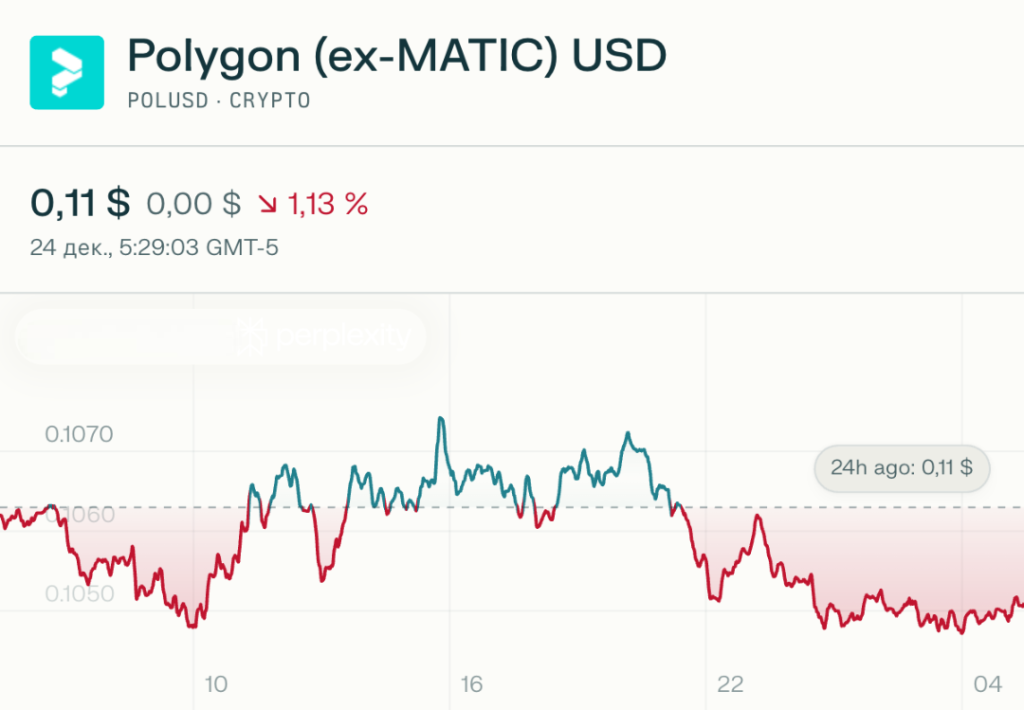
Polygon (MATIC) trades around $0.37 with a market capitalization of approximately $3.6B as of December 2025, maintaining its position in the top 30 cryptocurrencies. Under the hood runs a multi-chain scaling system for Ethereum, processing DeFi trades, gaming sessions, and enterprise tests at fees below a penny.
This analysis charts Polygon’s 2026–2030 trajectory: market snapshot and history tables, technical levels, ecosystem metrics and tokenomics, year-by-year price ranges across stress/base/optimistic scenarios, rival comparisons, investor strategies, and FAQ.
Current MATIC Price and Market Position
Polygon (MATIC) occupies a stable position within the top 25-30 cryptocurrencies by market capitalization, supported by persistent on-chain utilization rather than speculative volume spikes. Its market dynamics reflect infrastructure demand amid sector-wide volatility.
| Metric | Value (Dec 2025) | Notes |
| Current Price | $0.37 | Consolidated mid-range level |
| 24h Change | +1.2% | Marginal gain versus benchmarks |
| Market Cap | $3.6B | Established top-30 tier |
| Trading Volume (24h) | $185M | Adequate depth across venues |
| Circulating Supply | 9.88B MATIC | Post-vesting equilibrium phase |
Present valuation represents partial recovery from 2023 troughs near $0.30, while remaining 87% below the 2021 peak of $2.92. This compression signals Polygon’s maturation as a scaling utility rather than growth narrative asset.
What is Polygon (MATIC)?
Polygon evolved from Ethereum sidechain to full scaling framework: PoS mainnet, zkEVM, and Chain Development Kit for custom app-chains, all leveraging Ethereum security with independent throughput.
Key activity drivers:
- DeFi: Aave/QuickSwap at $1.1B+ TVL
- Gaming: Matr1x Fire with millions of daily txns
- Enterprise: RWA tokenization pilots
- NFTs: Sub-cent marketplaces
MATIC anchors economics via staking, gas, and governance across Ethereum-aligned chains. Traders holding ETH or stables often turn to reliable polygon crypto swap services to gain exposure without fiat gateways, reflecting Polygon’s practical integration into broader DeFi workflows. This positions it as Ethereum’s core scaler amid intensifying L2 rivalry.
MATIC Historical Price Performance
Polygon’s price trajectory mirrors broader market cycles while highlighting network-specific catalysts and setbacks. Key phases reveal patterns of adoption-driven rallies followed by compression during risk-off periods.
| Time Period | Key Events | Price Action |
| 2020–Early 2021 | Ethereum scaling narrative, initial dApps | $0.02 → $1.25 (+6,150%) |
| Nov 2021 | DeFi/NFT boom, Aave/QuickSwap launches | Peak at $2.92 ATH |
| 2022–2023 | Bear market, bridge exploits, macro tightening | Retrace to $0.30 lows |
| 2024 | zkEVM rollout, multi-chain expansion | Recovery to $0.65–$0.71 |
| 2025 (YTD) | L2 competition intensifies, steady usage | Consolidation $0.35–$0.40 |
Historical multiples demonstrate sensitivity to Ethereum ecosystem momentum and usage spikes, with drawdowns exceeding 85% in contraction phases. Recovery cycles typically lag leading L1s like Solana by 6-12 months, underscoring Polygon’s derivative positioning. Investors analyzing high-throughput alternatives face similar timing questions, as detailed in recent Solana price prediction analyses.
MATIC Technical Analysis
Key Technical Indicators
Current MATIC charts show consolidation within a multi-month descending channel, with momentum indicators flashing mixed signals amid L2 sector rotation.
Support and Resistance Levels
| Level Type | Price | Significance |
| Primary Support | $0.32 | 2023 lows + 200-day EMA |
| Secondary Support | $0.28 | Psychological + volume shelf |
| Primary Resistance | $0.42 | Recent highs + 50-day EMA |
| Major Resistance | $0.52 | 2024 breakout zone |
Moving Averages
| Period | EMA Value | Signal |
| 50-day EMA | $0.39 | Neutral |
| 100-day EMA | $0.41 | Bearish |
| 200-day EMA | $0.35 | Support |
Momentum Indicators
| Indicator | Value | Interpretation |
| RSI (14) | 48.2 | Neutral territory |
| MACD | -0.012 | Bearish crossover fading |
| Stochastic | 42.7 | Approaching oversold |
Volume profile confirms $185M daily average with spikes at support tests, suggesting accumulation rather than distribution. The setup favors range-bound trading until $0.42 resistance breaks or $0.32 support fails.
MATIC Fundamental Analysis
Ecosystem Metrics
Polygon’s on-chain fundamentals reflect sustained utilization across its scaling layers, with key metrics demonstrating resilience amid L2 fragmentation.
Core Network Statistics (Dec 2025):
- Total Value Locked: $1.15B across DeFi protocols
- Daily Active Addresses: 1.2M (stable YoY)
- Transaction Volume: 22M daily (gaming/DeFi dominant)
- Developer Activity: 450+ teams, zkEVM focus growing
Tokenomics Breakdown
| Metric | Value | Implications |
| Circulating Supply | 9.88B MATIC | Post-vesting maturity |
| Total Supply | 10B MATIC | Near-complete unlock |
| Staking Ratio | 38% of supply | Validator security + yield capture |
| Annual Inflation | ~2.5% | Offset by fee burns |
| Utility | Gas, staking, governance | Multi-chain demand driver |
Strategic Developments
Polygon’s execution roadmap addresses L2 challenges head-on:
- zkEVM, gradually entering production, is expected to enhance EVM-compatible zero-knowledge scaling.
- Chain Development Kit (CDK) deployment continues, supporting the creation of 50+ POL, Polygon’s staking token, supports validator security and multi-chain fee capture.
- Enterprise RWA pilots with tokenized treasuries and supply chains.
- Cross-chain bridges upgraded post-2022 exploits.
These fundamentals position MATIC as Ethereum-aligned infrastructure with measurable adoption vectors, though L2 competition caps marginal upside absent breakout catalysts.
Polygon (MATIC) Price Prediction 2026
Polygon’s 2026 trajectory hinges on Ethereum L2 consolidation, zkEVM adoption acceleration, and macro recovery post-Bitcoin halving. Base case assumes moderate TVL growth to $3B+ amid competitive pressures.
2026 Factors
Bullish Catalysts:
- zkEVM maturity driving EVM migration from Ethereum mainnet
- Enterprise RWA tokenization scaling to $500M+ on Polygon chains
- Bitcoin halving cycle lifting L2 sentiment
- POL migration enhancing multi-chain fee capture
Bearish Pressures:
- Intensified L2 competition from Optimism/Base/Arbitrum
- Ethereum Danksharding reducing mainnet scaling urgency
- Regulatory scrutiny on cross-chain bridges
- Prolonged macro risk-off environment
Expert Price Forecasts for 2026
| Source | Minimum | Average | Maximum |
| DigitalCoinPrice | $0.45 | $0.68 | $0.92 |
| Changelly | $0.52 | $0.71 | $1.05 |
| CoinCodex | $0.41 | $0.65 | $0.98 |
| WalletInvestor | $0.48 | $0.69 | $0.95 |
| Consensus View | $0.50 | $0.70 | $1.00 |
Analysis projects MATIC trading $0.50–$1.00 through 2026, averaging $0.70, a 90% upside from current levels if execution matches roadmap. Volatility persists given L2 narrative dependency.
Polygon (MATIC) Price Prediction 2027–2029
Mid-term forecasts incorporate L2 market share stabilization, Ethereum roadmap execution, and cycle peak/consolidation dynamics. Scenarios reflect base (steady growth), optimistic (leadership capture), and stress (marginalization) paths.
Scenario Framework 2027–2029
| Year | Stress Case | Base Case | Optimistic Case | Primary Driver |
| 2027 | $0.45–$0.65 | $0.80–$1.20 | $1.40–$2.00 | TVL expansion, enterprise scale |
| 2028 | $0.40–$0.60 | $1.10–$1.60 | $2.20–$3.50 | Cycle peak, RWA mainstreaming |
| 2029 | $0.35–$0.55 | $1.00–$1.50 | $2.50–$4.00 | Post-peak correction dynamics |
Base Case: Polygon secures 15-20% Ethereum L2 TVL share ($5-8B total), POL fee capture matures, moderate macro tailwinds yield 3-4x from current levels by 2029.
Optimistic Case: zk leadership + enterprise wins drive 25%+ market share ($10B+ TVL), positioning MATIC for 8-10x upside amid bull cycle extension.
Stress Case: L2 commoditization + bridge incidents cap at 10% share ($2-3B TVL), resulting in stagnation versus Ethereum benchmarks.
Ranges account for 70-85% cycle drawdowns observed historically, with execution risk weighted toward base trajectory.
MATIC Price Prediction 2030
Long-term valuation crystallizes around L2 consolidation outcomes, Ethereum’s finality layer status, and Polygon’s enterprise penetration. Projections span structural scenarios with execution dependency.
Long-Term Growth Drivers
| Factor | Base Impact | Optimistic Upside |
| Global L2 TVL | $15-25B total | $40B+ Polygon share |
| Enterprise RWA adoption | $2-5B tokenized | $10B+ institutional |
| zkEVM / CDK dominance | 20% EVM migration | 35%+ developer shift |
| POL fee economics | 3-5% yield capture | 8%+ burn acceleration |
| Macro adoption | 1B crypto users | Regulatory greenlight |
Expert Price Forecasts for 2030
| Source | Minimum | Average | Maximum |
| DigitalCoinPrice | $1.20 | $1.85 | $2.75 |
| Changelly | $1.50 | $2.40 | $3.80 |
| CoinCodex | $1.10 | $1.95 | $3.20 |
| WalletInvestor | $1.35 | $2.25 | $3.50 |
| Consensus View | $1.40 | $2.30 | $3.60 |
MATIC targets $1.40–$3.60 by 2030, averaging $2.30 (6x from current), feasible if Polygon claims durable 20% L2 market share with maturing tokenomics. Stress scenarios limit to $0.80 amid commoditization risks.
Is MATIC a Good Investment?
MATIC presents a calculated infrastructure bet rather than speculative upside. Evaluation weighs ecosystem maturity against L2 commoditization risks.
Potential Advantages
- Proven Ethereum scaling with $1.15B TVL and 22M daily transactions
- zkEVM/CDK positioning for enterprise RWA and gaming dominance
- POL migration strengthening multi-chain fee economics
- Staking yields averaging 4-6% with validator security role
- 87% below 2021 ATH, offering cycle recovery asymmetry
Potential Risks
- L2 fragmentation eroding individual market share
- Bridge security incidents repeating 2022 vulnerabilities
- Ethereum roadmap (Danksharding) diminishing sidechain necessity
- High correlation to ETH price (0.92 beta)
- Regulatory exposure on cross-chain operations
Investment Strategies for MATIC
Long-Term Holder:
- Accumulate at $0.32 support during corrections
- Stake 38%+ circulating supply for compounding yields
- Target 2029 base case $1.00–$1.50 exit
- Monitor L2 TVL share quarterly
Medium-Term Position:
- Enter $0.35–$0.40 range post-halving momentum
- Scale out at $0.70–$1.00 resistance zones
- Track zkEVM adoption vs Optimism/Arbitrum metrics
- Rebalance if ETH L2 TVL growth stalls
Active Trader:
- Trade MATIC/USDT breakouts above $0.42
- Short-term targets: $0.52 (2024 highs), stops below $0.32
- Monitor RSI divergences and MACD crossovers
- Position size 2-5% portfolio maximum
Frequently Asked Questions
Is MATIC a good long-term investment through 2030?
MATIC offers infrastructure exposure with 3-6x base case potential by 2030 if Polygon maintains 15-20% L2 market share. Success depends on zkEVM execution and enterprise adoption versus commoditization risks.
Can MATIC reach $5+ by 2030?
Unlikely under base/optimistic scenarios ($1.40–$3.60 range). $5+ requires 25%+ L2 dominance and 12x multiple expansion, exceeding historical cycle peaks for scaling tokens.
What are MATIC’s biggest risks 2026–2030?
L2 fragmentation diluting share, Ethereum Danksharding reducing scaling demand, repeated bridge exploits, and 85%+ bear market drawdowns remain primary threats.
How do Bitcoin cycles impact MATIC price?
MATIC lags BTC/ETH by 6-12 months in recoveries but amplifies drawdowns (beta 0.92 to ETH). Post-halving sentiment lifts L2 narratives, though usage fundamentals ultimately govern.
Does using Polygon require holding/staking MATIC?
No, users interact via gas in native tokens or bridged assets. Staking secures validators (38% participation) but isn’t mandatory for dApp usage.
How does Polygon compare to Solana for investors?
Polygon offers Ethereum-aligned security/composability at sub-cent fees; Solana prioritizes raw TPS but carries outage history. Trade-offs mirror broader L1/L2 positioning.
What time horizon suits MATIC positions?
3-5 years minimum for base case realization. Short-term traders target $0.42–$0.52 ranges; holders weather 70%+ corrections chasing 2029 $1.00–$1.50 targets.
Will POL migration significantly boost MATIC value?
POL enhances fee capture across chains but faces dilution from emissions (~2.5% annually). Net positive if TVL scales to $5B+, neutral otherwise.
How often should MATIC price predictions update?
Quarterly, tied to Ethereum roadmap milestones, L2 TVL shifts, and macro cycles. Static targets ignore 85% historical volatility.
Can Polygon benefit from RWA trends?
Yes, CDK enables enterprise pilots ($500M+ potential by 2027). Success requires regulatory clarity and bridge reliability versus public blockchains.