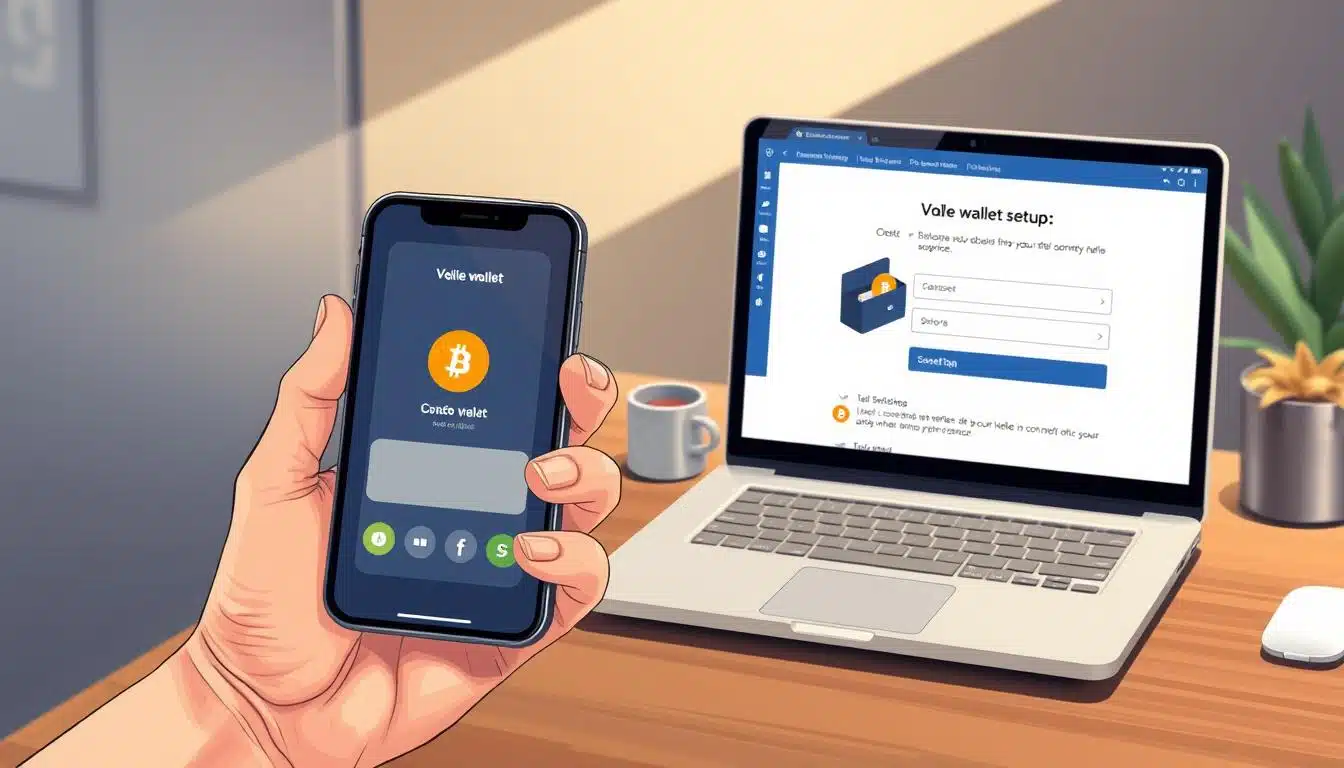
Bitcoin’s surge past $109,000 has transformed the digital currency landscape. Institutional investors are flocking to the market at unprecedented rates. This trend makes understanding cryptocurrency storage crucial for all investors.
A secure cryptocurrency wallet is your gateway to the digital economy. Your private keys control access to your funds. Proper setup is vital to protect your investment.
Digital wallet security is critical as cyber threats evolve. Safeguarding your assets requires understanding different storage options and their risks.
Knowing what is required to start using a bitcoin wallet is essential. This knowledge forms the basis for safe cryptocurrency management. The right setup gives you control over your digital wealth.
Key Takeaways
- Bitcoin’s surge past $109,000 makes secure wallet creation essential for all investors
- Proper cryptocurrency wallet setup protects your private keys and digital assets
- Digital wallet security requires understanding different storage options and their risks
- Institutional adoption increases the importance of professional-grade security practices
- Your wallet choice directly impacts your ability to safely store and manage crypto
- Understanding wallet requirements helps prevent costly security mistakes
Breaking: Bitcoin Wallet Adoption Surges 40% Amid Market Recovery
Bitcoin wallet adoption has skyrocketed by 40%. This growth is fueled by institutional demand and market recovery. Bitcoin remains steady at $109,000, while exchange reserves hit multi-year lows of 2.4 million BTC.
Improved security in hardware and software wallets has driven this growth. Institutional investment and retail adoption have created ideal conditions for wallet expansion across all user groups.
Latest Statistics Show Record-Breaking User Growth
Over 25 million new Bitcoin wallets were created globally. This marks the largest single-year increase in cryptocurrency history. Users are shifting towards self-custody solutions for better control of their assets.
Hardware wallet sales jumped 65% compared to 2023. Software wallet downloads increased by 35%. Mobile wallet apps lead with 70% of new installations.
Desktop solutions remain popular among institutional users and advanced traders. These users often require more advanced features for their trading needs.
United States Leads Global Adoption with 15 Million New Users
The United States leads Bitcoin wallet adoption with 15 million new users in 2026. This accounts for nearly 60% of total global growth. California, Texas, and New York top the list of states with highest adoption rates.
Florida and Illinois complete the top five states for Bitcoin wallet adoption. Growth is linked to areas with secure Bitcoin ATM networks and crypto-friendly regulations.
Millennials and Gen Z drive 80% of new wallet creations. Gen X adoption has also increased by 45%, showing wider acceptance across age groups.
Market Analysis and Expert Predictions for Q4 2026
Analysts predict Bitcoin wallet adoption could reach 50–60% year-over-year growth by December 2026. This outlook is supported by the latest CryptoQuant data, showing sustained institutional demand and growing interest from retail users. ARK Invest’s Cathie Wood continues to maintain her bullish Bitcoin predictions.
Wood suggests Bitcoin could grow 15 times within the next five years, a projection that aligns with increasing wallet adoption and broader cryptocurrency market maturity. This assumes continued institutional investment, regulatory clarity, and advances in wallet security.
“The surge in wallet adoption highlights the maturing crypto market, where users increasingly prioritize security and self-custody over convenience.”
— Leading Cryptocurrency Market Analyst
Experts also forecast accelerated adoption in Q4 2026, driven by holiday gifting, corporate crypto allocations, and improved wallet interfaces. Stable Bitcoin prices, user-friendly wallets, and heightened security measures are expected to create ideal conditions for continued expansion throughout the year.
Major Bitcoin Wallet Providers Launch New Security Features This Month
Bitcoin wallet providers are unveiling cutting-edge security features this month. They’re responding to growing institutional demand and recent regulatory changes. These upgrades mark the most significant wallet security improvements in years.
Leading companies are focusing on enhanced protection measures. They’re developing institutional-grade solutions that meet regulatory requirements. Experts believe these innovations will boost mainstream acceptance of cryptocurrencies.
Ledger Nano X Introduces Advanced Multi-Signature Support
Ledger’s flagship hardware device now offers comprehensive multi-signature wallet functionality. This new feature requires multiple authorizations before executing transactions. The cold storage enhancement provides unmatched security for high-value holdings.
Users can set up to 15 co-signers for maximum protection. The system allows flexible threshold settings based on security needs. Corporate clients can now distribute control over their Bitcoin reserves.
Electrum 4.5 Release Brings Enhanced Lightning Network Integration
Electrum’s latest version offers seamless Lightning Network connectivity. This update cuts transaction fees by up to 90%. Users can make instant payments while keeping control of their private keys.
The integration includes automated channel management and routing optimization. Advanced wallet security features protect Lightning channels from potential attacks. Electrum is now a leader in scalable Bitcoin solutions.
Coinbase Wallet Announces Institutional-Grade Security Tools
Coinbase Wallet introduces enterprise-level security protocols for institutional investors. The platform adds multi-party computation technology for better key management. These tools meet regulatory compliance standards for financial institutions.
The new security suite includes real-time transaction monitoring. Institutional clients get dedicated support and custom security setups. The platform works with existing corporate security systems.
Trust Wallet Expands Cross-Chain Compatibility
Trust Wallet now supports over 70 blockchain networks. This expansion includes better security for cross-chain transactions. Users can manage their portfolios across multiple cryptocurrencies easily.
The update introduces atomic swap for direct peer-to-peer exchanges. Multi-signature wallet support covers all supported networks. Trust Wallet keeps its non-custodial principles while adding new features.
| Wallet Provider | Key Security Feature | Target Users | Launch Date |
|---|---|---|---|
| Ledger Nano X | Advanced Multi-Signature | Corporate / High-Value | December 2026 |
| Electrum 4.5 | Lightning Network Integration | Daily Traders | November 2026 |
| Coinbase Wallet | Institutional Security Tools | Financial Institutions | December 2026 |
| Trust Wallet | Cross-Chain Compatibility | Multi-Asset Users | November 2026 |
These updates show the industry’s dedication to better security standards. New regulations are driving innovation in wallet technology. Hardware and software improvements are creating a safer Bitcoin ecosystem.
Complete Bitcoin Wallet Setup Guide: What Experts Recommend in 2026
Proper wallet setup is crucial for secure Bitcoin storage. This is especially true as institutional adoption grows and exchange-held reserves decline. Our guide covers the latest industry standards and expert recommendations for 2026.
The current market calls for increased security awareness. Bitcoin’s price swings and wider acceptance make proper wallet setup vital for all users.
Industry Leaders Reveal Best Practices for Wallet Selection
Top crypto security firms have set clear wallet selection criteria. These are based on user needs and tech skills. Hardware wallets consistently rank as the top choice for long-term storage. Software wallets work well for daily transactions.
“The key to successful Bitcoin storage lies in matching wallet type to usage patterns. Hardware wallets for savings, mobile wallets for spending.”
Security pros suggest evaluating wallets on these key factors:
- Open-source code verification and community audits
- Multi-signature support for enhanced security
- Regular software updates and active development
- Compatibility with your operating system and devices
- Recovery options and backup mechanisms
When choosing a wallet, prioritize security over convenience. Wallets with proven track records and transparent development practices offer the best protection.
Step-by-Step Process: Setting Up Electrum for Beginners
Experts prefer Electrum for its robust features and reliability. The setup process needs careful attention to detail and proper security measures.
- Download Electrum exclusively from the official website
- Verify the digital signature before installation
- Create a new wallet with strong encryption
- Generate a new seed phrase securely
- Configure network settings for optimal privacy
Always verify the signature during installation. This ensures you’re using legitimate software, not malicious copies that could compromise your Bitcoin.
Enable two-factor authentication and set up proper fee estimation. These features boost both security and transaction efficiency.
Private Key Generation and Backup Strategies
Private keys are the foundation of Bitcoin ownership. Proper generation and storage methods protect against technical failures and security breaches.
Modern wallets use secure random number generation for private keys. This process must never be compromised or rushed. Weak key generation can lead to theft.
Expert-recommended backup strategies include:
| Backup Method | Security Level | Accessibility | Cost |
|---|---|---|---|
| Hardware wallet backup | Highest | Medium | $50-200 |
| Metal seed storage | Very High | Low | $20-100 |
| Paper wallet backup | Medium | High | Free |
| Encrypted digital backup | High | Very High | $10-50 |
Use multiple backup locations for redundancy against physical disasters. Store copies in geographically separate locations to ensure recovery in various situations.
Recovery Phrase Security: New Standards and Tools
The seed phrase is the master key to your Bitcoin wallet. Its protection is critical. Recent incidents highlight the importance of proper seed phrase management.
Experts now advise against digital or cloud storage of seed phrases. Physical storage methods provide superior protection against hacking and unauthorized access.
New tools and standards for seed phrase security include:
- Cryptosteel and similar metal storage devices
- Multi-location distribution strategies
- Shamir’s Secret Sharing for advanced users
- Time-locked recovery mechanisms
Learn about proper seed phrase storage locations. This helps avoid common mistakes that could lead to permanent Bitcoin loss.
Test recovery procedures before storing large amounts. Practice restoring your wallet from the seed phrase to ensure the backup works correctly.
Regularly audit your storage methods to find potential weak points. Update your security practices to stay protected against new threats.
Recent Security Breaches Highlight Critical Bitcoin Wallet Protection Measures
In 2026, security breaches continue to push the crypto community to prioritize wallet protection. New incidents exposed vulnerabilities in both software and hardware wallets, prompting stronger security protocols across platforms. The financial impact of these breaches reached $3.4 billion, underscoring the growing importance of robust crypto security measures.
Experts emphasize that basic security is no longer enough. Hackers are developing increasingly sophisticated attacks targeting both individual investors and large institutions. As a result, wallet providers have implemented advanced multi-signature solutions, hardware encryption, and cross-chain safety features to safeguard users’ assets.
Analysis of 2026 Cryptocurrency Security Incidents
In 2026, there were 62 major crypto breaches, marking a 32% increase from 2025. These affected over 4.1 million users globally, revealing persistent weak spots in wallet infrastructure, transaction verification, and user practices.
The trend highlights the need for investors and businesses to adopt secure wallet solutions, regular updates, and multi-layered protection strategies to minimize risks in an increasingly targeted crypto environment.
The biggest breach happened in March. A major exchange lost $340 million due to hacked hot wallets. This event affected 890,000 users and showed the risks of centralized storage.
- Phishing attacks accounted for 34% of all security incidents
- Smart contract vulnerabilities caused 28% of reported breaches
- Social engineering attacks targeted 19% of victims
- Insider threats contributed to 12% of security failures
- Technical exploits represented 7% of incidents
Chainalysis reported record levels of stolen crypto funds. Their study found that 67% of successful attacks could have been stopped. Proper secure crypto storage practices would have made the difference.
“The sophistication of attacks has evolved dramatically. We’re seeing threat actors use AI-powered social engineering and advanced persistent threats specifically designed for cryptocurrency theft.”
Two-Factor Authentication Becomes Industry Standard
Two-factor authentication use jumped 156% among crypto users after these incidents. Major wallet providers now require 2FA for new accounts. Many offer multiple ways to authenticate.
Hardware-based keys were best at stopping unauthorized access. Time-based one-time passwords (TOTP) and SMS-based 2FA varied in effectiveness. Their success depended on how well they were set up.
| Authentication Method | Success Rate | User Adoption | Security Rating |
|---|---|---|---|
| Hardware Keys | 99.2% | 23% | Excellent |
| TOTP Apps | 94.7% | 67% | Very Good |
| SMS Codes | 87.3% | 89% | Good |
| Email Verification | 78.1% | 95% | Fair |
Security experts suggest using hardware keys when possible. These devices guard best against phishing and man-in-the-middle attacks. Popular choices include YubiKey, Ledger, and Trezor devices.
Cold Storage Solutions Gain Popularity Among Institutional Investors
Exchange-held Bitcoin dropped to 2.4 million BTC. This shows institutions prefer self-custody solutions. It’s a 31% decrease from 2023, driven by security worries and new rules.
Cold storage solutions saw huge demand growth. Hardware wallet sales went up 89% from last year. Institutional-grade devices led this increase. Multi-signature cold storage became the top choice for big crypto holders.
Major financial firms now keep 78% of their Bitcoin in offline storage. This shows growing trust in self-custody and awareness of exchange risks.
- Air-gapped systems provide complete network isolation
- Multi-signature wallets require multiple approvals for transactions
- Hardware security modules offer enterprise-grade protection
- Geographically distributed storage reduces single-point-of-failure risks
Expert-Recommended Security Protocols and Tools
Top cybersecurity pros have created thorough bitcoin security plans based on 2026 incidents. These combine multiple protection layers for strong defense.
The “Defense in Depth” approach is now the best practice for crypto security. It uses several independent security layers. If one fails, others keep protecting.
“No single security measure is sufficient in today’s threat landscape. Successful protection requires a comprehensive approach that addresses technical, operational, and human factors.”
Key security tools recommended by experts include:
- Antivirus software with cryptocurrency-specific protection modules
- VPN services for secure network connections
- Password managers with encrypted vault technology
- Network monitoring tools for detecting suspicious activity
- Backup verification systems for recovery phrase validation
Regular security checks are now required for institutional investors. These look at tech systems and work processes. They find weak spots before hackers can use them.
Cryptocurrency Analysts Predict Revolutionary Changes in Bitcoin Wallet Technology
Blockchain analysts foresee major changes in wallet technology that could transform the cryptocurrency world. Experts predict significant tech advances in the next three years. This forecast is supported by current trends and $2.8 billion in wallet infrastructure investments.
Regulatory clarity and tech innovation are driving wallet evolution. Future wallet features may include cross-chain functionality, privacy controls, and decentralized finance capabilities. Research shows 78% of users want better wallets for multiple digital assets.
Lightning Network Integration Expected to Double by 2026
The Lightning Network is growing fast, with over 5,000 active nodes and $180 million in capacity. Analysts predict this will double by 2026. Major wallet providers are adding native Lightning support.
Strike CEO Jack Mallers believes Lightning integration will become standard across blockchain wallet platforms. Lightning-enabled transactions cost 99% less than traditional Bitcoin transfers. This makes small payments practical for everyday use.
New developments in channel management and routing will improve user experience. Experts think automated balancing and smart routing will make Lightning Network operations invisible to users.
Regulatory Developments Shape Future Wallet Features
New crypto laws will greatly influence wallet development priorities. Compliance features are now essential in modern wallets. KYC integration and transaction reporting are becoming standard requirements.
EU’s MiCA regulation and similar rules create new specs for wallet providers. These laws require specific security standards and user protection measures. They will shape future wallet features across all platforms.
Compliance tools are becoming crucial wallet components. Automated tax reporting and real-time compliance monitoring will be standard in enterprise-grade wallets.
Emerging Technologies: Quantum-Resistant Encryption and AI Security
Quantum computing threats are driving the development of new crypto standards for wallet technology. NIST approved quantum-resistant algorithms that major wallet providers are implementing.
AI is another frontier in wallet security. Machine learning can detect unusual transactions and identify threats. It can also provide real-time security advice to users.
Biometric authentication is evolving beyond fingerprints. Advanced facial recognition and behavioral biometrics create multi-layered security. These systems make unauthorized access nearly impossible while staying user-friendly.
The next generation of Bitcoin wallets will be indistinguishable from traditional banking applications in terms of user experience, while maintaining the decentralized principles that make cryptocurrency revolutionary.
Conclusion
The cryptocurrency world is changing fast. Picking the right wallet is crucial. Bitcoin’s rise and growing adoption make choosing from the best bitcoin wallets a big decision.
Focus on security features, ease of use, and future-proofing when comparing wallets. Hardware wallets are safest for long-term storage. Software wallets work well for active traders.
Match your wallet to your needs and tech skills. Market swings and big players’ moves highlight the need for strong security.
Using different wallet types can boost protection and flexibility. Keep up with new tech, laws, and security risks affecting wallets.
Update your wallet software and security practices often. This helps safeguard your investments as Bitcoin grows.
Bitcoin storage is improving. New encryption and better designs are coming. Use these tips to keep your crypto safe and manage it well.