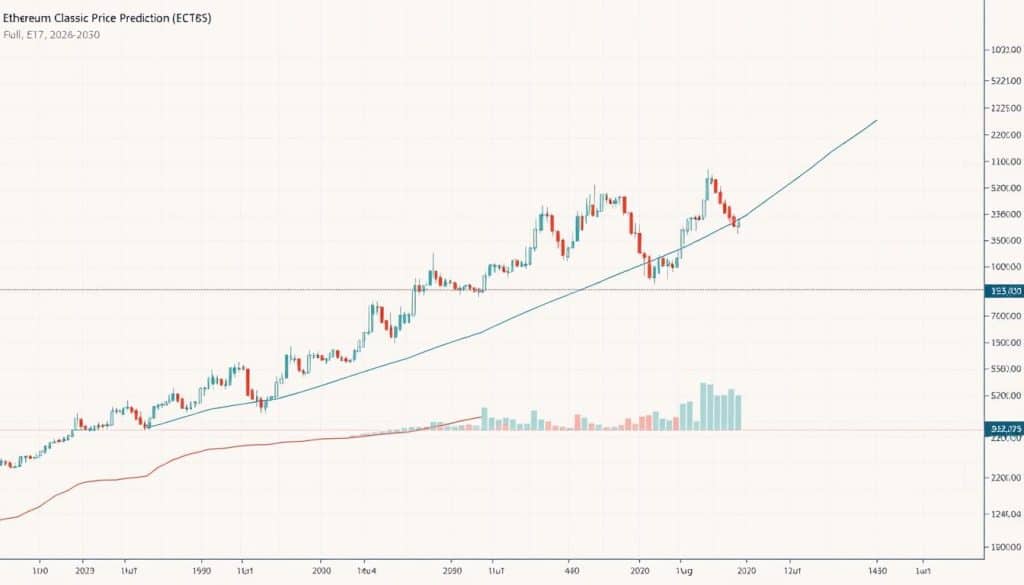
The Ethereum Classic (ETC) price outlook for 2026–2030 depends on cryptocurrency market conditions, network adoption, mining economics, monetary policy, and continued blockchain development. ETC remains distinct from Ethereum because it maintains a Proof-of-Work consensus mechanism and follows its own development roadmap.
As of November 11, 2026, ETC trades at approximately $6.71, with a market capitalization of around $1.07 billion and a circulating supply of approximately 158.98 million coins. Its maximum supply is approximately 210.7 million ETC.
The long-term outlook is uncertain. A sustained recovery would require stronger network activity, healthy miner participation, improved ecosystem development, and renewed demand for proof-of-work smart contract platforms. However, competition, security concerns, regulatory changes, and broader cryptocurrency market weakness could limit its growth.
Rather than treating any single price target as guaranteed, investors should evaluate bullish, neutral, and bearish scenarios when assessing Ethereum Classic’s potential through 2030.
Market data reference: November 11, 2026. Prices and market statistics are subject to change.
Ethereum Classic Price Prediction: Quick Overview
Ethereum Classic is a decentralized blockchain network that supports smart contracts and decentralized applications. Its native cryptocurrency, ETC, is used for transaction fees and rewards paid to miners who help secure the network.
The following table summarizes the main considerations behind the Ethereum Classic price forecast.
| Category | Market outlook |
|---|---|
| Cryptocurrency | Ethereum Classic (ETC) |
| Consensus mechanism | Proof of Work |
| Current reference price | Approximately $6.71 |
| Market capitalization | Approximately $1.07 billion |
| Circulating supply | Approximately 158.98 million ETC |
| Maximum supply | Approximately 210.7 million ETC |
| Historical all-time high | $176.16, May 2021 |
| Monetary policy | 5M20 emission schedule |
| Forecast period | 2026–2030 |
| Main growth drivers | Adoption, network development, market demand |
| Main risks | Competition, volatility, security, regulation |
ETC’s historical price performance demonstrates that the cryptocurrency can experience substantial market cycles. However, previous gains do not establish what its future price will be.
For investors researching the asset, understanding its technology, monetary policy, and market position is more useful than relying on isolated price predictions.
What Is Ethereum Classic (ETC)?
Ethereum Classic is an open-source blockchain that originated from the original Ethereum network. It continued operating after the 2016 Ethereum hard fork, which followed the controversial DAO incident.
The two networks subsequently developed separate communities and technical roadmaps.
Ethereum Classic maintains the original chain’s commitment to transaction immutability and decentralized operation. Its native token, ETC, supports transaction payments, smart contract execution, and mining incentives.
Unlike Ethereum, which transitioned to Proof of Stake in September 2022, Ethereum Classic continues using Proof of Work.
This difference is central to understanding ETC’s identity and potential investment appeal.
Ethereum Classic vs. Ethereum
Ethereum Classic and Ethereum share historical origins and similar smart contract capabilities, but they are separate blockchain networks.
| Feature | Ethereum Classic | Ethereum |
|---|---|---|
| Native token | ETC | ETH |
| Consensus | Proof of Work | Proof of Stake |
| Network origin | Original Ethereum chain | Post-2016 hard fork |
| Smart contracts | Supported | Supported |
| Monetary policy | 5M20 emission schedule | Different issuance and fee-burning mechanisms |
| Main distinction | Commitment to Proof of Work and immutability | Proof-of-Stake ecosystem and broader development roadmap |
Ethereum Classic appeals to users who prefer a Proof-of-Work smart contract blockchain. Ethereum, meanwhile, has a substantially different ecosystem and development strategy.
These differences can influence developer interest, network activity, investment demand, and the long-term competitive position of both assets.
Investors comparing blockchain projects can also explore this Solana vs. Ethereum comparison.
How ETC’s Proof-of-Work Network Works
Proof of Work is a blockchain consensus mechanism in which miners use computational resources to validate transactions and produce new blocks.
Ethereum Classic miners compete to solve cryptographic problems. Successful miners receive block rewards and applicable transaction fees.
This process helps maintain the network’s security without relying on token staking.
However, Proof of Work also creates economic requirements. Mining operations need sufficient revenue to cover electricity, hardware, maintenance, and other operating expenses.
If ETC’s market value and mining revenue decline substantially, some miners may become less willing to support the network.
Consequently, mining economics are an important consideration when evaluating the long-term Ethereum Classic price prediction.
Current Ethereum Classic Price and Market Performance
Ethereum Classic was trading at approximately $6.71 on November 11, 2026, according to the referenced market data.
Its market capitalization was approximately $1.07 billion, supported by a circulating supply of roughly 158.98 million ETC.
These figures provide a starting point for evaluating ETC’s current market position.
Cryptocurrency prices change continuously, so investors should check current exchange prices and market statistics before making financial decisions.
ETC Price, Market Cap, and Trading Volume
Three important metrics help explain Ethereum Classic’s market performance.
1. Market price
The ETC market price represents the amount buyers are currently willing to pay for one token. It changes according to buying and selling activity across cryptocurrency exchanges.
2. Market capitalization
Market capitalization is calculated by multiplying the circulating supply by the current token price.
For example:
$6.71 × 158.98 million ETC = approximately $1.07 billion.
This calculation helps investors compare Ethereum Classic with other cryptocurrencies.
3. Trading volume
Trading volume measures the value or quantity of ETC traded during a particular period.
Increasing volume can indicate stronger market participation, but it does not automatically mean that investors are accumulating ETC.
Volume should be evaluated alongside price direction, liquidity, order-book depth, and market conditions.
For broader market comparisons, consult Forbes’ cryptocurrency price data.
Historical Price Performance
Ethereum Classic has experienced significant price fluctuations throughout its trading history.
Its recorded historical low was approximately $0.4524 in July 2016, while its historical high reached $176.16 in May 2021, according to the referenced CoinMarketCap historical data.
The 2021 peak occurred during a broader cryptocurrency market expansion.
However, ETC subsequently experienced substantial corrections.
This historical performance illustrates two important characteristics:
- ETC has demonstrated the ability to experience major upward price movements during favorable market cycles.
- Its price can also decline substantially when market sentiment weakens.
A return to its historical high would require significant buying demand and a much higher market valuation than its November 2026 reference level.
Therefore, historical highs should be treated as reference points rather than realistic guaranteed targets.
Key Technical Indicators
Technical analysis can help investors evaluate ETC’s market direction, momentum, and potential support and resistance areas.
Several commonly used indicators are relevant.
Relative Strength Index (RSI): RSI measures the speed and magnitude of recent price movements. Readings above 70 are traditionally considered overbought, while readings below 30 are traditionally considered oversold. These levels are not reliable standalone trading signals.
Moving averages: The 50-day and 200-day moving averages help identify medium- and long-term price trends. A sustained move above these indicators may indicate improving momentum.
Trading volume: Higher volume accompanying a breakout can strengthen the evidence that a price movement has broad market participation.
Support and resistance: Support represents an area where buying interest has historically emerged. Resistance represents an area where selling pressure has previously increased.
Market structure: Higher highs and higher lows can indicate an improving trend, while lower highs and lower lows may suggest continued weakness.
Investors should examine daily and weekly charts rather than relying on a single short-term indicator.
Ethereum Classic Price Prediction for 2026
The Ethereum Classic price prediction for 2026 depends on whether the cryptocurrency market can establish a sustainable recovery and whether ETC can attract additional demand.
At the November 2026 reference price of approximately $6.71, ETC remains considerably below its historical high.
This creates potential recovery opportunities, but it also highlights the risks associated with investing in an asset that has experienced substantial long-term price depreciation.
Bullish, Neutral, and Bearish Scenarios
Instead of presenting unsupported predictions as analyst consensus, the following scenarios illustrate how different market conditions could influence ETC.
Bullish scenario
A bullish outcome would require improving cryptocurrency market sentiment, stronger demand for ETC, greater network activity, and continued development of its ecosystem.
Higher trading volume, increased liquidity, and sustained miner participation could support a recovery.
If these conditions develop together, ETC could outperform its recent market levels.
Neutral scenario
A neutral scenario assumes that ETC continues trading through market cycles without achieving a major improvement in adoption or demand.
In this situation, the cryptocurrency could experience temporary rallies followed by corrections.
Its performance would likely remain closely connected to broader cryptocurrency market conditions.
Bearish scenario
A bearish scenario could develop if cryptocurrency demand weakens, competing networks attract more developers, or mining economics become less attractive.
Reduced liquidity and negative investor sentiment could increase selling pressure.
A prolonged downturn could result in ETC establishing new lower price levels.
These scenarios are analytical frameworks, not verified forecasts or guaranteed price ranges.
Factors That Could Influence ETC in 2026
Several developments deserve attention when evaluating ETC’s near-term outlook:
- Overall Bitcoin and cryptocurrency market performance.
- Changes in ETC trading volume and market liquidity.
- Miner participation and network hashrate.
- Smart contract activity and application development.
- Progress on proposed Ethereum Classic network upgrades.
- Regulatory developments affecting digital assets.
- Institutional disclosures and investment-product activity.
Investors should monitor these indicators together because no single development guarantees a positive price reaction.
Ethereum Classic Price Prediction for 2027–2028
The 2027–2028 Ethereum Classic forecast will depend heavily on whether the network can translate technical development into measurable ecosystem growth.
Technology improvements can make a blockchain more competitive, but they do not automatically generate token demand.
The relationship between development, adoption, transaction activity, and market value is particularly important for long-term ETC analysis.
Network Development and Olympia
Olympia is a proposed Ethereum Classic network upgrade that focuses on fee-market improvements, protocol funding, and governance.
The initiative includes proposals related to EIP-1559-style transaction fees, an on-chain treasury, and a governance framework.
One important distinction separates the Olympia proposal from Ethereum’s implementation of EIP-1559.
Ethereum burns its base transaction fee, permanently removing that portion from circulation. The Olympia proposal instead redirects the base fee toward a treasury mechanism.
Therefore, it would be inaccurate to claim that Olympia automatically makes ETC deflationary.
Its potential benefits would depend on successful implementation, community agreement, security testing, and the effectiveness of its governance structure.
Investors should follow the relevant Ethereum Classic network proposals rather than assuming that proposed upgrades have already been activated.
The wider Ethereum ecosystem also continues to evolve. Readers interested in related developments can explore the Ethereum Prague-Electra upgrade.
Adoption, Mining, and Market Demand
Network adoption is one of the most important long-term factors influencing Ethereum Classic.
A blockchain needs active users, developers, applications, infrastructure providers, and miners to maintain a sustainable ecosystem.
Several indicators can help evaluate ETC’s development between 2027 and 2028:
- Active addresses and transaction activity.
- Growth in deployed smart contracts.
- Decentralized application usage.
- Network hashrate and mining participation.
- Exchange liquidity and trading activity.
- Developer contributions and client maintenance.
If these indicators improve consistently, they could strengthen the investment case for ETC.
Conversely, declining usage and limited developer activity could make it more difficult for Ethereum Classic to compete with alternative blockchain networks.
Ethereum Classic Price Prediction for 2030
The Ethereum Classic price prediction for 2030 is especially uncertain because long-term cryptocurrency valuations depend on technological, economic, and regulatory developments that cannot be known in advance.
ETC has several characteristics that could support its long-term relevance, including its Proof-of-Work consensus mechanism, established blockchain history, smart contract capabilities, and capped monetary policy.
However, these characteristics alone are insufficient to establish a specific future price.
A meaningful 2030 outlook must consider how much demand the network can attract and whether that demand can support a higher market capitalization.
Long-Term Growth Opportunities
Ethereum Classic could benefit from several developments over the coming years.
Continued demand for Proof of Work
Some cryptocurrency participants prefer Proof-of-Work networks because of their established mining-based security model.
ETC’s commitment to Proof of Work gives it a distinct position within the smart contract blockchain sector.
Ecosystem development
More applications, infrastructure, and developer participation could improve network utility.
However, actual adoption should be measured through on-chain activity rather than announcements alone.
Predictable monetary policy
Ethereum Classic follows its 5M20 emission schedule, which reduces block rewards by 20% every five million blocks.
This creates a declining issuance schedule and a theoretical maximum supply of approximately 210.7 million ETC.
The policy is designed to limit long-term token issuance while continuing to reward miners.
Improved network infrastructure
Client development, network maintenance, security improvements, and more efficient transaction processing could support the ecosystem’s competitiveness.
These factors provide potential opportunities, but their impact on ETC’s price will depend on actual execution and market demand.
Potential Risks and Challenges
Ethereum Classic faces several challenges that could limit its long-term performance.
Competition
Ethereum Classic competes with Ethereum and other smart contract platforms for developers, applications, users, and investment capital.
Projects with larger ecosystems may have an advantage in attracting new participants.
Security concerns
Proof-of-Work networks must maintain sufficient mining security to protect against attacks.
Ethereum Classic has experienced historical chain reorganization and 51% attack incidents. These events demonstrate why network security and hashrate remain important considerations.
Limited adoption
A blockchain can maintain its technical infrastructure without experiencing significant user growth.
If ETC does not attract more meaningful application activity, its long-term demand could remain limited.
Regulatory uncertainty
Different jurisdictions have different approaches to cryptocurrency trading, custody, taxation, and institutional participation.
Unfavorable regulatory changes could affect market access and investor demand.
Market volatility
Even established cryptocurrencies can experience substantial declines during market downturns.
Long-term price projections should account for the possibility of prolonged corrections.
What Would ETC Need to Reach Higher Price Levels?
Market capitalization provides a useful way to evaluate ambitious cryptocurrency price targets.
At the November 2026 reference price of $6.71, ETC’s circulating market capitalization is approximately $1.07 billion.
The following table illustrates hypothetical price levels and their corresponding market valuations.
| Hypothetical ETC price | Approximate market cap using current circulating supply |
|---|---|
| $6.71 | $1.07 billion |
| $13.42 | $2.13 billion |
| $20.13 | $3.20 billion |
| $33.55 | $5.33 billion |
| $67.10 | $10.67 billion |
| $100 | $15.90 billion |
| $176.16 | $28.01 billion |
These figures are mathematical illustrations, not predictions. They assume the circulating supply remains approximately 158.98 million ETC. Actual future supply and market capitalization will differ.
This comparison is important because it shows the amount of market value that would be needed to support higher ETC prices.
For example, returning to $100 would require a market capitalization of approximately $15.9 billion at the reference circulating supply.
A return to the historical high of $176.16 would require approximately $28 billion.
Such outcomes would likely require a combination of substantial market demand, stronger ecosystem development, and favorable overall cryptocurrency conditions.
What Factors Could Affect Ethereum Classic’s Price?
Understanding the factors behind ETC’s market valuation is essential for making a realistic long-term assessment.
Supply and Monetary Policy
Ethereum Classic’s monetary policy follows ECIP-1017, which established a declining block-reward schedule.
Under the 5M20 model, mining rewards decrease by 20% after every five million blocks.
This gradually reduces the number of new ETC tokens entering circulation.
The maximum theoretical supply is approximately 210.7 million ETC.
A limited supply can contribute to scarcity, but scarcity alone does not guarantee appreciation.
For ETC to increase in value, demand must remain stable or grow relative to the available supply.
Investors can review the original Ethereum Classic monetary policy proposal for the technical details.
Proof-of-Work Security and Miner Incentives
Mining is fundamental to Ethereum Classic’s operation.
Miners validate transactions, produce blocks, and receive rewards for contributing computational resources.
The financial sustainability of mining depends on several factors:
- ETC’s market price.
- Block rewards.
- Transaction fees.
- Mining hardware efficiency.
- Electricity costs.
- Network difficulty and hashrate.
A stronger ETC market can improve mining profitability, although individual mining economics vary considerably.
If mining becomes unprofitable for a significant portion of participants, network hashrate could weaken.
Therefore, miner incentives are closely connected to ETC’s long-term security and market outlook.
Network Adoption and Developer Activity
A successful blockchain needs more than a functioning consensus mechanism.
It also needs users and developers who create meaningful economic activity.
Ethereum Classic’s smart contract functionality allows developers to build decentralized applications and other blockchain-based services.
Increasing application usage could support transaction demand and strengthen the ecosystem.
Investors should monitor actual network metrics, development repositories, deployed applications, and transaction activity to determine whether adoption is improving.
Regulation and Institutional Participation
Cryptocurrency regulation can influence market accessibility, investor confidence, and institutional participation.
Clearer regulatory requirements may encourage some financial institutions to develop digital asset services.
However, institutional involvement should not be assumed simply because a cryptocurrency is established or listed on major exchanges.
Investors should look for verifiable disclosures, investment-product filings, custody developments, and actual trading activity.
ETC-related investment products and institutional announcements should be assessed individually rather than treated as proof of guaranteed future demand.
For readers researching traditional investment exposure to the Ethereum ecosystem, the Grayscale Ethereum Trust price outlook provides an additional comparison.
Competition and Overall Crypto Market Conditions
Ethereum Classic’s price is also affected by the broader cryptocurrency market.
Bitcoin market cycles, Ethereum demand, interest rates, liquidity conditions, and investor risk appetite can influence ETC trading.
Even when Ethereum Classic makes technological improvements, its price may decline if the wider cryptocurrency market experiences a correction.
Conversely, a strong market recovery could increase demand for alternative cryptocurrencies.
This relationship makes market-wide analysis an important component of any ETC forecast.
Is Ethereum Classic a Good Investment?
Ethereum Classic may appeal to investors who want exposure to an established Proof-of-Work smart contract blockchain.
However, whether ETC is a suitable investment depends on individual financial circumstances, risk tolerance, investment horizon, and portfolio strategy.
Its established history and capped monetary policy are potential advantages, but competition, volatility, and adoption challenges remain significant concerns.
Potential Advantages
Established blockchain history: Ethereum Classic has operated as an independent blockchain since the 2016 split.
Proof-of-Work consensus: Its mining-based security model differentiates it from Ethereum and many newer smart contract networks.
Capped supply: Its monetary policy provides a theoretical maximum supply of approximately 210.7 million ETC.
Smart contract functionality: Developers can build decentralized applications and deploy compatible smart contracts.
Established market presence: ETC has an established trading history and is available through multiple cryptocurrency exchanges.
Investment Risks and Risk Management
ETC remains a volatile cryptocurrency, and investors should understand the possibility of losing a substantial portion of their investment.
Some practical risk-management considerations include:
- Avoid investing money needed for essential expenses.
- Diversify rather than concentrating an entire portfolio in one cryptocurrency.
- Consider dollar-cost averaging instead of relying on a single purchase price.
- Evaluate liquidity before entering or exiting large positions.
- Monitor network security and development progress.
- Avoid using excessive leverage.
- Reassess investment assumptions when market conditions change.
Investors should also distinguish between short-term trading strategies and long-term holdings.
Technical indicators may help traders identify potential entry and exit areas, while long-term investors may place greater emphasis on adoption, network security, and monetary policy.
For readers who are still learning about cryptocurrency investing, this step-by-step guide to buying Ethereum provides additional background on purchasing digital assets.
Ethereum Classic Price Prediction: Frequently Asked Questions
What is the Ethereum Classic price prediction for 2026?
The Ethereum Classic price prediction for 2026 depends on market demand, cryptocurrency liquidity, network activity, and investor sentiment. A bullish scenario could involve a recovery in ETC’s market valuation, while a bearish scenario could produce additional declines. Investors should use current market data and multiple scenarios instead of relying on a guaranteed price target.
Can Ethereum Classic reach $100?
Ethereum Classic could theoretically reach $100, but doing so would require a substantial increase in market capitalization. At a circulating supply of approximately 158.98 million ETC, a $100 token price would represent a market capitalization of roughly $15.9 billion. This is a hypothetical calculation, not a prediction that ETC will reach that level.
What is the Ethereum Classic price prediction for 2027?
The 2027 ETC outlook will depend on network development, mining participation, ecosystem adoption, and broader cryptocurrency market conditions. Progress on proposed upgrades such as Olympia could influence investor sentiment, but the effect will depend on implementation and actual network usage.
What is the Ethereum Classic price prediction for 2028?
The 2028 Ethereum Classic forecast remains uncertain. Stronger decentralized application activity, improved infrastructure, and sustained demand could support higher valuations. However, competition from other smart contract platforms and weak market conditions could limit growth.
What is the Ethereum Classic price prediction for 2030?
The 2030 ETC price outlook depends on whether Ethereum Classic can maintain its competitive position and attract sustainable network demand. Its Proof-of-Work consensus and capped monetary policy provide distinguishing characteristics, but long-term appreciation is not guaranteed.
What makes Ethereum Classic different from Ethereum?
Ethereum Classic and Ethereum originated from the same blockchain but separated following the 2016 hard fork. Ethereum Classic continues using Proof of Work, while Ethereum transitioned to Proof of Stake in 2022. Both networks support smart contracts, but their development strategies and monetary policies differ.
Does Ethereum Classic have a maximum supply?
Yes. Ethereum Classic follows a monetary policy with a theoretical maximum supply of approximately 210.7 million ETC. Its 5M20 emission schedule reduces block rewards by 20% every five million blocks, gradually slowing the introduction of new tokens.
Is Ethereum Classic deflationary?
Ethereum Classic has a declining issuance schedule, but declining issuance does not automatically make the cryptocurrency deflationary. Its existing monetary policy reduces new token issuance over time. The proposed Olympia fee mechanism also needs to be distinguished from Ethereum’s fee-burning mechanism because the proposal redirects the base fee to a treasury rather than automatically destroying it.
How does the Olympia upgrade affect ETC’s price potential?
Olympia proposes improvements to transaction fee mechanics, protocol funding, and governance. Its proposed EIP-1559-style mechanism redirects base fees to a treasury rather than burning them. If successfully implemented, the initiative could influence network development and ecosystem funding. However, it does not automatically guarantee higher ETC prices or a deflationary supply.
What are the biggest risks associated with Ethereum Classic?
The main risks include cryptocurrency market volatility, competition from other blockchain networks, potential security vulnerabilities, limited adoption, regulatory uncertainty, and changes in mining profitability. These factors could negatively affect ETC’s long-term market value.
What technical indicators are useful for analyzing ETC?
Common indicators include the Relative Strength Index, moving averages, trading volume, support and resistance, and broader market trend analysis. These tools can help investors evaluate momentum and market structure, but they should not be treated as reliable standalone price-prediction systems.
Is Ethereum Classic a good long-term investment?
Ethereum Classic may be worth researching for investors interested in Proof-of-Work blockchain technology. However, its long-term investment potential depends on adoption, network security, market demand, and competition. Investors should evaluate their risk tolerance and financial objectives before purchasing ETC.
What trading strategies can investors use for Ethereum Classic?
Common strategies include dollar-cost averaging, trend-following, support and resistance analysis, and portfolio diversification. Each approach has different risks, and no strategy guarantees profits. Investors should consider liquidity, volatility, transaction costs, and potential losses before trading.
Conclusion: What Is the Future of Ethereum Classic?
The Ethereum Classic price prediction for 2026–2030 depends on more than historical price movements or optimistic market forecasts.
ETC has several distinguishing characteristics, including its Proof-of-Work consensus mechanism, smart contract functionality, established network history, and capped monetary policy.
These features could help maintain its relevance in the cryptocurrency market.
However, Ethereum Classic must continue attracting developers, users, miners, and investment demand to strengthen its long-term position.
The proposed Olympia upgrade also deserves attention, particularly because its fee-market and treasury mechanisms could influence future network development. Its implementation status and final technical design should be verified before drawing conclusions about its effects.
Investors should evaluate ETC through multiple scenarios rather than assuming that previous market highs will return. Stronger adoption and favorable market conditions could support recovery, while competition, security challenges, and declining demand could create additional downside pressure.
Ultimately, Ethereum Classic offers exposure to a distinct segment of the blockchain ecosystem, but its future value remains uncertain.
Conduct independent research, monitor current market data, and consider your financial objectives and risk tolerance before making any cryptocurrency investment decision.
Disclaimer: This article is for informational and educational purposes only. It does not constitute financial, investment, or trading advice. Cryptocurrency prices are highly volatile, and past performance does not guarantee future results.