

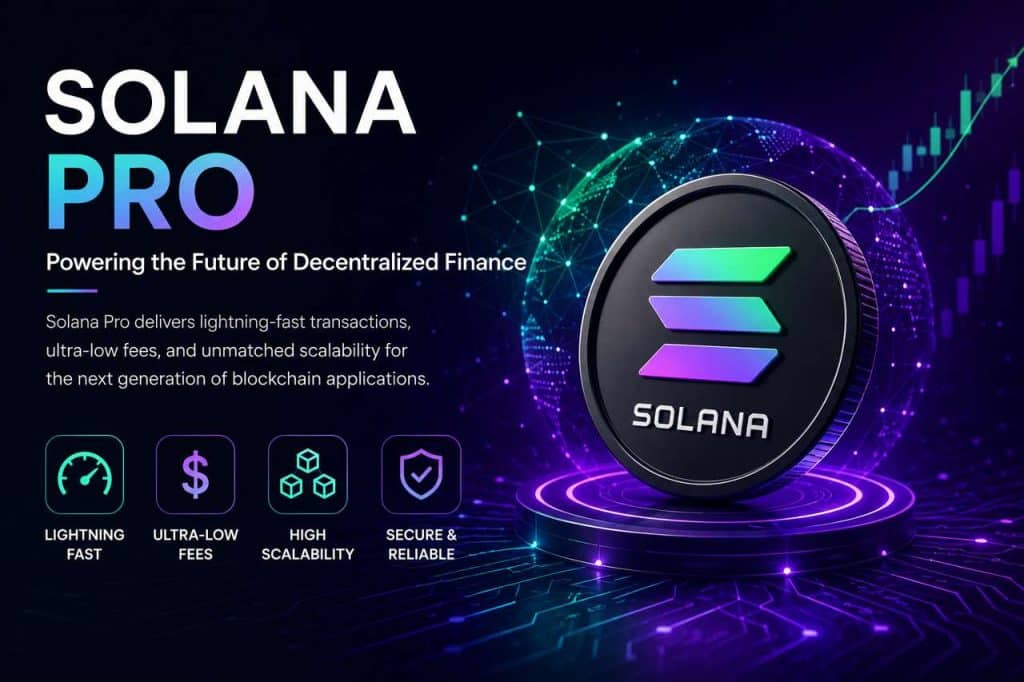
.“Solana Pro” is not clearly identified in official Solana documentation as a separate Solana blockchain or official Solana product. The term may refer to a third-party platform, service, trading product, or content brand using the Solana name. Before depositing funds or connecting a wallet to any service called Solana Pro, verify its official website, operator, regulatory disclosures, wallet permissions, and independent security information.
For the underlying technology, Solana is a Layer-1 blockchain designed for high-throughput applications, digital assets, payments, and decentralized finance (DeFi). Its architecture uses accounts, programs, instructions, transactions, and a fee model based on signatures and optional priority fees.
This guide explains what can be established about Solana, how its transaction system works, what “Solana Pro” may mean, and what users should check before using a Solana-related trading or investment platform.
What Is Solana Pro?
The phrase Solana Pro requires clarification because it is not established in the official Solana documentation as the name of the Solana blockchain itself.
Solana is the underlying blockchain network. On Solana, applications interact with on-chain programs, accounts, tokens, and transactions. The official documentation describes Solana programs as the blockchain’s equivalent of smart contracts on other networks.
If “Solana Pro” refers to a particular third-party service, users should identify the company or application behind it before treating claims about fees, trading tools, security, customer support, or integrations as factual.
Solana vs. Solana Pro
| Term | What it refers to |
|---|---|
| Solana | A Layer-1 blockchain network and its broader ecosystem |
| SOL | Solana’s native cryptocurrency used for network fees and other activities |
| Solana programs | On-chain programs that perform application logic |
| Solana Pro | An ambiguous term that should be tied to a specific, independently verifiable product or service |
The distinction matters because performance or security characteristics of the Solana network should not automatically be attributed to a third-party service using “Solana” in its name.
How Does the Solana Blockchain Work?
Solana processes activity through a model built around accounts, programs, instructions, and transactions. Accounts hold state, while programs contain executable logic. Instructions tell programs what actions to perform, and multiple instructions can be combined into a transaction.
Solana also uses Proof of History as part of its approach to establishing the passage and ordering of time, alongside its broader consensus architecture. The official documentation defines Proof of History as a sequence of proofs showing that data existed before a particular proof and that a measurable amount of time passed.
For developers, this architecture supports applications including DeFi, tokenized assets, payments, games, and other on-chain applications.
Why Is Solana Known for Fast and Low-Cost Transactions?
Solana is designed for high-throughput transactions with relatively low network fees. However, “fast” and “low cost” should not be interpreted as a guarantee that every transaction will have the same confirmation time or fee.
Solana’s current fee documentation states that transactions have a base fee of 5,000 lamports per signature, plus an optional prioritization fee. Priority fees can increase the scheduling priority of a transaction when demand for block space is higher.
The official Solana learning materials describe the network as capable of processing transactions in less than a second with costs generally measured in fractions of a cent, while actual transaction costs and execution conditions can vary.
How Are Solana Transaction Fees Calculated?
For legacy and v0 transactions, the basic model is:
Total fee = base fee + prioritization fee
The base fee depends on the number of signatures. A priority fee depends on the requested compute-unit limit and compute-unit price. Solana’s documentation notes that the priority fee is based on the requested compute units rather than actual usage, making appropriate compute-budget configuration important for developers.
Every transaction fee is paid in SOL. Solana also supports fee sponsorship, allowing a separate account to pay the network fee on behalf of a user.
What Can Solana Be Used For?
Solana supports a broad range of applications rather than a single trading function.
Common use cases include:
- DeFi: decentralized exchanges, lending, staking-related applications, and other financial protocols.
- Tokenized assets: fungible tokens, stablecoins, NFTs, and Token-2022 assets.
- Payments: applications can use Solana for digital payments and settlement.
- Gaming: developers can build applications with on-chain assets and game logic.
- Developer infrastructure: wallets, RPC services, SDKs, analytics tools, and other infrastructure connect applications to the network.
- Consumer applications: Solana’s ecosystem includes applications designed for everyday users rather than only cryptocurrency traders.
How Do Smart Contracts Work on Solana?
Solana generally uses the term program rather than “smart contract.”
A Solana program contains executable logic, while the state it works with is stored in separate accounts. Programs receive instructions and operate on the accounts supplied to those instructions.
Developers commonly use Rust and frameworks such as Anchor, although the Solana ecosystem supports multiple development approaches and tools. Official developer resources provide courses, documentation, templates, SDKs, and other infrastructure for building on Solana.
Is Solana Suitable for Trading and DeFi?
Solana is used by decentralized finance applications and trading protocols, but the blockchain itself is not an investment strategy or a guarantee of trading performance.
A user interacting with a Solana-based decentralized exchange may encounter:
- Network transaction fees
- Token price volatility
- Slippage
- Liquidity risk
- Smart-contract or program risk
- Wallet-security risks
- MEV and transaction-ordering considerations
- Risks associated with individual tokens and protocols
For this reason, “fast transactions” should not be confused with low investment risk.
What About Solana ETFs?
Solana-related exchange-traded products are a separate financial-market topic from the Solana blockchain itself. Whether a particular Solana ETF or exchange-traded product is available depends on the jurisdiction, issuer, exchange, and current regulatory status.
Any article discussing a specific Solana ETF should identify the product, issuer, jurisdiction, listing venue, date, and authoritative filing or exchange source rather than implying that Solana Pro itself provides ETF trading.
Solana vs. Ethereum: What Is the Difference?
Solana and Ethereum are both programmable blockchain ecosystems, but their technical architectures and developer environments differ.
| Area | Solana | Ethereum |
|---|---|---|
| Network type | Layer-1 blockchain | Layer-1 blockchain |
| Application logic | Programs | Smart contracts |
| Native asset | SOL | ETH |
| State model | Account-based model with executable programs and separate data accounts | Account-based architecture with smart-contract state |
| Development | Rust and other supported approaches; Anchor is widely used | Solidity and other Ethereum-compatible languages |
| Scaling approach | High-throughput Layer-1 architecture | Ethereum mainnet plus a broad Layer-2 ecosystem |
| Fees | SOL-denominated network fees plus possible priority fees | ETH-denominated gas fees whose cost varies with network conditions |
Neither network should be described as universally “better” without defining the specific use case. Developers and users should compare transaction economics, tooling, liquidity, security assumptions, application availability, and their own requirements.
How Can You Verify a Solana Transaction?
The official Solana Explorer allows users to inspect on-chain information such as transactions, accounts, programs, and tokens.
A practical verification workflow is:
- Copy the transaction signature from the wallet or application.
- Open Solana Explorer.
- Search for the transaction signature.
- Check its status, accounts, instructions, and other available transaction details.
- Confirm that the transaction corresponds to the action you intended to perform.
Never rely solely on a screenshot or transaction status displayed by an unfamiliar third-party website.
Solana Security: What Should Users Check?
Security depends on both the underlying network and the application or service being used.
Before connecting a wallet to a Solana application or a service described as “Solana Pro,” check:
- The exact domain name and company behind the service.
- Whether the service has verifiable documentation.
- What wallet permissions it requests.
- Whether deposits or withdrawals are subject to restrictions.
- Whether the service publishes security documentation or audits.
- Whether its fees are clearly disclosed.
- Whether independent sources identify the operator.
- Whether claims about returns, trading performance, or guaranteed profits are supported by evidence.
A blockchain’s security does not automatically make every application built on that blockchain safe.
How Should You Evaluate a Platform Called Solana Pro?
If you are evaluating a specific service called Solana Pro, start with the product itself rather than assuming that its branding means it is affiliated with Solana.
Use this checklist:
1. Identify the operator
Look for a legal company name, jurisdiction, contact information, and verifiable corporate presence.
2. Verify the official domain
Typosquatting and impersonation are common risks in cryptocurrency. Check the domain carefully before entering credentials or connecting a wallet.
3. Check how funds are handled
Determine whether you retain custody of your assets or transfer funds to an account controlled by the platform.
4. Review fees
Look for deposit, withdrawal, trading, network, and service fees. Do not assume that Solana’s relatively low network fees mean a third-party platform has low fees.
5. Investigate security claims
Look for independently verifiable audits, security disclosures, incident history, and wallet-permission information.
6. Separate blockchain claims from product claims
A statement about Solana’s transaction architecture does not prove that a third-party application offers faster trading, better execution, guaranteed security, or superior returns.
What Are the Main Risks of Using Solana-Based Applications?
Solana applications can involve several layers of risk.
Market risk: SOL and other digital assets can experience substantial price volatility.
Protocol risk: Smart-contract or program vulnerabilities can result in losses.
Application risk: A third-party application may have security, operational, liquidity, or custody problems independent of the Solana network.
Wallet risk: Losing a private key or approving a malicious transaction can result in permanent loss of assets.
Liquidity and execution risk: A quoted token price may differ from the eventual execution price because of slippage and changing liquidity.
Regulatory risk: Rules governing crypto assets, exchanges, ETFs, stablecoins, and DeFi differ between jurisdictions and can change over time.
These risks are particularly important when evaluating a product marketed as “Solana Pro,” because the name alone does not establish an affiliation with the Solana network.
Solana Pro FAQs
Is Solana Pro the same as Solana?
No conclusion should be made from the name alone. Solana is the Layer-1 blockchain and ecosystem documented by the Solana Foundation. “Solana Pro” should be associated with a specific verified product or operator before claims about its functionality or affiliation are accepted.
Is Solana a cryptocurrency?
Solana is the blockchain network; SOL is its native cryptocurrency. SOL is used for network fees and other functions within the ecosystem.
Are Solana transaction fees always cheap?
Solana’s base network fee is low compared with many blockchain transactions, but the total fee can include a priority fee. Fees can therefore vary according to transaction requirements and network conditions.
Does Solana use smart contracts?
Yes, although Solana generally calls them programs. Programs contain executable logic and operate on accounts supplied through instructions.
Can Solana be used for DeFi?
Yes. Solana supports a range of DeFi applications, including decentralized exchanges, tokenized assets, and other financial applications. Individual protocols carry their own technical, liquidity, smart-contract, and market risks.
Can I verify Solana transactions independently?
Yes. Solana Explorer provides tools for searching transactions, accounts, tokens, and programs on the network.
Does Solana Pro guarantee trading profits?
A legitimate platform should not be assumed to guarantee profits simply because it uses Solana technology or includes “Solana” in its name. Cryptocurrency trading involves market and execution risks, and claims of guaranteed returns should be independently verified.
Final Takeaway
Solana is a high-throughput Layer-1 blockchain with an ecosystem spanning DeFi, payments, tokenized assets, games, and other applications. Its architecture uses programs, accounts, instructions, and transactions, while its fee system combines a base fee with optional prioritization fees.
The more important question surrounding Solana Pro is what specific product or service the name represents. Because the term is not established by the official Solana documentation as the name of the Solana blockchain itself, users should verify the operator, website, custody model, fees, security claims, and regulatory information before using it.
For authoritative technical information, start with the official Solana documentation and developer resources rather than relying on promotional descriptions.
The biggest information-gain improvement is the entity clarification: the original article attributed numerous unverified platform features to “Solana Pro.” The revised version separates those claims from documented Solana facts, which is substantially safer for users and more useful for search/answer engines.