

Last updated: October 13, 2026. Volume and fee figures come from CoinGecko, DefiLlama and each platform’s published fee page on September 30, 2026.
Use a centralized exchange (CEX) if you want the easiest way to buy crypto with a bank card or transfer. Use a decentralized exchange (DEX) if you want to trade from your own wallet without handing your coins to a company. Use peer-to-peer (P2P) when you need a local payment method, and OTC when an order is too big to fill on an order book without moving the price.
Key Takeaways
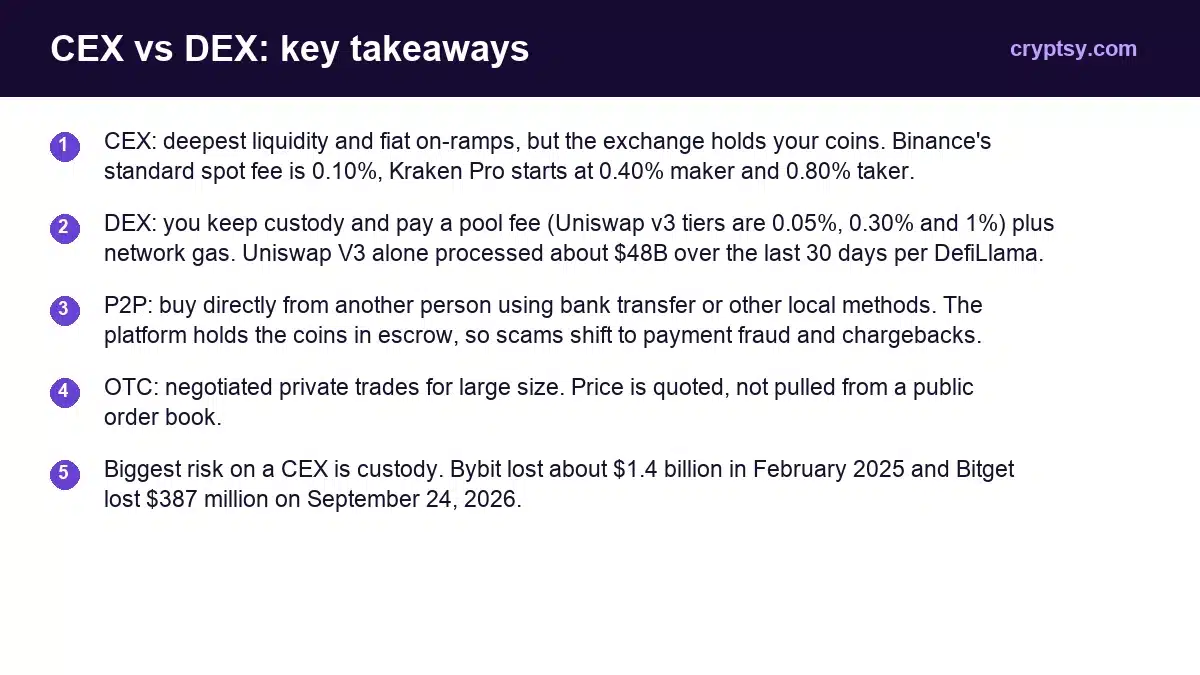
- CEX: deepest liquidity and fiat on-ramps, but the exchange holds your coins. Binance’s standard spot fee is 0.10%, Kraken Pro starts at 0.40% maker and 0.80% taker.
- DEX: you keep custody and pay a pool fee (Uniswap v3 tiers are 0.05%, 0.30% and 1%) plus network gas. Uniswap V3 alone processed about $48B over the last 30 days per DefiLlama.
- P2P: buy directly from another person using bank transfer or other local methods. The platform holds the coins in escrow, so scams shift to payment fraud and chargebacks.
- OTC: negotiated private trades for large size. Price is quoted, not pulled from a public order book.
- Biggest risk on a CEX is custody. Bybit lost about $1.4 billion in February 2025 and Bitget lost $387 million on September 24, 2026.
CEX vs DEX vs P2P vs OTC at a glance
| CEX | DEX | P2P | OTC | |
|---|---|---|---|---|
| Who holds your coins | The exchange | You (your wallet) | Platform escrow during the trade | Desk, then you after settlement |
| Needs ID (KYC) | Usually yes | No, only a wallet | Depends on platform | Yes, at most desks |
| Typical cost | 0.10% to 0.80% per trade at entry tiers | Pool fee 0.05% to 1% plus gas | Often free for the buyer, small fee for the ad poster | Quoted spread, negotiated |
| Fiat on-ramp | Yes (card, bank) | No (you need crypto first) | Yes (local payment apps, bank) | Yes (wire) |
| Liquidity | Deepest order books | Good on major pairs, thin on small tokens | Depends on local supply | Sized for large orders |
| Main risk | Hacks, insolvency, freezes | Smart contract bugs, fake tokens, wallet mistakes | Payment fraud, disputes | Counterparty and minimum size |
| Best for | Beginners, active traders | Self-custody, new tokens | Countries with limited banking access | Large, low-slippage trades |
What is a centralized exchange (CEX)?
A CEX is a company that runs an order book and keeps your crypto in its own wallets while you trade. You log in with a password, verify your identity, and buy with a card or bank transfer. Binance, Coinbase, Kraken, OKX and Bybit are the best-known examples.
Scale is the draw. CoinGecko’s exchange ranking on September 30, 2026 showed Binance reporting about 115,800 BTC of 24-hour volume (roughly $9.7 billion at a $83,700 Bitcoin price), Coinbase about 23,500 BTC (about $2.0 billion) and Kraken about 20,700 BTC (about $1.7 billion). Those are self-reported volumes and should be read as a rough ranking, not an audited number.
CEX fees
- Binance: 0.100% maker and 0.100% taker at the entry tier, or 0.075% with the BNB discount, per Binance fee schedule.
- Kraken Pro: 0.40% maker and 0.80% taker at the base tier, falling to 0.00% maker and 0.05% taker at the highest volume, per Kraken fee schedule.
- Coinbase Advanced: a tiered maker-taker schedule based on your 30-day trading volume. Coinbase shows your current tier and rates in your account, per Coinbase Help.
Check the exact tier on the day you trade. All three have changed their schedules more than once. The simple buy button on most exchanges adds a spread on top, so the headline percentage is not the full cost. For a cost-first comparison, see our list of low-fee exchanges.
The CEX security record
Custody is where CEXs fail. On February 21, 2025, attackers stole about $1.4 billion to $1.5 billion from Bybit, and the FBI attributed the theft to North Korea’s TraderTraitor group (FBI notice). The attack came through infrastructure tied to the Safe{Wallet} multisig platform during a routine cold-to-hot transfer.
It happened again on September 24, 2026, when about $387 million left Bitget’s hot wallets. Halborn’s write-up says the attackers fed spoofed withdrawal requests into the approval process instead of stealing private keys, and the incident was attributed to Lazarus Group. Bitget said its $464 million User Protection Fund covers customer losses (Halborn analysis).
The other failure mode is the exchange itself. FTX’s 2022 collapse showed that a platform can misuse customer deposits, which is why proof-of-reserves pages and a clean regulatory record matter. Our guide to risky and fake exchanges lists the warning signs.
What is a decentralized exchange (DEX)?
A DEX is a set of smart contracts. You connect a wallet such as MetaMask, approve a token, and swap against a liquidity pool. No account, no ID, and the exchange never holds your coins.
Uniswap is the reference example. DefiLlama shows Uniswap V3 at about $48.3 billion and Uniswap V4 at about $43.1 billion of volume over the last 30 days, with PancakeSwap V3 at about $19.8 billion. Fees depend on the pool. Uniswap v3 has standard tiers of 0.05%, 0.30% and 1%, and v4 lets pool creators set any fee from 0% to 100% (Uniswap docs). Protocol fees are now switched on for some pools, taking about one-sixth of the swap fee, with liquidity providers keeping the rest.
On top of the pool fee you pay network gas, and on thin pairs you pay slippage. Check the price impact before you confirm any swap.
DEX risks
- Smart contract bugs. DefiLlama’s hack tracker lists about $2.2 billion stolen across all incidents in 2026 so far, including bridges and lending protocols.
- Fake tokens. Anyone can list a token on a DEX, including copies of real ones. Copy the contract address from the project’s official site or CoinGecko.
- Wallet mistakes. There is no support desk. A wrong address or an unlimited approval to a malicious contract cannot be reversed.
Bridges add their own risk when you move between chains. Our bridge guide covers which ones have held up.
Before you swap on a DEX
- Check the token contract. Names and tickers get copied. Match the address to the project’s official site or CoinGecko.
- Check the price impact. The swap screen shows how much your own order moves the pool price. A few percent on a small trade means the pool is thin.
- Keep slippage tight. A wide slippage setting lets the trade fill at a much worse price while it waits to confirm, and makes you an easier target for sandwich bots.
- Approve only what you need. Unlimited token approvals stay open after the swap. Revoke old ones you no longer use.
- Read the wallet prompt. Confirm the network, the amounts and the contract before you sign. Nobody can reverse it afterwards.
What is peer-to-peer (P2P) crypto trading?
P2P platforms match you with another person who sells crypto for your local currency. You pay by bank transfer, cash deposit or a payment app, and the platform holds the crypto in escrow until the seller confirms receipt.
Binance P2P is the largest mainstream example. Third-party fee breakdowns report that buyers taking an existing ad pay nothing, while the person posting the ad pays roughly 0.15% to 0.35% depending on region. Confirm the current rate on Binance’s P2P fee page before relying on it.
P2P has also lost a major name. Paxful announced on October 1, 2025 that it would stop operations by November 1, 2025, citing compliance costs and the legacy of disputes between its co-founders. It had served users in more than 140 countries. If you rely on P2P, pick a platform with a track record and keep trades inside its escrow and chat.
Bisq is the non-custodial option. It runs as desktop software, uses multisig escrow and never holds your funds, at the cost of slower trades and fewer payment methods.
P2P safety checklist
- Only pay from an account in your own name, and never pay outside the platform’s chat.
- Release nothing until the money is in your account, not when a screenshot arrives.
- Prefer sellers with many completed trades and a high completion rate.
- Be wary of a buyer who pushes you to hurry or asks you to use a third party to pay.
What is OTC crypto trading?
OTC (over-the-counter) means trading directly with a desk instead of on a public order book. You ask for a quote on a size, agree a price, and settle by wire and on-chain transfer. The point is to avoid moving the market: a very large market order on a public book walks through the price levels and can cost far more than the quoted fee.
Most OTC desks are built for large orders and verify who you are before trading. Minimum sizes differ from desk to desk, so ask for the minimum before you assume you qualify. For small and mid-size trades, a normal exchange order with a limit price is cheaper and simpler.
CEX vs DEX: fees, privacy and ease of use
Which is cheaper?
Neither, every time. Compare the total cost of the trade, not the headline fee.
On a CEX that means the trading fee, any spread on the simple buy button, and the withdrawal fee when you move coins out. On a DEX it means the pool fee, network gas, any token approval transaction, and price impact. A 0.05% pool on a thin pair can cost more than a 0.40% CEX fee once your order pushes the price. On a liquid pair with low gas, the DEX often wins.
Which is more private?
A DEX asks for no name, only a wallet. That is not the same as anonymous. Every swap sits on a public blockchain, and once one address is linked to you, through an exchange withdrawal for example, your history can be traced.
Regulated CEXs verify your identity and keep records because anti-money laundering rules require it. Privacy depends on the whole path your coins take, not on one platform.
Which is easier for beginners?
A CEX, by a distance. You get a password reset, a support desk and a card payment option. A DEX expects you to handle a seed phrase, pick the right network, pay gas in the chain’s own coin and read token approvals. Each of those is a place to lose money for good.
Many people use both: buy on a CEX, withdraw to their own wallet, and swap on a DEX when they need a token the exchange does not list. Each extra transfer is one more chance to pick the wrong network or paste the wrong address, so test with a small amount first.
Which one should you use?
| Your situation | Best fit | Why |
|---|---|---|
| First purchase with a bank card | CEX | Fastest on-ramp and support if something goes wrong. Move long-term holdings to your own wallet. |
| Holding for years | CEX to buy, then self-custody | Keeps the exchange risk to the time you need it. See cold storage methods. |
| Buying a newly launched token | DEX | New tokens list on DEXs first. Verify the contract address. |
| No bank access or a blocked card | P2P | Local payment methods and escrow. Stay inside the platform. |
| Trading $100K or more in one order | OTC desk or a limit-order ladder | Avoids slippage on a public book. |
| Want futures or leverage | CEX | See our derivatives exchange guide. Leverage can wipe out a position fast. |
| Comparing exchanges for a specific coin | CEX | Use the exchanges by token list. |
A practical rule for splitting your crypto
Treat an exchange as a place to trade, not a place to store. Keep the amount you plan to trade this month on the exchange, and move the rest to a wallet you control. In both the Bybit and Bitget incidents the exchange said customers would be covered, but that depends on the exchange having the money to do it, which is not guaranteed for every platform.
If you are choosing where to start, see our list of the best exchanges by country to see which platforms serve your location.
Not financial advice
This guide explains how different exchange types work. It is not investment advice. Crypto can lose value quickly and exchange funds are not insured like bank deposits in most countries.
Frequently Asked Questions
What is the difference between a CEX and a DEX?
A CEX (centralized exchange) is a company that holds your coins and runs an order book, like Binance, Coinbase or Kraken. A DEX (decentralized exchange) is a set of smart contracts such as Uniswap where you swap straight from your own wallet and keep custody.
Is a DEX safer than a CEX?
It depends on the risk. A DEX removes the risk of an exchange being hacked or going insolvent with your coins, but adds smart contract bugs, fake tokens and user error that cannot be reversed. In 2025 and 2026 both Bybit ($1.4 billion) and Bitget ($387 million) were hit on the CEX side.
How much do exchange fees cost?
Binance charges 0.10% maker and 0.10% taker at its entry tier. Kraken Pro starts at 0.40% maker and 0.80% taker. Coinbase Advanced uses a tiered maker-taker schedule based on 30-day volume. Uniswap v3 pools charge 0.05%, 0.30% or 1% plus network gas.
What is P2P crypto trading?
Peer-to-peer trading lets you buy or sell crypto directly with another person using bank transfers or local payment apps, while the platform holds the crypto in escrow. Binance P2P and Bisq are examples. Paxful announced it would shut down by November 1, 2025.
What does OTC mean in crypto?
OTC means over-the-counter: you trade with a desk at a quoted price instead of on a public order book. It is designed for large orders so the trade does not move the market price.
Which type of exchange is best for beginners?
A regulated centralized exchange is the easiest start because it accepts bank cards and offers support. After buying, move coins you plan to hold long term to a wallet you control.
Are DEXs anonymous?
No. A DEX does not ask for your name, but every swap is recorded on a public blockchain. Once one of your addresses is linked to you, for example through an exchange withdrawal, your trades can be traced.
Can you use a CEX and a DEX together?
Yes, and many people do. A common pattern is to buy with a bank card on a CEX, withdraw to your own wallet, and swap on a DEX for tokens the exchange does not list. Test each new transfer with a small amount first.