Bitrue KYC has two levels. Level 1 scans your ID and checks your face, then opens deposits, withdrawals, spot and futures trading. Level 2 adds phone number verification. The single withdrawal limit is 2 BTC at Level 1 and 500 BTC at Level 2, and Bitrue says a decision takes 1 to 3 minutes.
Verification is not optional here. Bitrue set a deadline of June 10, 2023 for all users to complete KYC.
Key Takeaways
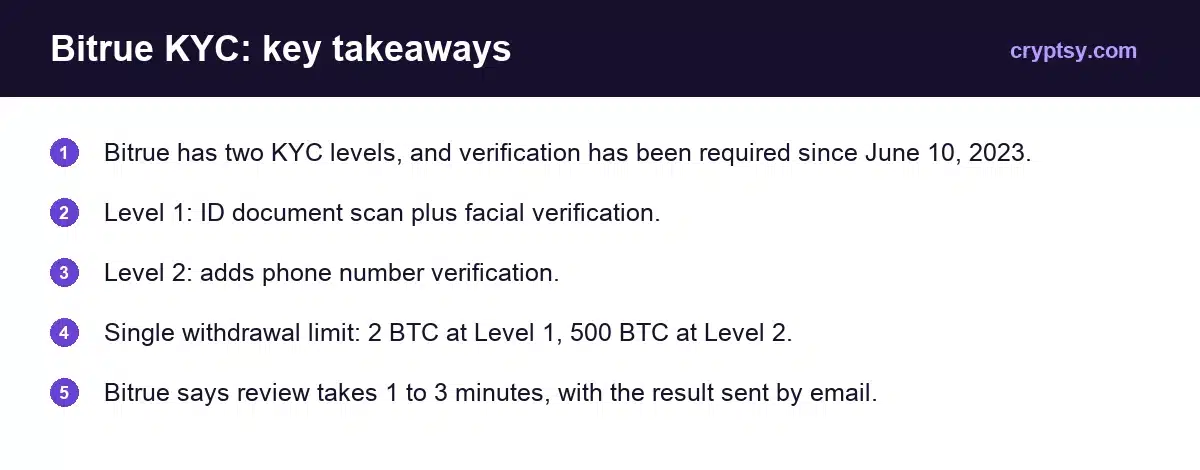
- Bitrue has two KYC levels, and verification has been required since June 10, 2023.
- Level 1: ID document scan plus facial verification.
- Level 2: adds phone number verification.
- Single withdrawal limit: 2 BTC at Level 1, 500 BTC at Level 2.
- Bitrue says review takes 1 to 3 minutes, with the result sent by email.
Bitrue KYC Levels at a Glance
| Level 1 | Level 2 | |
|---|---|---|
| What you do | Document scan (OCR) plus facial verification | Level 1, then phone number verification |
| Single withdrawal limit | 2 BTC | 500 BTC |
| Deposits and withdrawals | Yes | Yes |
| Spot and futures trading | Yes | Yes |
| Fiat currency trading | Yes | Yes |
| Lending products | Yes | Yes |
| Review time | 1 to 3 minutes | 1 to 3 minutes |
These details come from Bitrue’s KYC Optimization and Upgrade Notice. Before that upgrade, fiat trading and lending needed Level 2. Now both open at Level 1.
Note the wording: Bitrue’s limits are per withdrawal, not per day. The notice does not publish a daily cap.
Is KYC Mandatory on Bitrue?
Yes. Bitrue told users to complete KYC before 3:00 UTC on June 10, 2023, and said that failing to do so would mean being unable to use its products.
What happens to an account that never verified?
- Blocked: deposits, opening positions and other functions.
- Still allowed: withdrawals and closing positions.
So funds are not trapped. You can close out and withdraw, but you cannot keep trading.
The 2023 notice came with a small carrot: users who verified before June 2, 2023 were promised an extra 5 USDT reward. That offer is long gone, but the requirement stayed.
Bitrue also warned that separate emails might follow with product-specific instructions, so check your inbox if an older account still shows restrictions.
Which Bitrue Level Do You Need?
Level 1 is enough for most people. It opens everything: deposits, withdrawals, spot, futures, fiat and lending.
The only difference at Level 2 is size. If you ever need to send more than 2 BTC in one withdrawal, add your phone number and move up. It is one extra step, so there is little reason to skip it.
How Bitrue Compares With Other Exchanges
All three exchanges below now require identity checks. They publish their limits in different units, so compare with care.
| Exchange | Levels | Published withdrawal limit |
|---|---|---|
| Bitrue | Level 1, Level 2 | 2 BTC and 500 BTC per withdrawal |
| MEXC | Primary, Advanced | 80 BTC and 200 BTC per day |
| KuCoin | One standard verification | 999,999 USDT per 24 hours |
Bitrue’s Level 1 cap is the tightest of the three for a single transfer. Its Level 2 cap is the largest single-withdrawal figure any of them publishes.
What You Need for Bitrue KYC
Bitrue’s own KYC guide lists the basics:
- A valid government ID: passport, national identity card or driver’s license. It must be unexpired and clearly readable.
- A phone that can receive SMS codes, for mobile number verification.
- A working camera and good lighting for the photos and face scan.
Some users may also be asked for proof of address at higher verification levels, such as a bank statement or utility bill showing full name and residential address.
How to Complete Bitrue KYC
- Log in and open the account section, then select Verification or ID Verification.
- Start Level 1. Scan your identity document and complete facial verification.
- No facial verification on your device? Bitrue lets you scan a QR code and continue on a webpage instead.
- After Level 1 is approved, go straight to phone number verification for Level 2.
- Watch your email. Bitrue sends the KYC result there.
One caveat. Bitrue’s older blog guide from November 2025 describes the steps in a different order, with phone verification first and the ID upload second. The newer upgrade notice puts the ID scan and face check at Level 1. Follow whatever your verification page shows.
Why Bitrue KYC Gets Rejected
Bitrue names the usual causes: unclear images, wrong file formats, cropped photos, and a name that does not match the ID exactly.
- Use clear, unedited photos with every edge of the ID visible.
- Avoid glare, shadows and blur.
- Enter your name exactly as it appears on the document.
- Remove hats and glasses for the face scan.
- If the face scan fails, improve the lighting or clean the camera lens.
Still pending after a long wait? Contact Bitrue support with your reference details. And only upload documents on the official Bitrue website.
Does Bitrue KYC Affect Fees?
No. KYC controls access and withdrawal size, not the maker or taker rate. See our Bitrue fees guide for trading costs. If you are comparing identity checks across exchanges, our Gate.io KYC guide covers another exchange that requires verification before deposits.
Frequently Asked Questions
Is KYC mandatory on Bitrue?
Yes. Bitrue required all users to complete KYC by June 10, 2023. Accounts that did not can still withdraw and close positions, but cannot deposit or open new positions.
What is the Bitrue withdrawal limit after KYC?
Bitrue’s KYC upgrade notice sets a single withdrawal limit of 2 BTC for Level 1 verified users and 500 BTC for Level 2 verified users.
What documents do I need for Bitrue KYC?
A valid, unexpired government ID such as a passport, national identity card or driver’s license, plus a phone that can receive SMS codes. Some users may be asked for proof of address.
How long does Bitrue KYC take?
Bitrue says its streamlined review reaches a decision within 1 to 3 minutes. The result is sent by email.
What is the difference between Bitrue Level 1 and Level 2?
Level 1 uses a document scan and facial verification and opens deposits, withdrawals, trading, fiat and lending. Level 2 adds phone number verification and raises the single withdrawal limit from 2 BTC to 500 BTC.