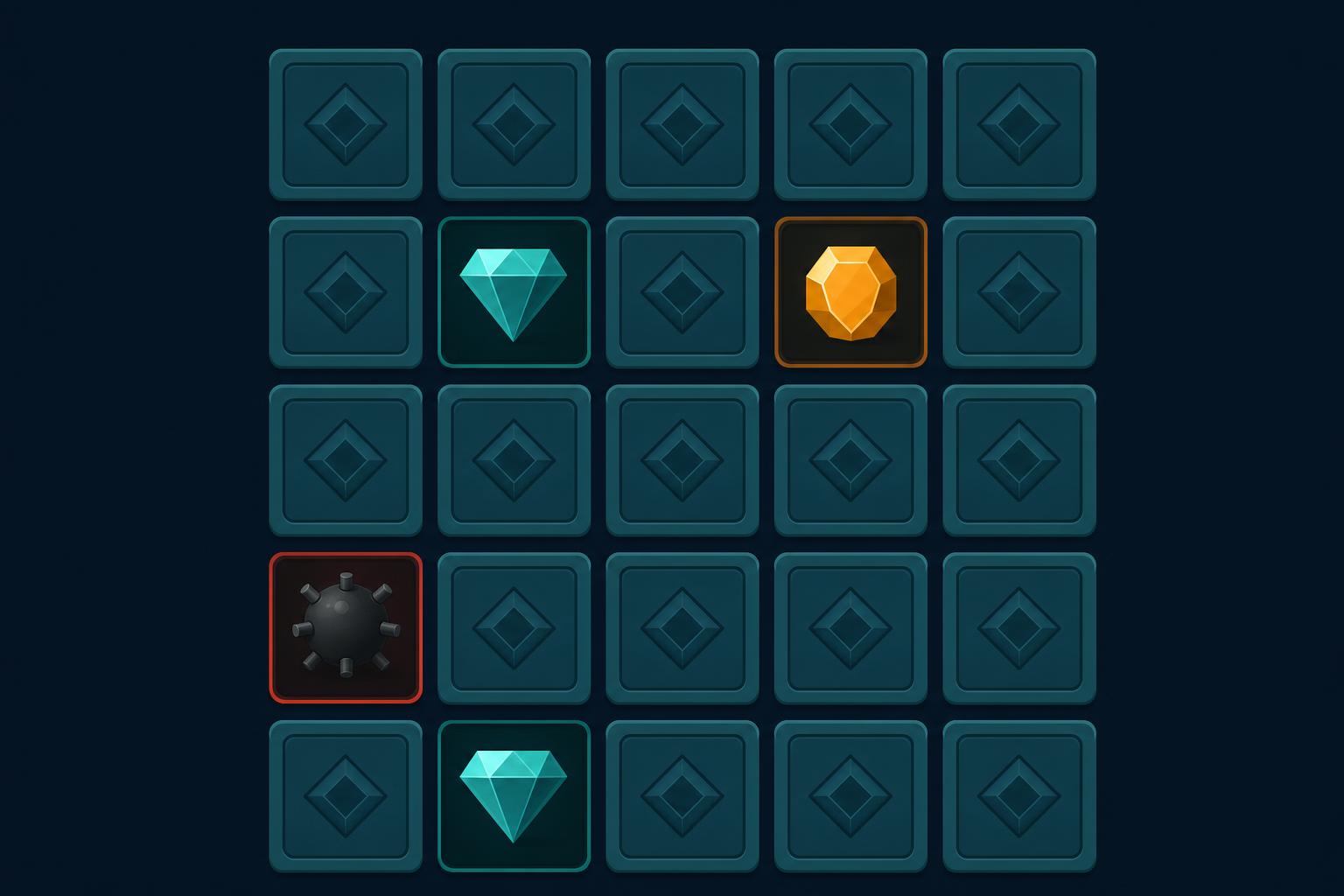


The mines format turns the familiar minesweeper puzzle into a casino game: a field of hidden tiles conceals diamonds and mines, and the round is a running decision about whether to keep revealing or stop. Searches for the format usually arrive with a casino brand attached, but the judgment that actually protects your money — understanding the game, setting limits before you play, and vetting any operator before you deposit — is the same wherever you end up playing. This guide covers those fundamentals, then points you toward the crash-game guides on this site if you want to compare formats before committing to one.
What a mines game is
Turbo Games describes its Mines title as a provably fair instant game built on the classic minesweeper idea: diamonds and mines are hidden on the field, and every safe tile you open lifts what the round could pay out. That short description captures the whole appeal. There is no bonus wheel, no paylines, no theme to learn — just a grid, a stake, and a sequence of reveals where each safe pick raises the pressure on the next one.
The details beyond that core loop vary from game to game. How a round ends, whether you can collect winnings at any point, what hitting a mine costs you, and how the field is laid out are all defined by each title’s own rules. Read the rules of the specific game in front of you rather than assuming they match another mines title you have played, and treat any third-party summary — including this one — as a starting point, not a substitute for the operator’s own documentation.
Play the demo before you stake anything
Turbo Games offers a free online demo of its Mines game, and a free mode is the right first stop for any instant game. A demo teaches you the interface, the pace of a round, and how it feels to face the keep-going-or-stop decision without money attached. What a demo cannot do is tell you anything about future results with real money on the table: it is a rehearsal for the mechanics, not a preview of outcomes. If a game you are considering has no free mode at all, weigh that in your decision — it means your first lesson in how the game behaves will be a paid one.
Strategy: control what you can, ignore what you cannot
Mines strategy conversations often drift toward tile patterns, lucky corners, and prediction tools. Be skeptical of all of it. Unless a game’s own documentation says otherwise, treat every round as independent and every tile as equally unknowable — and anyone selling signals or predictor apps for a game marketed as provably fair is asking you to pay for something the fairness model exists to rule out. What you can actually control is a short list:
- Your stake size. Decide it before the session, keep it a small share of a budget you can afford to lose entirely, and never raise it to chase back a loss.
- Your stopping point. Decide before the round how far you intend to go, and hold to it. The format is built around the temptation of another reveal; a rule you set in advance is the only counterweight you have in the moment.
- Your risk appetite per round. Pressing on after each safe tile means accepting more risk in exchange for a larger potential payout. Neither the cautious approach nor the aggressive one is inherently correct — but choose one deliberately rather than deciding tile by tile under adrenaline.
- Your session length. Instant games resolve quickly, which makes it easy to play far more rounds than intended. Set a time or round limit alongside your budget.
Reading a provably fair label
Provable fairness is a claim you should be able to act on, not just read. When a game or casino uses the label, look for an explanation of how you, the player, can verify a finished round yourself. If the operator documents a verification process and gives you the means to run it, the label carries weight. If the words appear in marketing copy with no way to check anything, treat them as decoration. This is worth settling before you deposit, because it is one of the few quality signals you can evaluate without risking money.
Alternatives: the crash-game family
If you are weighing the mines format against other instant games, the crash family is the most useful next read. This site’s guide to the Aviator crash format explains how that game’s rounds work and how to pick where to play it, and the JetX guide does the same for another title in the family. Comparing a second format before you commit to one is cheap insurance: it clarifies whether you like this specific game or instant games generally, and that answer should shape where your bankroll goes.
Choosing where to play
A list of recommended casinos is only as good as the testing behind it. Whoever’s list you read, confirm the basics yourself before depositing anywhere to play mines or any other instant game: whether the operator publishes licensing information you can verify, whether the bonus and withdrawal terms are readable and specific, whether a free or demo mode exists, and whether the fairness claims come with a way to check them. The guide to choosing a crash gambling site before you deposit walks through that vetting process in detail, and every point in it applies just as directly to a casino offering mines.
Finally, keep the frame honest: this is entertainment, not income. Set your limits before the first round, keep them, and walk away from any game — mines included — the moment it stops feeling like a choice.