Solana launchpads help cryptocurrency projects distribute tokens, raise funds, attract early supporters, or introduce digital collectibles to a community. The best platform for a project depends on its launch model: curated fundraising, permissionless token creation, meme-coin trading, or NFT distribution.
For creators who want no-code token sale tools, Smithii is worth evaluating. For curated token fundraising, Solanium is an option to investigate. For permissionless meme-coin launches, Pump.fun uses a bonding-curve model. For NFT creators, Magic Eden’s launchpad has historically focused on NFT collection launches. StarLaunch should be treated as a historical option rather than an active-launch recommendation until its operating status changes.
These platforms are not direct substitutes for one another. Some help teams conduct presales or initial DEX offerings (IDOs), while others let users create tokens that become tradable through automated market mechanisms. An NFT launchpad, meanwhile, serves a different purpose from a fungible-token fundraising platform.
This guide compares their use cases, explains how Solana token launches work, and outlines the fees, eligibility requirements, liquidity considerations, and security risks to investigate before participating.
What Are Solana Launchpads?
Solana launchpads are platforms or tools that help cryptocurrency projects create, distribute, or sell tokens on the Solana blockchain. Depending on the platform, they may provide token creation interfaces, fundraising infrastructure, investor allocation systems, community promotion, NFT minting, or mechanisms for establishing token liquidity.
Solana launchpads appeal to creators because the network supports relatively low-cost transactions and token-related applications. The network’s base transaction fee is currently specified in its documentation as 5,000 lamports per signature, although priority fees and account-creation costs can increase the total cost of an operation. See the official Solana fee documentation.
Launchpads can also give prospective buyers a structured way to discover new projects. However, access to an early token sale does not guarantee a listing, future liquidity, or a positive return.
What are the main types of Solana launchpads?
There are four useful categories to understand:
- Curated IDO and presale platforms: Review project applications and organize token sales, sometimes with staking, allowlists, or allocation rules.
- Permissionless token launch platforms: Allow users to create tokens with relatively few entry barriers, often using a bonding curve or another automated pricing mechanism.
- No-code token launch tools: Help creators configure token sales, token distribution, and liquidity-related settings without writing all the required code themselves.
- NFT launchpads: Help creators release digital collectibles or NFT collections rather than conventional fungible tokens.
The distinction matters because the level of project screening, the way investors acquire assets, and the risks involved can differ substantially.
Best Solana Launchpads in 2026: Platform Comparison
The following comparison focuses on each platform’s intended use and the checks readers should make before relying on it. It is not a performance ranking, and inclusion does not constitute an endorsement.
| Platform | Primary use case | Launch model | Important consideration |
|---|---|---|---|
| Smithii | No-code Solana token launches and presales | Creator-configured token sale tools | Review tool fees, contract behavior, and liquidity settings |
| Solanium | Curated fundraising and IDO participation | Project applications and sale-specific eligibility | Verify current sale activity and $SLIM staking requirements |
| Pump.fun | Permissionless token creation, particularly meme coins | Bonding curve followed by potential migration to PumpSwap | Low entry barriers mean little project vetting |
| Magic Eden | NFT collection launches and distribution | NFT-focused launch infrastructure | Do not assume NFT launch support means fungible-token presale support |
| StarLaunch | Historical cross-chain fundraising platform | Previously offered curated launches | Its June 2026 announcement said launchpad activity was winding down |
1. Smithii: No-Code Solana Token Launch Tools
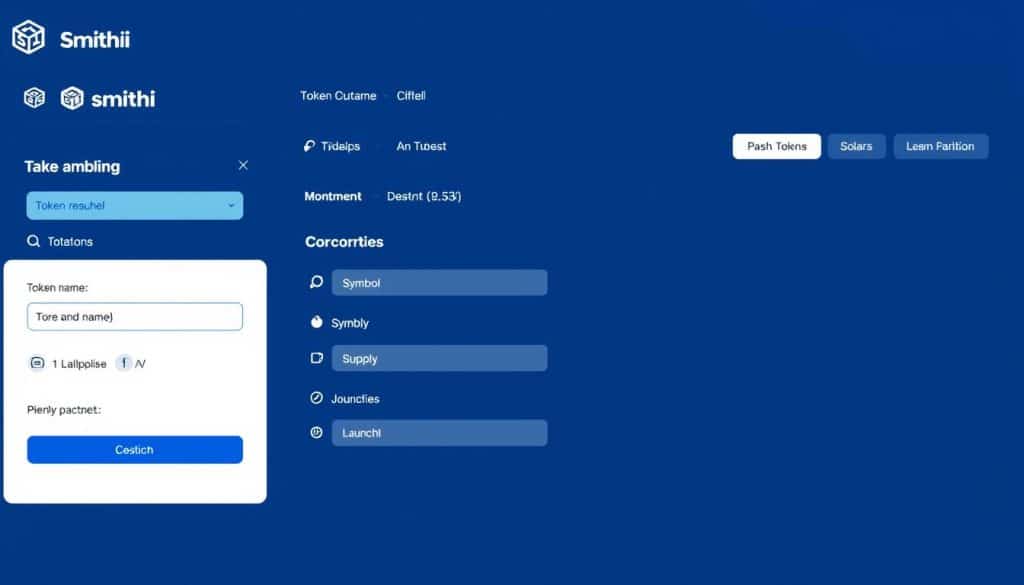
Smithii provides tools for creating and managing Solana tokens. Its documented token launchpad supports creator-configured token sales, including settings such as the payment token, sale price, whitelist, minimum and maximum purchases, liquidity allocation, and handling of unsold tokens. See the Smithii token launchpad documentation.
Smithii is worth considering for creators who want a guided workflow rather than building every launch component from scratch.
Key features to investigate
- No-code token creation and launch workflows.
- Configurable presale and token sale parameters.
- Whitelist and purchase-limit options where supported.
- Token distribution tools.
- Liquidity-related configuration.
- Documentation describing supported contracts and tools.
Potential advantages
- Accessible to creators without extensive smart contract development experience.
- Offers several token-management tools within one ecosystem.
- Lets creators configure important sale parameters before launching.
Limitations and risks
- Using a no-code interface does not eliminate smart contract or configuration risks.
- A token sale tool does not automatically provide a reputable investor community.
- Creators still need to plan tokenomics, liquidity, communications, and ongoing development.
- Tool fees, network fees, account costs, and liquidity requirements must be evaluated separately.
Best suited for: Creators who need a guided way to configure a Solana token sale and manage related launch tasks.
Before using Smithii, check the current price shown by the tool, inspect the contract documentation, and independently verify any audit claims.
Explore Smithii’s Solana token launch tools.
2. Solanium: Curated IDO and Fundraising Platform
Solanium is a fundraising platform that has offered token sales, staking, and community participation features. Its documentation describes a Solana-based platform with decentralized fundraising and governance-related functionality, while its current website describes a multichain launchpad.
Solanium is a candidate for users interested in curated token sales rather than simply creating a freely tradable token. However, its suitability depends on whether it has active offerings and whether a particular user meets the relevant sale requirements.
Key features to investigate
- Project applications and fundraising launches.
- $SLIM staking and sale-specific participation requirements.
- Project announcements and sale documentation.
- Allocation rules and contribution limits.
- Token distribution and vesting terms where applicable.
Potential advantages
- A fundraising-oriented model can provide more structure than a permissionless token launch.
- Project applications can introduce an additional review step.
- Sale documentation can help participants understand allocation and eligibility rules.
Limitations and risks
- Platform screening does not guarantee project legitimacy or future performance.
- Staking requirements may introduce token-price risk and opportunity costs.
- Allocation rules may change between sales.
- The existence of a platform does not mean that an active sale is available.
Best suited for: Users researching curated IDOs who are willing to check current offerings, staking requirements, and sale terms.
Before acquiring $SLIM for participation, calculate the full cost of acquiring and staking it, read the relevant rules, and confirm whether an upcoming sale actually exists.
Explore Solanium and its official documentation.
3. Pump.fun: Permissionless Meme-Coin Launches
Pump.fun is a token launch and trading platform associated with Solana meme coins. Its bonding-curve mechanism allows a newly created coin to be bought and sold according to a pricing function tied to the curve’s reserves.
According to Pump.fun’s bonding-curve documentation, a coin can graduate from its bonding curve to PumpSwap when it reaches the required threshold. The migration mechanism is automatic under the documented conditions.
This differs from a conventional IDO. Rather than requiring every token to pass through a curated presale, Pump.fun is designed to make token creation and early trading accessible.
Key features
- Permissionless token creation.
- Automated bonding-curve pricing.
- Trading during the initial launch phase.
- Potential migration to PumpSwap.
- A relatively low barrier to creating a token.
Potential advantages
- A creator can launch without going through a conventional curated IDO process.
- Buyers can observe trading activity from the early stage.
- Automated pricing and migration rules can reduce some manual launch steps.
Limitations and risks
- Permissionless access does not establish that a project is legitimate.
- A bonding curve is a pricing mechanism, not a guarantee of liquidity at a favorable price.
- Large trades can have substantial price impact.
- Tokens may lose most or all of their market value.
- Trading volume, social-media attention, and apparent popularity are not proof of sustainable demand.
Best suited for: Users researching permissionless meme-coin creation and early-stage token trading who understand the associated volatility and technical risks.
Review the current Pump.fun documentation and fee schedule before trading. Fees and launch mechanics can change.
4. Magic Eden: NFT Launches and Digital Collectibles
Magic Eden is known for its NFT marketplace and NFT-related creator infrastructure. Solana’s own NFT documentation describes Magic Eden’s launchpad as a product intended to help creators mint collections without requiring extensive technical knowledge.
For NFT creators, a launchpad may support collection distribution and help reach potential collectors. This use case should be distinguished from selling a fungible cryptocurrency token through an IDO.
Key features to verify
- Current NFT launch and minting support.
- Collection eligibility and application requirements.
- Creator fees and minting terms.
- Supported collection standards and wallet compatibility.
- Post-launch marketplace and collection-management features.
Potential advantages
- A recognizable NFT marketplace can provide a discovery channel for collections.
- NFT-specific tooling addresses different needs from token presale software.
- Existing marketplace infrastructure may help creators manage collection distribution.
Limitations and risks
- Marketplace visibility does not guarantee demand for a collection.
- NFT prices and liquidity can fluctuate sharply.
- Creator acceptance and launch services may change over time.
- Do not assume that historical multichain support or previous launch features remain available.
Best suited for: NFT artists, digital collectible creators, and teams launching collections rather than conventional fungible-token presales.
Confirm the current product offering and launch availability directly through Magic Eden.
5. StarLaunch: Verify Its Current Operating Status
StarLaunch historically operated as a curated, cross-chain fundraising platform with an association with the Solana ecosystem. Its earlier model included project launches and mechanisms designed to structure participation.
However, StarLaunch announced in June 2026 that it was winding down its launchpad activity, including new IDOs, node sales, and launches. See the platform’s announcement on its current status.
For that reason, it should not be presented as an ordinary active launchpad recommendation without newer primary-source evidence showing that its launch services have resumed.
If researching StarLaunch for historical comparisons, examine archived sale records, previous project documentation, and the terms of any existing token or staking arrangements. Do not infer that an older launch schedule, feature, or token utility remains operational.
Best suited for: Historical research into Solana and cross-chain fundraising models, rather than assuming new launches are available.
Check StarLaunch’s official website and its latest announcements for any subsequent status changes.
Which Solana launchpad is best for your needs?
The right choice depends on what you want to accomplish.
- Creating a token sale without building all the tooling yourself: Start by evaluating Smithii’s documented features and costs.
- Participating in curated fundraising: Investigate Solanium’s current sale calendar and eligibility requirements.
- Creating or trading a permissionless meme coin: Understand Pump.fun’s bonding curve, fee structure, and migration process.
- Launching an NFT collection: Investigate Magic Eden’s currently supported creator services.
- Considering StarLaunch: Verify its operating status before taking any action.
There is no universally best Solana launchpad. A useful comparison should evaluate actual functionality, current availability, total costs, security controls, and the project’s suitability for the platform.
How Do Solana Launchpads Work?
Solana launchpads use different processes, but a typical fundraising launch follows several stages.
- Project preparation: The team defines the product, token supply, tokenomics, roadmap, intended utility, and fundraising goals.
- Platform selection and application: The team chooses a suitable platform and submits any required application or documentation.
- Technical preparation: The token and relevant contracts or launch programs are configured and tested.
- Sale terms and eligibility: The platform or project defines pricing, allocation, purchase limits, vesting, and any whitelist, staking, or identity-verification requirements.
- Community outreach: The team publishes project information, communicates risks, and explains the sale.
- Token distribution: Eligible participants contribute funds or acquire tokens according to the published rules.
- Liquidity and trading: Depending on the model, the token may enter a decentralized exchange pool, trade on a bonding curve, or follow another distribution mechanism.
- Post-launch development: The project team continues building, communicating with holders, and managing its stated commitments.
Not every platform uses all these stages. Permissionless launch platforms, for example, may allow a token to become tradable without a conventional application, whitelist, or curated sale.
What is the difference between an IDO and a bonding-curve launch?
An initial DEX offering (IDO) generally refers to a token sale organized around fundraising and distribution, with the token intended to trade on a decentralized exchange or associated market. The exact rules vary by platform.
A bonding-curve launch uses a mathematical pricing mechanism in which the price changes according to the curve’s state and trading activity. On Pump.fun, the documented mechanism supports trading before a coin graduates to PumpSwap.
The main differences are the launch process, price discovery, eligibility, and how the initial market is established.
| Factor | Curated IDO | Bonding-curve launch |
|---|---|---|
| Project screening | May include an application and review | May be permissionless |
| Initial acquisition | Sale-specific terms and allocation | Purchases and sales follow curve mechanics |
| Eligibility | May require staking, registration, or KYC | Depends on platform rules and applicable restrictions |
| Pricing | May be set or determined by sale terms | Changes according to the bonding curve |
| Liquidity | Depends on the sale and liquidity plan | May begin with the curve and transition to a pool |
| Main concern | Allocation, vesting, project execution, and sale terms | Volatility, price impact, concentration, and project quality |
Neither model inherently guarantees fair distribution, investor protection, or successful price performance.
How to Choose a Solana Launchpad
Choosing a platform requires more than comparing popularity or the number of tokens launched. Evaluate the following factors against your own goals.
1. Define your launch objective
Creators should decide whether they need a token sale, a permissionless launch, an NFT mint, or tools for distributing an existing token.
Investors should decide whether they are comfortable with a curated sale, a bonding-curve launch, or a highly speculative token with little project history.
2. Check platform activity
Review the current launch calendar, recent completed sales, official announcements, and evidence of actual platform activity.
A platform’s historical reputation is not proof that it currently supports new launches. Likewise, a large number of token creations does not necessarily mean a high number of successful projects.
3. Compare total costs
Calculate the full cost of participation or launch, not just the advertised entry fee. Include platform charges, network fees, token-account creation, staking capital, sale contributions, liquidity commitments, and any applicable taxes.
4. Examine project screening and transparency
For curated sales, look for published eligibility rules, disclosures, team information, token allocation, and a clear description of the review process.
For permissionless launches, assume that you may need to perform most of the research yourself.
5. Understand tokenomics
Review the total supply, circulating supply, team and investor allocations, vesting schedules, treasury arrangements, mint authority, and any other privileges embedded in the token or related contracts.
Large insider allocations, unclear vesting, or concentrated ownership can create material risks for other holders.
6. Inspect liquidity arrangements
Understand how initial liquidity is created, who controls it, whether any lock or vesting conditions apply, and what happens if the project fails to attract buyers.
A liquidity lock does not automatically prevent every type of fraud, and the existence of a trading pool does not mean you can sell a large position at the displayed price.
7. Assess the technical and operational risks
Review independent audit reports where available, contract addresses, security documentation, administrative permissions, and incident history.
An audit is evidence of a review of a particular scope and version. It is not a blanket guarantee that the entire platform or project is safe.
How to Launch a Token on Solana
A creator who wants to launch a token should prepare the project before selecting a tool.
Step 1: Define the token’s purpose
Explain why the token exists, who it is for, and what function it performs. Avoid promising guaranteed returns or implying that a token will appreciate simply because it has a limited supply.
Step 2: Prepare tokenomics and documentation
Document the intended total supply, initial distribution, team allocation, vesting, treasury, token utility, and plans for liquidity.
A useful project document should clearly distinguish existing functionality from features that are only planned.
Step 3: Select the launch model
Decide whether a no-code token sale, curated IDO, permissionless launch, or NFT launch is appropriate. Compare platform availability, requirements, costs, and technical limitations.
Step 4: Configure and test the token
Use the relevant platform documentation to configure token parameters and any launch contracts. Test the workflow before accepting public contributions, and confirm who controls minting, freezing, metadata updates, and other administrative privileges.
Step 5: Establish transparent sale terms
Publish the sale price or pricing mechanism, purchase limits, contribution rules, token distribution schedule, liquidity plan, fees, and refund conditions, if any.
Do not describe a sale as guaranteed, risk-free, or fair without explaining exactly what those terms mean.
Step 6: Conduct security and compliance checks
Review contract security, wallet permissions, applicable legal requirements, and any necessary identity-verification procedures. Requirements vary by jurisdiction and by the type of asset or offering.
Step 7: Launch and maintain the project
After launch, communicate regularly, publish progress against the roadmap, explain any material changes, and manage liquidity and token distribution according to the disclosed terms.
Important: Creating a token is not the same as building a viable project. A successful launch also requires a credible purpose, transparent governance, ongoing development, and a sustainable community.
How to Participate in a Solana Token Launch
Investors and collectors should approach every new launch as an independent research decision.
Step 1: Set up a compatible wallet
Use a reputable wallet that supports Solana assets, such as Phantom, Solflare, or Backpack. Download it from the provider’s official website or verified application listing.
Secure the recovery phrase offline. Never share it with a launchpad, project team, support agent, or anyone claiming they need it to verify your account.
Step 2: Verify the platform and token
Use official project announcements to locate the correct website and token mint address. Check that the mint address matches the project documentation rather than relying on a token name, ticker, logo, or social-media post.
Step 3: Read the sale rules
Check eligibility, contribution limits, accepted assets, fees, vesting, claim dates, and any restrictions on transferring or selling the token.
If a platform requires staking, calculate the capital required and consider the risk of the staking token losing value.
Step 4: Research the project
Read the documentation, investigate the team and product, review tokenomics, and check contract permissions and holder concentration where reliable data is available.
Ask what evidence supports the project’s claimed use case and whether its roadmap is realistic.
Step 5: Understand what happens after the sale
Find out how tokens are distributed, whether they are subject to vesting, how liquidity is established, and whether the token has a confirmed market where it can be traded.
Never assume that an IDO or token launch guarantees a major exchange listing.
Step 6: Set a risk limit
Only commit funds you can afford to lose. Avoid borrowing to participate or buying solely because of social-media hype, influencer promotion, or fear of missing out.
Security tip
Before signing a transaction, inspect the wallet prompt carefully. A legitimate-looking website can still request an unexpected approval or transfer. If a transaction’s purpose is unclear, reject it and verify the instructions through the platform’s official documentation.
Solana Launchpad Fees, Tokenomics, and Liquidity
The cost of a Solana launch can include several separate components. Confusing them can cause creators to underestimate launch budgets and buyers to overlook the cost of participation.
What fees should you expect?
| Cost category | What it covers | What to verify |
|---|---|---|
| Network fees | Processing transactions on Solana | Base and optional priority fees |
| Token-account costs | Creating accounts needed to hold assets | Whether new accounts are required and whether deposits are recoverable |
| Platform fees | Using a launchpad or token creation tool | Current published pricing |
| Staking capital | Acquiring or locking a platform token | Lock duration, sale eligibility, and price volatility |
| Sale contribution | Funds committed to a token sale | Minimums, maximums, and refund terms |
| Liquidity allocation | Assets committed to support trading | Amount, control, lock conditions, and withdrawal rules |
| Trading costs | Fees and price impact when buying or selling | Platform fee schedule, slippage, and pool depth |