The Binance hack on October 29, 2026 drained an estimated $5.3 billion to $5.9 billion in crypto from the world’s biggest exchange. Deposits and withdrawals are frozen for now. If you move casino bankroll through Binance, here is what that means for you today.
Short version: your Binance balance is stuck until the exchange reopens transfers. Binance says it will cover every loss. And if you play from the US on Binance.US, you are not affected.
Binance Hack: The Key Facts for Crypto Players
- When: Thursday, October 29, 2026. Binance confirmed a security incident that afternoon, US time.
- How much: Chainalysis put the theft near $5.9 billion. Glassnode tallied about $5.3 billion in outflows. Binance has not confirmed a final figure.
- Frozen so far: about $3 billion, including more than 1.567 billion USDT frozen by Tether and over 800 million USDC frozen by Circle.
- Transfers: deposits and withdrawals are temporarily suspended. No restart date yet.
- Losses: Binance says it will cover them with its SAFU fund and company funds.
If those estimates hold, this is the largest crypto theft ever recorded, well above the roughly $1.5 billion taken from Bybit in February 2025. CoinDesk has the running figures.
What the Binance Hack Means for Your Casino Bankroll
Most crypto players use an exchange as the bridge. You buy coins there, send them to a gaming account, and send winnings back to cash out. With Binance paused, that bridge is down in both directions.
Funding a gaming account from Binance
You cannot withdraw from Binance right now. Coins sitting in your Binance wallet stay there until the exchange lifts the pause. Plan your play around that. Anything you already moved to your gaming account or a personal wallet is untouched.
Cashing out winnings to Binance
Hold off. Deposits are suspended too, so a cashout sent to your Binance deposit address could sit in limbo. Send winnings to a self-custody wallet you control instead, or wait for Binance to announce that deposits are back.
Watch for fake Binance messages
Big hacks bring a wave of phishing. Binance told users to ignore unofficial links, messages and requests for account details. Fake “refund” or “verify your account” emails are the classic follow-up. Our guide to spotting crypto scams covers the warning signs.
How the Binance Hack Happened
Binance’s first findings point to a hacked laptop belonging to a DevOps engineer. The attacker reportedly used it to reach an internal service and push through unauthorized withdrawals. Binance says it found no sign that wallet private keys were exposed.
Blockchain intelligence firm TRM Labs tied the attack to TraderTraitor, a North Korean group, with high confidence. Investigator ZachXBT named the Lazarus Group as the likely attacker. These are analyst findings. Nobody has been officially charged.
Where the Binance hack funds sit now
You can watch the stolen coins move on-chain. Blockchain tracker Arkham Intelligence groups the attacker’s addresses into one entity, labelled binance-hacker-1029. When we checked it early on October 30 (UTC), it showed about $5.79 billion spread across 71 addresses, mostly USDT, bitcoin, ether and USDC.
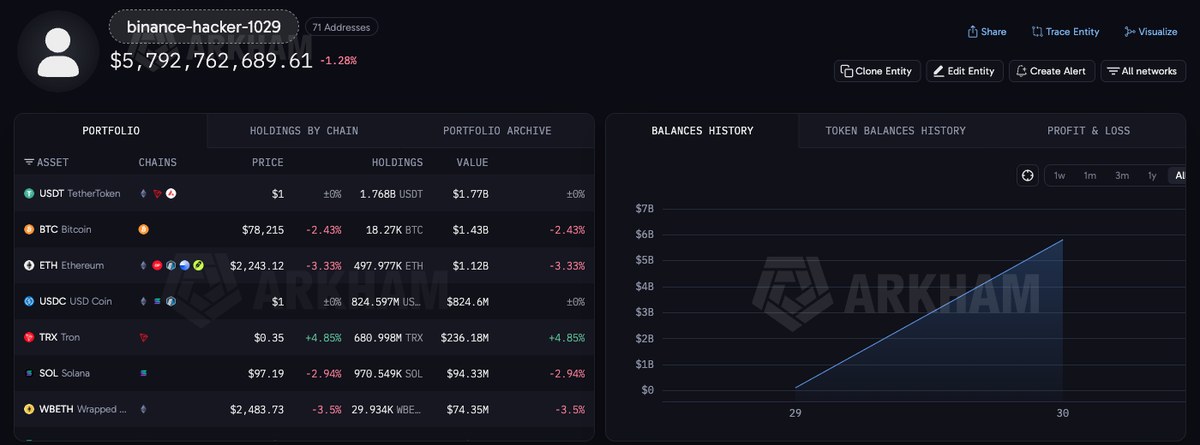
The balance is not standing still. Part of it is already frozen by Tether and Circle, and Arkham data shows some of the funds moving through Uniswap, CoinDesk reported.
Binance Hack and US Players on Binance.US
Binance.US runs separately from Binance.com. It said customer funds and services are secure and operating normally, The Block reported. US customers can keep using it as usual. If you are new to it, see our breakdown of Binance.US fees.
Crypto Prices After the Binance Hack
The market took a hit. Bitcoin fell 4.8% to below $77,000, ether dropped 5.7%, and BNB, Binance’s own token, slid 8%, according to CoinDesk. Stablecoins held their dollar peg. If you keep a gaming bankroll in BTC or ETH, it is worth less in dollar terms than it was before the hack.
What Comes Next After the Binance Hack
Binance has promised a full post-mortem once its investigation ends, and that report should settle the final loss figure. The frozen total may still grow as Binance works with law enforcement and stablecoin issuers. Until withdrawals restart, follow only Binance’s official app, website and X accounts for updates. We will update this story as new facts are confirmed.
Binance founder Changpeng Zhao, who no longer runs the exchange but is still its biggest shareholder, backed the pledge: “as a shareholder, I expect all user funds will be fully covered.”

Play responsibly. Real-money online casinos in the US are for players 21 and over. If gambling stops being fun, call 1-800-MY-RESET for free, confidential help from the National Council on Problem Gambling.
Binance Hack FAQ
Was Binance really hacked?
Yes. Binance confirmed a security incident on October 29, 2026, and co-founder Yi He said the exchange will cover all hacking losses. A final loss figure has not been published yet.
How much crypto was stolen from Binance?
Analyst estimates sit between about $5.3 billion and $5.9 billion. Binance’s own first estimate of the total impact was about $6.3 billion, according to CoinDesk. The number may still change.
Can I withdraw casino winnings to Binance right now?
Not safely. Binance has paused deposits and withdrawals while it investigates, so crypto sent to a Binance deposit address may sit unavailable. Wait until Binance confirms on its official channels that deposits are open again.
Is Binance.US affected by the hack?
No. Binance.US said it is a separate, independent platform and that customer funds and services are operating normally.
Will Binance users get their money back?
Binance says user funds are safe and that it will cover losses with its SAFU emergency fund and company money. About $3 billion of the stolen crypto has already been frozen.
Sources
- CoinDesk, Binance hack coverage, October 29, 2026
- The Block, Binance investigating hack, October 29, 2026
- TechCrunch, Binance pauses withdrawals, October 29, 2026
- AFP via Yahoo Finance, Binance confirms major hack, October 30, 2026
- Bitcoin.com News, What is confirmed and what is not, October 29, 2026
Figures as of 03:30 UTC, October 30, 2026.