Solana Mila Coin is a name used for Solana-based crypto tokens, but the name alone does not uniquely identify one asset. Multiple tokens using MILA, Mila, or Mila Solana branding appear in crypto-data and block-explorer sources. That means the most important step before buying is to identify the exact Solana token mint/contract address rather than relying on the name or ticker.
Some secondary crypto sources describe a Mila Solana project as an AI-integrated platform focused on areas such as automated trading, market analysis, and risk management. However, those descriptions should be treated as project claims or secondary-source descriptions unless the specific token, product, code, and development team can be independently verified. Gate, for example, describes Mila Solana as a Solana-based platform that incorporates AI rather than as an AI system itself.
This distinction matters because Solana provides the underlying blockchain infrastructure; it does not automatically mean that every token launched on Solana has Solana-level adoption, security, liquidity, or utility.
What is Solana Mila Coin?
Solana Mila Coin generally refers to a token marketed under the Mila/MILA/Solana branding and associated with the Solana ecosystem. The precise identity of the asset must be established from its mint address.
A Solana token is represented on-chain by a unique address. Its name and ticker are metadata and are not sufficient proof of authenticity. Current crypto-data sources demonstrate the problem: Solscan lists more than one token using the “Mila Solana” name, while Solflare separately lists a token called Mila Coin (MILA) with its own mint address and an unverified status.
Therefore, there is no safe universal “Mila Solana contract address” that should be copied from a generic search result. Verify the address against the project’s official channels and an independent Solana block explorer before trading.
Why does the contract address matter?
The contract, more precisely the token mint address on Solana, uniquely identifies the token you are interacting with.
For example, crypto-data sources currently show different Solana assets using Mila-related branding. Solflare identifies a Mila Coin (MILA) token at one address, while Solscan has separate token pages for assets named Mila Solana. This means searching for “MILA” and buying the first result can result in purchasing a completely different asset.
Is Mila Solana an AI project?
Mila Solana is described by some secondary sources as a Solana-based crypto project that incorporates AI-related tools, but the available evidence does not establish that the token itself is an AI technology or that every token using the Mila name belongs to that project.
Gate’s published explanations describe Mila Solana as a blockchain-based platform integrating AI for functions such as trading analysis, automated trading, predictive analytics, and risk-management tools.
The distinction is important:
- Solana is the underlying blockchain network.
- Mila/MILA refers to a project or token using the Mila branding.
- AI integration refers to claimed applications or tools built around the project.
- The token itself is not automatically an AI model.
- Running on Solana does not mean a token inherits Solana’s entire ecosystem or network-level utility.
AI-related marketing should also be separated from measurable functionality. A claim that a project uses AI does not by itself establish that its models are proprietary, independently tested, profitable, or capable of predicting cryptocurrency prices.
What does Solana provide to Mila Solana?
If the relevant Mila token is issued on Solana, it benefits from the infrastructure of the Solana network rather than operating its own independent blockchain.
Solana’s architecture uses accounts and programs, with transactions invoking on-chain programs to modify state. Solana describes programs as its equivalent of smart contracts, while the SPL ecosystem provides programs and standards for tokens. The practical implications are:
- The token uses Solana’s network for transaction processing.
- Users normally need SOL to pay Solana transaction fees.
- Solana-compatible wallets can generally interact with Solana tokens.
- Solana’s network infrastructure does not guarantee a particular token’s liquidity or legitimacy.
- A token’s own functionality depends on its deployed programs, token configuration, liquidity, applications, and adoption.
Solana’s current documentation describes a base transaction fee plus an optional prioritization fee.
Solana Mila Coin price and market performance
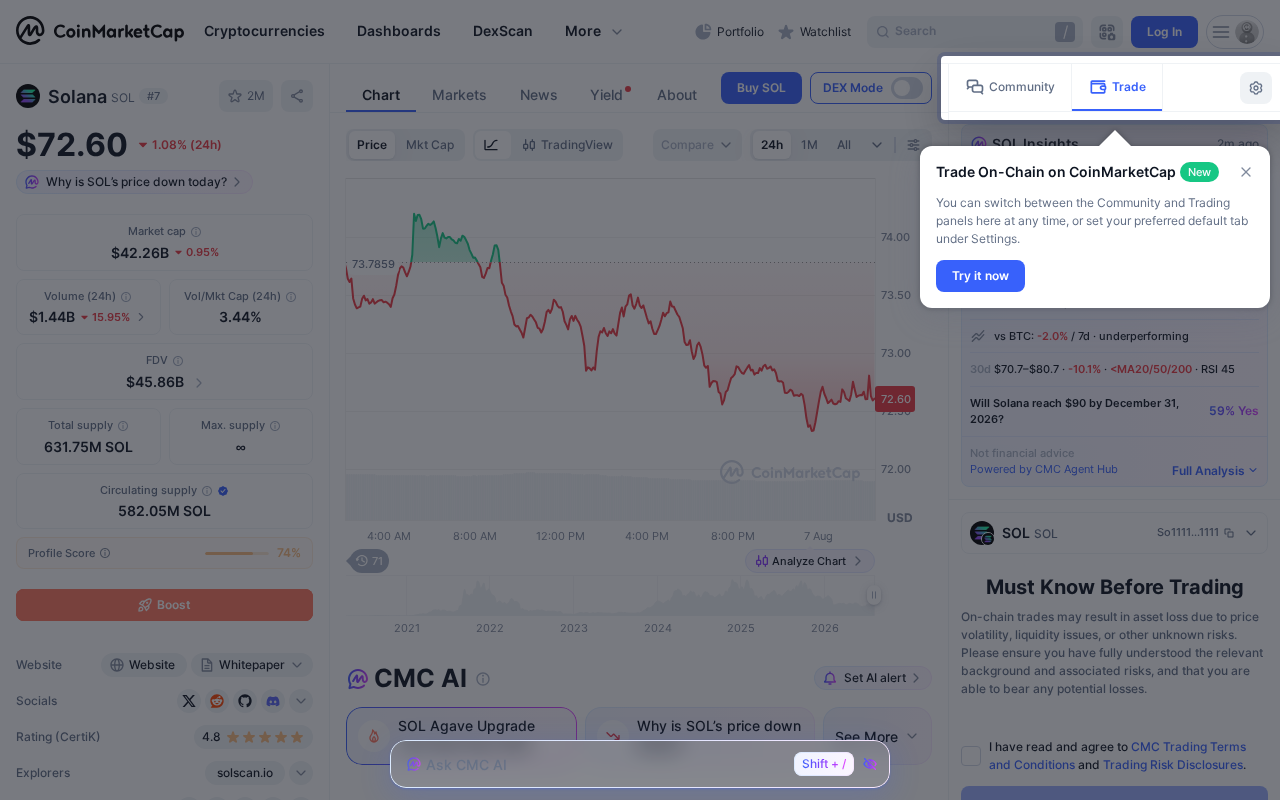
There is no single reliable price for “Solana Mila Coin” without identifying the exact token mint address.
This is one of the most important facts to understand when researching MILA. Different tokens can have the same or similar names, symbols, and branding. Consequently, a price displayed for one Mila token may have nothing to do with another Mila Solana token.
For example, Solflare currently lists a Mila Coin (MILA) asset and reports insufficient price information because of very low liquidity, while other data providers list separate Mila-branded Solana assets. Before using a quoted MILA price, check:
- Blockchain: Is the asset actually on Solana?
- Mint address: Does it match the address published by the project?
- Ticker and name: Do they match, while recognizing that these fields can be duplicated?
- Liquidity: Can a meaningful order actually be executed?
- Trading volume: Is the reported volume associated with the same mint?
- Holder distribution: Are a few wallets controlling most of the supply?
- DEX liquidity: Is sufficient liquidity available for both buying and selling?
- Source: Is the data coming from an established market-data provider or directly from an on-chain source?
Why market cap can be misleading for small Solana tokens
A token can display a seemingly attractive market capitalization while having very little actual liquidity. Market capitalization is generally calculated as:
Market cap = token price × circulating supply
That number does not tell you how much money could actually be withdrawn from the market at the quoted price.
For a thinly traded token, attempting to sell a large position can move the price substantially. This is why liquidity, trading volume, holder concentration, and market depth should be considered alongside market capitalization.
What are the technical specifications of Solana Mila Coin?
The token’s technical specifications depend on the exact Mila asset being researched. The safest approach is to inspect the token’s on-chain data rather than copy specifications from similarly named websites.
Solana consensus and Proof of History
Solana uses Proof of Stake and Proof of History as components of its network design. Proof of History provides a cryptographic mechanism for establishing the ordering and passage of time between events. This is a property of Solana itself, not a proprietary consensus mechanism invented by an individual Mila token.
Transaction fees
Solana transactions require SOL for network fees under the normal transaction model. Solana’s current documentation describes a base fee and optional prioritization fees.
Consequently, describing Mila as a “low-fee token” should be understood primarily as a statement about operating on Solana’s infrastructure, unless the Mila project has implemented additional fee mechanisms of its own.
What are the claimed use cases of Mila Solana?
Descriptions of the Mila Solana project associate it with AI-enabled crypto trading and market-analysis functionality. Broader descriptions also mention DeFi and other blockchain applications. These claims should be separated into network capabilities and Mila-specific capabilities.
| Area | What Solana provides | What must be verified about Mila |
|---|---|---|
| Token transfers | Solana token infrastructure | Whether Mila has meaningful payment adoption |
| Smart contracts | Solana programs | Whether Mila operates its own useful applications |
| DeFi | DEXs, lending and other protocols exist on Solana | Whether the specific Mila token has meaningful DeFi utility |
| AI tools | Not a property of every Solana token | Whether Mila has functioning, independently verifiable AI products |
| Trading | Solana supports on-chain markets | Whether Mila provides genuine trading technology |
| Tokenization | Solana can support tokenized assets | Whether Mila has a real tokenization application |
| Community | Solana has a large ecosystem | Whether Mila has active, authentic adoption |
Solana’s official DeFi documentation describes its ecosystem as supporting DEXs, lending markets, oracles and other financial applications. That does not mean every Solana token automatically provides those services.
How to verify the Solana Mila Coin contract address
Before buying any Mila Solana token, use a repeatable verification process.
Step 1: Find the project’s official source
Locate the project’s official website or verified social account and identify the published token mint address.
Do not rely solely on:
- Search-engine snippets
- Telegram messages
- Influencer posts
- DEX search suggestions
- User comments
- A token name or ticker
- An unaffiliated “official contract” page
Step 2: Compare the address character by character
Paste the address into a reputable Solana block explorer such as Solscan.
The explorer should show the same token, mint, transactions and associated on-chain activity you expect. Solscan provides token pages that allow users to inspect Solana token activity.
Step 3: Check the token’s verification status
A token can exist on-chain without being verified by a wallet, token registry, or data provider. Solflare, for example, currently labels the Mila Coin (MILA) asset it lists as not verified and warns that its risk scanner has identified potential concerns.
Verification is not proof that a token will increase in value, but the absence of verification is an additional reason to perform careful due diligence.
Step 4: Inspect holders and liquidity
Look for:
- Number of holders
- Largest wallet balances
- Liquidity-pool size
- Liquidity-provider concentration
- Recent buy/sell activity
- Token mint and freeze authorities where applicable
- Whether liquidity appears locked or removable
- Whether the project has meaningful organic usage
Step 5: Perform a small test transaction if you proceed
If you decide to trade despite the risks, verify the receiving token after the transaction. Do not assume that a successful transaction proves you purchased the intended asset.
How to buy Solana Mila Coin
The basic process for purchasing a verified Solana token is:
- Set up a Solana-compatible wallet.
- Fund the wallet with SOL.
- Verify the exact Mila token mint address.
- Use a Solana-supported exchange or DEX.
- Confirm the token address and trading pair before signing.
- Review the expected price impact and liquidity.
- Execute the swap only after checking the transaction details.
- Confirm the resulting token balance in your wallet.
Wallets such as Phantom and Solflare are commonly used across the Solana ecosystem, but wallet compatibility does not establish that a particular MILA token is legitimate. The transaction fee is paid through Solana’s fee mechanism, normally using SOL.
What should you check before swapping?
Before signing a transaction, check:
- Correct token mint
- Correct network
- Correct trading pair
- Expected amount received
- Price impact
- Slippage settings
- Liquidity
- Token permissions and authorities where relevant
- DEX reputation
- Wallet transaction details
Never approve a wallet transaction simply because a website labels the button “Buy MILA.”
What are the risks of Solana Mila Coin?
The main risks are not limited to cryptocurrency price volatility. Token-identification risk is especially important for Mila-related searches because multiple assets use similar names.
1. Multiple tokens can share the same name
Current public data demonstrates that multiple Solana assets can appear under Mila-related names. This makes the token mint address more important than the name.
2. Low liquidity
Solflare currently reports insufficient price information and very low liquidity for the Mila Coin (MILA) asset on its platform. Low liquidity can make it difficult to enter or exit a position without significant price impact.
3. Holder concentration
Solflare’s risk information for its listed Mila Coin asset identifies substantial concentration among a small number of wallets. Concentrated ownership can create additional market and governance risks because large holders may have the ability to influence supply and price.
4. Unverified project claims
Claims about a development team, partnerships, AI technology, trading systems, or future products should be independently verified. A project’s own website can establish what the project claims. It does not independently prove that the claim is accurate.
5. AI marketing risk
AI terminology is increasingly common in cryptocurrency marketing. An “AI-powered” label does not establish:
- Proprietary machine-learning technology
- Predictive accuracy
- Profitable trading
- Independent audits
- Institutional adoption
- Guaranteed returns
Any claim that an AI system can reliably guarantee cryptocurrency profits deserves particular scrutiny.
6. Smart-contract and wallet risk
Solana-based tokens can involve risks arising from token configuration, associated programs, liquidity pools, wallet approvals, or other smart-contract interactions. Users should inspect the actual on-chain implementation where possible rather than assuming that being issued on Solana makes a token safe.
Is Solana Mila Coin the same as every MILA token?
No. A ticker such as MILA is not sufficient to identify a cryptocurrency.
Public blockchain ecosystems can contain multiple tokens with identical or similar names and symbols. Current data provides concrete examples of different assets carrying Mila-related names and different mint addresses.
This also explains why different websites can show completely different prices, market caps, supplies, or descriptions for “MILA.” When comparing two listings, compare their mint addresses first.
How to research the Solana Mila development team
A development team is easier to evaluate when claims can be connected to independently verifiable evidence.
Check:
- Named founders and developers
- Professional history
- Public GitHub activity
- Smart-contract deployment history
- Technical documentation
- Audits
- Product demonstrations
- On-chain activity
- Verified partnership announcements
- Corporate registrations where relevant
- Consistency between public claims and blockchain activity
Avoid treating anonymous or pseudonymous team members as automatically fraudulent. At the same time, anonymity means that traditional background checks may be limited.
The strongest evidence is generally not a biography on a project website but verifiable work and on-chain activity that correspond to the project’s claims.
How should Mila Solana partnerships be verified?
A partnership should ideally be confirmed by both parties.
For example, if Mila claims to have partnered with a wallet, exchange, technology company, or blockchain project:
- Find the announcement on Mila’s official channel.
- Find the corresponding announcement on the alleged partner’s official channel.
- Check whether the announcement describes an actual integration, investment, technical collaboration, listing, or something less substantial.
- Check whether the partnership is still active.
- Look for evidence that the announced product or integration actually exists.
A logo appearing on a website is not equivalent to a commercial or technical partnership.
Solana Mila Coin vs. Solana itself
These should not be treated as the same investment or technology.
| Solana | Mila Solana token/project |
|---|---|
| Layer-1 blockchain network | Token/project operating within the Solana ecosystem |
| Has its own validators and network infrastructure | Generally relies on Solana’s infrastructure |
| Native asset is SOL | Mila’s token is a separate asset |
| Network-level transaction fees use SOL | Trading Mila does not make Mila equivalent to SOL |
| Broad ecosystem of applications | Mila-specific utility must be independently established |
| Network performance is a property of Solana | Mila’s adoption and liquidity are token-specific |
Solana’s documentation explains that SOL is the network’s native token and that Solana programs provide the infrastructure for on-chain applications.
What information should be monitored over time?
Because small cryptocurrency projects can change quickly, a useful Solana Mila research checklist includes:
- Exact token mint address
- Current liquidity
- Trading volume
- Number of holders
- Largest-holder concentration
- Token supply
- Mint/freeze authority status
- Liquidity-pool changes
- Development activity
- Product releases
- AI functionality that can actually be demonstrated
- Partnership confirmations
- Exchange availability
- Security audits
- Official announcements
Market data should be timestamped because price, liquidity, volume and holder distribution can change rapidly.
Frequently Asked Questions
There is no single address that should safely be presented as “the” Solana Mila Coin contract without first establishing which Mila token the user means. Public data currently shows multiple Mila-related Solana assets with different mint addresses.
Why are there multiple MILA tokens?
Token names and tickers are not unique identifiers on public blockchains. Different projects can use the same or similar names, which is why the mint address should be used when identifying an asset.
Where can I check Solana Mila Coin data?
Use a Solana block explorer such as Solscan to inspect the token’s on-chain identity and transactions. Wallet/data platforms such as Solflare can provide additional information about price, liquidity, verification and risk indicators.
Does Solana Mila Coin have low transaction fees?
If the token operates on Solana, transactions use Solana’s fee infrastructure. Solana currently documents a base transaction fee plus optional prioritization fees.
That does not mean trading costs are always negligible: DEX price impact, liquidity, slippage and other application-level costs can matter.
Is Solana Mila Coin a good investment?
There is not enough verified information to reduce that question to a simple yes or no. The relevant considerations include the exact token identity, liquidity, holder concentration, project functionality, team transparency, security, market activity and the user’s own risk tolerance.
How can I buy Solana Mila Coin?
First identify the correct token mint address, then fund a Solana-compatible wallet with SOL and use a reputable Solana trading venue that supports the verified asset. Check the token address, liquidity, price impact and transaction details before signing.
What are the biggest Solana Mila Coin risks?
Key risks include token-identity confusion, low liquidity, concentrated ownership, market volatility, unverified project claims, smart-contract or wallet risks, and the possibility that AI or partnership claims are stronger than the independently may refer to different mint addresses, liquidity pools or networks. Always compare the verifiable evidence.
Why does the Solana Mila price differ between websites?
Different websites may be tracking different Mila-branded tokens. Even when two pages display “MILA,” they may refer to different mint addresses, liquidity pools or networks. Always compare the underlying token address before comparing prices.
Bottom line
The most important fact about Solana Mila Coin is that the name alone is not enough to identify the asset. Multiple Mila-related tokens appear in public crypto-data sources, so the exact Solana mint address should be verified before using any quoted price, market-cap figure, exchange listing, or buying guide.
Some secondary sources describe Mila Solana as a Solana project incorporating AI-oriented trading and analytical tools, but those claims should be distinguished from independently verifiable technology and on-chain activity.