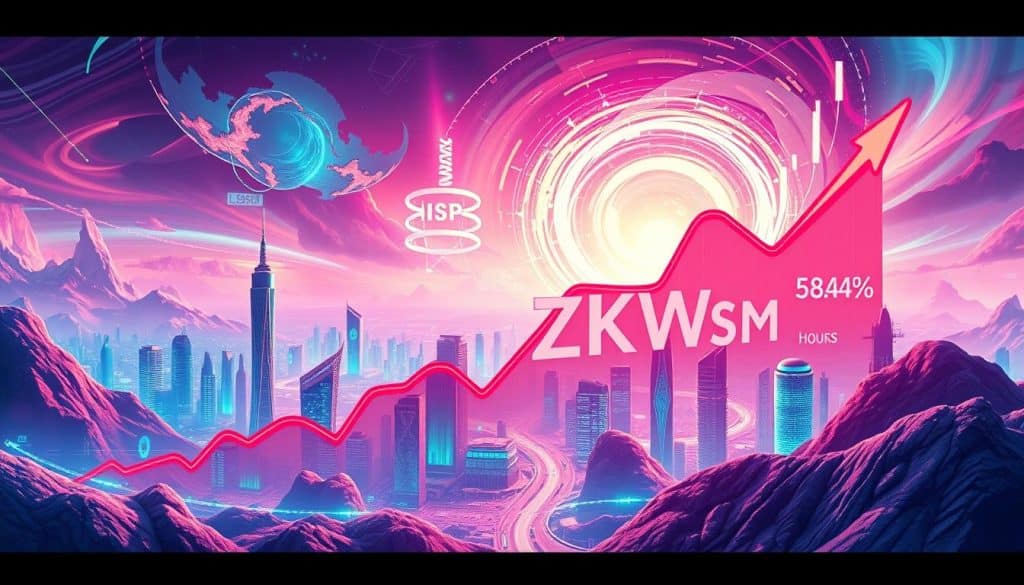
In a single trading day, ZKWASM’s price jumped by 58.44%. This surge is like those making headlines in crypto. It’s way beyond the usual market changes.
This piece will give you a brief overview of the ZKWASM price increase. It includes a look at the price movement, analysis of charts, and trading volume. We will also make some future price predictions based on Bitget-style reports.
We’ll use on-chain data, exchange info, and real-world trading patterns to explain. For example, we’ll look at how FUR surged and how such changes can impact US traders. We’ll talk about the ZKWASM move and its 58.44% increase.
The article will also touch on important topics for US investors. These include when trades are taxed, rules to follow, and how to trade safely on platforms like Coinbase. We’ll include charts, a source list, and tools to track ZKWASM Price in money like dollars.
Key Takeaways
- ZKWASM surge: a 58.44% 24h rally that demands both technical and on-chain investigation.
- The article provides charts, volume snapshots, and Bitget-style conversion examples for fiat tracking.
- On-chain flows and exchange listings will be evaluated to explain the move.
- U.S. investors get guidance on tax, compliance, and platform options for trading.
- Scenario-based price models and tools will help interpret continuation or retracement risks.
ZKWASM Price spike overview and headline facts
ZKWASM’s value soared by 58.44% in just one day. This quick summary shares key details to help readers understand this significant change. It shows the way percent changes are figured out and lets us compare this leap with other big moves in the crypto world.
Daily performance snapshot
ZKWASM saw its price jump 58.44% in 24 hours. This spike happened in just one day, showing a strong rise from start to finish.
To give this some perspective, consider Furfication (FUR). It had a huge jump of +212.84% in a day and +624.34% in a week. This shows how extreme and swift such increases can be in the crypto market.
Percentage change explained
To measure percent changes, we look from one closing price to the next. We do this by subtracting the previous close from the new one, dividing by the previous close, and then multiplying by 100. This approach helps us see the real change over 24 hours without the distractions of daily fluctuations.
The highs and lows in a day often lead to big percentage changes. For example, FUR’s daily high was 0.1303 JMD, and its low was 0.01872 JMD. Such differences between the high and low points can lead to significant percentage increases even if the start price was somewhere in between.
Trading volume and short-term volatility
Big price changes usually come with a lot of trading. ZKWASM’s jump brought a surge in trading that increased its volatility for the day.
FUR’s case shows this well. Its trading volume reached about 646,126,175.51 JMD one day and then dropped 28.73% the next. This demonstrates how quickly trading volumes can change and affect prices.
| Metric | ZKWASM (this event) | FUR (comparable examples) |
|---|---|---|
| 24h price change | +58.44% | +212.84% |
| 7d price change | Data pending | +624.34% |
| Reported 24h high / low | Intraday high above open; range expanded | High 0.1303 JMD / Low 0.01872 JMD |
| Trading volume (24h) | Significant spike vs prior day | 646,126,175.51 JMD equivalent |
| Volume change (day-to-day) | Marked increase during spike | -28.73% following peak |
| Short-term volatility | Elevated ZKWASM volatility during surge | Large intraday swings demonstrated by high/low |
What triggered the 58.44% ZKWASM Price surge
The ZKWASM price soared due to market events and clear on-chain signals. Announcements, big wallet movements, and a new exchange listing increased demand quickly.
Market-moving news and announcements
Partnerships, a mainnet launch, updated staking rewards, and new exchange listings often spark interest. These announcements make people act fast. Bitget suggests that new listings and busy markets mean quick demand from both big and small buyers.
On-chain signals and whale activity
Large deposits and big purchases from a few wallets signal price jumps. Watching money move in and out of exchanges hints at buying or selling trends. When whales, or big money holders, start collecting tokens, prices usually jump soon after.
Exchange listings or liquidity events
Being listed on big exchanges like Bitget, Binance, or Coinbase opens up new liquidity. More liquidity or trading options increase trading volume and narrow price gaps. High trading volumes and popular trading pairs, like seen with FUR trading, highlight how volatility grows with major listings or liquidity boosts for ZKWASM.
- Partnerships or mainnet milestones often spark media coverage and buyer interest.
- Concentrated on-chain buys and rapid exchange deposits are reliable early signs.
- Major exchange listings can convert latent demand into instant market orders.
Technical analysis: charts, support and resistance
Traders use charts and indicators to understand the ZKWASM price movement. They use a clear candlestick chart with volume bars to spot the best moments to buy or sell. By using a 24-hour candlestick and volume chart, traders can identify when the market speeds up and when it takes a breather.
24-hour candlestick and volume chart to show the surge
A 24-hour candlestick chart with volume highlights day-to-day price changes clearly. For example, FUR’s price swung from a high of 0.1303 JMD to a low of 0.01872 JMD in one day. This created big candle bodies and volume spikes, showing key moments of buying and selling.
To analyze, place vertical volume bars beneath the candlesticks. Search for areas where volume and price increase together. These spots usually show where big players enter or leave the market. A real-time chart can help with making quick trading decisions and identifying misleading signals.
Key support and resistance levels after the rally
After a big price jump, look for new support and resistance levels. The new support is often near the low point right after the price jump. Mark this level and another resistance level near the top prices of the day.
Consider FUR’s highest price of 0.3846 JMD as a main resistance level to focus on for future targets. Breaking this level could change the market trend and attract new buyers.
Momentum indicators readers should watch
Keep an eye on the RSI to find when the market is very bought or sold. After big price moves, like FUR’s rise, the RSI might show high numbers quickly. This can mean a market turnaround is coming soon.
Notice MACD for trend changes and use OBV to see if volume backs up the price change. Day traders should use VWAP to check big investors’ interest during the day.
For more on those methods, read a helpful guide at unleashing the power of crypto technical analysis. Mixing chart patterns, zones of support and resistance, RSI, MACD, and volume tools creates a fuller picture for trading after a big rally.
Fundamental drivers behind the rally
The ZKWASM’s recent rise is due to project advancements, token redesign, and market trends. Knowing ZKWASM’s basics helps us distinguish between temporary excitement and lasting demand.
Updates and roadmap achievements create lasting interest if they bring real partnerships or uses. For example, news about mainnet updates, DeFi features, or working with big names like Chainlink or Coinbase Wallet boosts on-chain activity and draws new users. Always check the project’s official website, GitHub, and verified Twitter to make sure news is legit.
Listings on exchanges can make a token more visible, but that doesn’t mean people will keep wanting it. A listing like Bitget’s can make trading volumes jump. But real interest sticks around if there’s useful stuff to do with the protocol or product after it’s listed.
Whether a token’s popularity keeps growing depends a lot on its use and economics. Things like staking rewards, how tokens are burned, and when they get released affect how many are out there. Look at how many tokens are in circulation, the inflation rate, and how many the team has to see if there’s a risk of too many tokens flooding the market. A report once showed a token with a market cap of “–” and no tokens circulating, highlighting the importance of accurate info. Double-check the token’s economics in its whitepaper and token contracts on the blockchain.
It’s not just about how many tokens there are. A token with good rewards for staking or regular burning can keep people interested. On the other hand, if a lot of tokens suddenly become available, the price might drop.
The wider crypto market’s trends also impact altcoin values. Moves in Bitcoin and Ethereum can drag smaller coins along. When the overall market is doing well or risky bets are favored, altcoins might rise. But news of interest rate increases or government oversight can make prices drop fast. Watching how altcoins move with Bitcoin and Ethereum can help you decide when to buy or sell.
Changes in how much fiat money you need to buy a token can affect its appeal. For instance, seeing a token’s price in USD, JMD, and KHR shows how currency values and availability can sway demand locally. People in different places respond to both the token’s economy and changes in how much their money is worth.
To guess what might happen next, look at product plans, clear token economics, and big picture trends together. Each helps explain ZKWASM’s basics and whether its price might keep up or fall back.
Comparative statistics: ZKWASM versus similar tokens
This piece looks at ZKWASM and compares it to similar market players. We check if its 58.44% rise is part of a trend or a one-time thing. Here’s what to look at and compare for a deep dive into ZKWASM and other altcoins.
Start by gathering 24-hour and 7-day change percentages for similar tokens. For example, FUR had huge jumps: 24h at +212.84% and 7d at +624.34%. These numbers help understand ZKWASM’s +58.44% rise and set expectations for altcoin performances.
Next, look at trading volumes and how they relate to market cap. FUR’s 24-hour volume was 646,126,175.51 JMD, but it fell by -28.73%. This drop is key for judging if gains can last. A stable or growing volume-to-market-cap ratio suggests good momentum.
Also, review multi-day price changes to see the swings. FUR’s price swung a lot over 7 days, from a high of 0.3614 JMD to a low of 0.003709 JMD. Doing the same for ZKWASM helps compare volatility correctly.
A table then helps outline these findings. Fill it with up-to-date info to compare percentage changes, volume shifts, and volatility clearly.
| Token | 24h % | 7d % | 24h Volume (JMD eq.) | Volume / Market Cap | 7d High / Low (JMD) |
|---|---|---|---|---|---|
| ZKWASM | +58.44% | , | [populate] | [populate] | [populate] |
| FUR | +212.84% | +624.34% | 646,126,175.51 | [populate] | 0.3614 / 0.003709 |
| Peer A | [populate] | [populate] | [populate] | [populate] | [populate] |
Use this table to make smart decisions about momentum and risk. Highlighting differences in volume and volatility is vital. Big gains without matching volume could mean weak rallies. Wide price ranges over a week show higher risk in altcoin investments.
Lastly, drawing these data points on graphs and heatmaps really helps. Seeing short-term changes, volume shifts, and volatility together offers a complete view. This detailed method gives ZKWASM and other tokens a clear comparison for traders and analysts.
Market data and on-chain evidence backing the move
The need for ZKWASM is rising. We see this in both trading patterns and wallet activities. It’s smart to match exchange data with ZKWASM’s on-chain behavior. This helps confirm trends and dodge misleading hints.
Exchange orderbook and liquidity snapshots
Measure the liquidity of orderbooks by looking at depth and spread. You want narrow spreads and plenty of orders at different prices. Big orders can cause price moves, especially in thinner markets.
Look at the depth charts from exchanges like Bitget. Thin layers near the surface can lead to quick price changes. For detailed study, capture minute-by-minute data during busy times.
On-chain flows: deposits, withdrawals, and smart-contract activity
Watch for big moves to and from exchanges and how smart contracts are used. A lot of incoming deposits might mean prices are about to drop. Moving funds to secure wallets could mean people are gathering more.
Keep an eye on how much ZKWASM is moving and what new smart contracts are doing. A spike in activity with new contracts can mean solid demand.
Third-party data sources and transparency notes
Choose trusted data sources for accurate checks. Top picks include CoinMarketCap and CoinGecko for general data, Glassnode for on-chain details, and Bitget for orders. For updates on market moves, websites like crypto price analysis are great.
Keep records of all data and when you searched it. Matching exchange records with blockchain checks helps verify your findings. Using clear data versions aids in explaining quick market changes.
| Data Type | Primary Source | Key Metric |
|---|---|---|
| Orderbook depth | Bitget API | Top 10 levels volume, spread, slippage |
| Exchange flows | Exchange trade feeds | Net deposits/withdrawals per hour |
| Smart-contract activity | Etherscan / BscScan | Contract calls, new approvals, token locks |
| On-chain metrics | Glassnode | Active addresses, transfer volume |
| Market aggregates | CoinGecko / CoinMarketCap | Price, volume, exchange distribution |
Putting all this information together gives a full view of market dynamics. Combine it with ZKWASM’s on-chain facts for detailed event analysis.
Price prediction models and short-term outlook
ZKWASM’s recent spike makes it crucial to analyze scenarios and use the right tools for outcomes. Here are three likely paths after a 58.44% rise, with indicators and calculators for a solid ZKWASM price forecast.
Bull continuation: If volume stays high and prices climb over the new resistance, we might see higher prices soon. Traders should watch for volume and moving average signals to confirm this uptrend.
Consolidation: The price might move sideways near the new level as buyers and sellers adjust. Traders should watch the Average True Range (ATR) and neutral oscillator readings. This scenario is good for traders using calculators for position sizing and profit targets.
Retracement: After quick jumps, prices often drop by 20–50%. Looking at past data, swings within 24 hours and week-long volatility can lead to moderate pullbacks. Watching large wallet activities can show if the pullback has support.
Next, keep an eye on volume, RSI levels of 50–60, and the 50/200 EMA crossover. Check Glassnode for big transfers and address activity to gauge ongoing accumulation.
Useful tools for outcome modeling include TradingView for charts, Glassnode for blockchain data, and CoinGecko or CoinMarketCap for market info. Spreadsheets can help predict profits or losses from ZKWASM trades.
To analyze quickly, make a table with three price targets, probabilities, and trade sizes. Then calculate potential profits or losses. Trading calculators can then show risk and return amounts for each scenario.
Update your information often and review your indicators daily. A systematic look at scenarios improves short-term forecasts and helps traders adjust to changing data.
How investors can interpret this rally and risk management
A sudden 58.44% spike demands calm analysis. Start by making a clear plan. This should cover how much to invest, when to exit, and understanding taxes. It’s important to stay objective and not let emotions guide you after a big price move.
Position sizing and stop-loss guidelines for volatile moves
Keep your investments small. Most traders use 1–5% of their portfolio for risky tokens. Choose the lower end for extremely volatile days. Look at FUR’s big swing as a lesson in cautious investing.
Instead of flat rates, set stop-losses based on market swings. Use stops that adjust with volatility or place them under critical support areas. Have several goals for taking profit to ease the stress of deciding when to sell.
Tax, regulatory, and compliance considerations for U.S. investors
Track the purchase price of every trade. Since the IRS sees crypto as property, you need to report gains or losses. Staying on top of this is crucial, especially if you trade often or win big.
Reporting rules change with each platform. Check with your broker or exchange how they report. If you’re unsure, talk to a tax expert. For advice on managing risks and reporting, check out this link: managing cryptocurrency risk.
Checklist for evaluating whether to buy, hold, or sell
- Confirm official news from project channels before acting.
- Check on-chain accumulation and large transfers for buy/sell pressure.
- Verify liquidity depth and exchange orderbook to avoid slippage.
- Review tokenomics: circulating supply, total supply, and inflation schedule.
- Assess regulatory exposure and your personal tax obligations, including crypto taxes US for U.S. residents.
- Match potential move to your risk tolerance and ZKWASM risk management plan.
- Use a sell checklist that includes target price, stop status, and news updates before executing exits.
Use a disciplined approach to how much you invest and when to sell. Keep detailed records for taxes and follow a strict set of rules to avoid errors during big market changes.
How to track ZKWASM Price and trade safely
Start with choosing well-known, U.S.-friendly trading websites and tools you can trust. Look into the orderbook, spreads, and the most recent withdrawals before making any trades. When moving your money between places, do small test trades first.
Recommended exchanges and liquidity notes
Go for exchanges like Coinbase, Kraken, and Binance.US because they’re regulated and familiar. They’re great for keeping your money and doing transactions in your local currency. Bitget and similar platforms offer more trading pairs and bigger orderbooks for advanced trading. Look into their fees, how much you can withdraw daily, and what they ask for KYC before putting in a lot of money.
Real-time tools, converters and charting platforms to monitor price
TradingView is good for detailed charts with different time frames. CoinGecko or CoinMarketCap are quick picks for seeing the current price and how much is out there. Use live data from exchange APIs for recent trades and blockchain explorers for contract actions. If you need prices in different currencies, find crypto converters that update prices in real-time.
Practical guide to converting and withdrawing
Make a simple chart to figure out what you’ll get after a trade, accounting for fees and price changes. Use the example of FUR below as a guide when switching ZKWASM to your local money. Remember to consider different fees and potential price swings.
| Amount (FUR) | Example Rate: 1 FUR = 0.1118 JMD | Example Rate: 1 FUR = 2.8 KHR | Estimated Slippage/Fees |
|---|---|---|---|
| 1 | 0.1118 JMD | 2.8 KHR | 0.5% – 1.5% |
| 5 | 0.5592 JMD | 14 KHR | 0.5% – 2.0% |
| 10 | 1.118 JMD | 28 KHR | 0.7% – 3.0% |
| 50 | 5.59 JMD | 140 KHR | 1.0% – 4.0% |
Brace for wider spreads on less common pairs and when prices jump around. Set your price with limit orders and do small withdrawal tests to see fees and path. Track how long withdrawals take and any bank limits on big, cross-border money moves.
Practical compliance and safety tips
Keep your account fully set up with KYC to avoid withdrawal limits and speed up transfers. Make sure your private and API keys are safe. Use hardware wallets for withdrawals if you can. When trading big amounts, break them up and watch the charts as you go.
Final operational checklist
- Make sure the exchanges you pick fit where you live and your KYC status.
- Combine TradingView, exchange data, and price sites to keep up with ZKWASM price.
- Use crypto price tools for currency comparisons and base your trades on a straightforward chart.
- Do test withdrawals, check out the fees, and plan for changes in price before making big moves.
Evidence, sources and data appendix
This appendix shows you where we got our information from. It includes core sources for building charts and conversion examples. You’ll find exchange websites, market trackers, and data from blockchains. All these help make our data clear and honest.
Here are the top sources we recommend: Bitget for checking crypto pairs, CoinGecko and CoinMarketCap for a market summary. For charts, we like TradingView. Glassnode is great for blockchain info. For contract details, try Etherscan or BscScan. For real-time trading data, Binance, Coinbase, and Bitstamp are useful. Check out the profit calculator for seeing your potential earnings.
To quickly get data, grab 1m or 5m candlestick charts from TradingView. Download charts as CSVs. Use REST APIs from exchanges to get detailed trade info. Always check your data against Bitget and CoinGecko to make sure it matches up.
Source list for charts, volume and conversion tables
We got our charts and data from several main places:
- Bitget for current rates and market data.
- CoinGecko and CoinMarketCap for daily stats and overviews.
- TradingView for detailed chart images and data files.
- Glassnode for tracking money flowing in and out of cryptos.
- Etherscan and BscScan for big transactions and contract actions.
- APIs from Binance, Coinbase, and Bitstamp for trading data.
Statistics referenced in the article
Here are some stats we used. Remember to double-check them:
- The recent surge in FUR price: over 200% in 24 hours!
- In a week, FUR jumped more than 600%.
- Highs and lows of FUR price in different currencies.
- The volume of FUR traded and changes from the day before.
Graphs and downloadable CSV or image assets to embed
Add a 24-hour candlestick chart and volume graph to your work. Provide CSV files that match our format. This lets analysts easily use exchange data.
| Asset | Recommended Export | Columns | Use Case |
|---|---|---|---|
| ZKWASM price | TradingView PNG + CSV | time, open, high, low, close, volume | Creating daily charts and volume analysis |
| FUR conversions | Bitget snapshot and CSV | timestamp, pair, price, base_amount, quote_amount, rate | Making reports on FUR to JMD and KHR conversions |
| Exchange trades | CSVs of trades from exchanges | timestamp, trade_id, side, price, amount, fee | Analyzing trading flows and spikes |
| On-chain transfers | CSV from Etherscan or BscScan | timestamp, tx_hash, from, to, value, token | Watching big moves and contract activities |
How to export data: Go to TradingView, pick a time, and use the export option for charts. For exchange data, use the public endpoints. Glassnode and CoinGecko also let you download data. Name your files clearly with the source and timestamp.
Have a simple README file. List filenames, source links, timestamps, and parameters. This helps make your work transparent and easy to follow.
Conclusion
The ZKWASM conclusion is easy to understand: it saw a 58.44% jump in just 24 hours. This increase was due to timely news, as well as visible transactions and trading on exchanges. To know if this trend will last, look at the trading volume, how deep the orderbook is, and any new listings.
This summary gives useful steps for following a crypto rally. You can track prices and liquidity in real-time with tools like TradingView and CoinGecko. Also, use Glassnode and Bitget-style converters. Apply conversion templates from FUR to JMD and KHR to understand changes in value. Always record your trades for tax purposes in the U.S. and check the project’s details on supply and token workings before investing.
When trading, be mindful about how much you invest and set stop-losses that fit your comfort with risks. Keep an eye on transactions and how many orders there are for the next 24–72 hours. This will help you see if the rise by 58.44% is just the beginning or a brief high. For a broad view of the market, read this update from a trusted source: market trends summary.