Last updated: September 23, 2026
Quick Answer: Crypto trading tools are software platforms that help traders perform specific jobs such as market research, charting, on-chain analysis, trade execution, portfolio tracking, alerts, risk management, security checks and automation. There is no single tool that is best for every trader. A practical toolkit combines a reliable market-data source, charting platform, portfolio tracker and—when needed—specialist on-chain, execution or automation tools.

The cryptocurrency market operates continuously, so traders can easily become overwhelmed by price feeds, charts, exchange interfaces, blockchain data, social signals and portfolio information. The purpose of a trading toolkit is to turn that information into a workflow that is easier to monitor and manage.
For example, a trader might use:
Market data → charting → fundamental/on-chain research → trade execution → risk management → portfolio tracking
Each tool performs a different job.
This distinction matters because an exchange is not necessarily an analysis platform, a charting platform is not necessarily an execution platform, and an AI market summary is not proof that a trade will be profitable.
What Are Crypto Trading Tools?
Crypto trading tools are software platforms, websites, APIs and applications that help users research, analyze, execute, monitor or manage cryptocurrency trades.
Common categories include:
- Market-data aggregators
- Charting and technical-analysis platforms
- Crypto screeners
- On-chain analytics
- DeFi analytics
- Portfolio trackers
- Price and technical alerts
- Trading terminals
- Exchange APIs
- Trading bots
- Risk-management tools
- Wallet and transaction-security tools
- Tax and transaction-recording software
- News and sentiment-monitoring platforms
The right combination depends on whether you are a long-term investor, swing trader, day trader, arbitrage trader, DeFi user or automated trader.
What Should a Crypto Trading Toolkit Include?
A practical toolkit does not need dozens of subscriptions.
For many traders, five categories cover most of the workflow:
| Tool category | Main purpose | Example use |
|---|---|---|
| Market data | Prices, volume, market cap | Find and compare assets |
| Charting | Technical analysis | Study trends and price levels |
| On-chain analytics | Blockchain activity | Analyze wallets, flows and protocols |
| Execution | Place trades | Buy, sell or manage positions |
| Portfolio/risk | Track exposure | Monitor holdings, P&L and risk |
Advanced traders can add:
- APIs
- Trading bots
- Order-book analysis
- Derivatives analytics
- DeFi dashboards
- Smart-money/wallet tracking
- Security scanners
- Automated alerts
The objective is not to collect the largest number of tools. It is to create a workflow where every tool has a clear purpose.
Which Crypto Trading Tools Are Best for Market Research?
Market-data tools are the starting point for most crypto research because they provide prices, trading volume, market capitalization, supply information, exchange markets and historical data.
CoinMarketCap
CoinMarketCap can be used for:
- Cryptocurrency prices
- Market capitalization
- Trading volume
- Rankings
- Watchlists
- Portfolio tracking
- Historical market information
Its current portfolio product distinguishes between a watchlist, which monitors assets you’re interested in, and a portfolio, which records what you actually own and what you paid.
That distinction is useful for traders because research assets and owned assets serve different purposes.
CoinGecko
CoinGecko provides market data across cryptocurrencies, exchanges and blockchain networks.
Its current API documentation covers:
- Real-time prices
- Historical prices
- Market data
- Exchange information
- Derivatives
- On-chain DEX data
- Liquidity
- Trading pairs
- Token metadata
CoinGecko also provides historical market data and on-chain datasets through its API.
What Are the Best Crypto Charting Tools?
Charting tools help traders analyze price action, indicators, market structure and historical behavior.
TradingView
TradingView is one of the most comprehensive charting environments available to crypto traders.
Its current platform supports crypto charts alongside other markets, while its alert system can monitor:
- Price levels
- Indicators
- Strategies
- Drawing tools
- Chart patterns
- Watchlists
- Custom Pine Script conditions
TradingView’s technical alerts can trigger when specified conditions occur, including indicator thresholds, price movements and chart-pattern events.
This makes TradingView useful for both manual traders and traders building rule-based workflows.
What can you analyze with a charting platform?
Common indicators include:
- Moving averages
- RSI
- MACD
- Bollinger Bands
- Volume
- VWAP
- Support and resistance
- Fibonacci levels
- Trendlines
- Market structure
Indicators should be treated as analytical inputs rather than automatic buy or sell signals.
A strategy that produces a signal is not necessarily profitable after fees, slippage and changing market conditions.
How Do Crypto Trading Alerts Work?
Crypto trading alerts notify traders when predefined conditions occur instead of requiring them to watch charts continuously.
For example, an alert might trigger when:
- BTC crosses a specified price
- RSI reaches a threshold
- A moving average crosses another moving average
- Price enters a predefined range
- A chart pattern is detected
- A custom strategy condition occurs
TradingView currently supports price and technical alerts across indicators, strategies, drawings and other chart conditions.
Why alerts matter
Without alerts, traders can spend hours watching screens.
With alerts, the workflow becomes:
Define condition → create alert → wait → investigate when triggered
This can reduce unnecessary screen time, although an alert should trigger research, not automatically trigger a trade.
What Are Crypto On-Chain Analysis Tools?
On-chain analytics tools analyze data recorded directly on blockchains, such as transactions, wallet activity, token flows, protocol usage and smart-contract interactions.
On-chain analysis can help answer questions that price charts cannot.
For example:
- Are large wallets accumulating or distributing?
- Is a protocol’s TVL increasing?
- How much activity is occurring on a blockchain?
- Are stablecoin balances changing?
- Are token unlocks approaching?
- How much DEX volume is taking place?
- Which wallets interact with a protocol?
Which Tools Can Be Used for DeFi and On-Chain Analysis?
DeFiLlama
DeFiLlama is particularly useful for DeFi research.
Its current dashboard tracks metrics including:
- Total value locked
- Stablecoin market capitalization
- DEX volume
- Perpetuals volume
- Protocol fees
- Protocol revenue
- Upcoming token unlocks
- RWA metrics
DeFiLlama describes itself as a DeFi TVL aggregator with open-source data and transparent methodology. Its current coverage includes thousands of protocols and hundreds of chains.
This makes it useful when evaluating whether activity around a protocol is actually growing.
Other on-chain research categories
Advanced traders may also use:
- Wallet intelligence
- Entity labeling
- Token-holder analysis
- Smart-money tracking
- DEX liquidity analysis
- Token unlock calendars
- Blockchain explorers
- Custom SQL dashboards
No single on-chain metric should be interpreted in isolation.
For example, increasing TVL does not automatically mean that a token is undervalued.
What Are Crypto Portfolio Tracking Tools?
Portfolio trackers consolidate holdings, transactions and performance so traders can understand their overall exposure across exchanges and wallets.
A portfolio tracker can answer:
“How much crypto do I actually own, and how has the total position performed?”
That is different from a watchlist, which answers:
“Which assets am I monitoring?”
CoinMarketCap’s current documentation explicitly distinguishes these two functions.
Useful portfolio-tracking features
Look for:
- Multi-wallet support
- Exchange integrations
- Cost-basis tracking
- Realized P&L
- Unrealized P&L
- Asset allocation
- Transaction history
- Performance charts
- Tax-reporting compatibility
A trader with funds spread across three exchanges and two wallets can otherwise have difficulty calculating total exposure.
What Are Crypto Screeners?
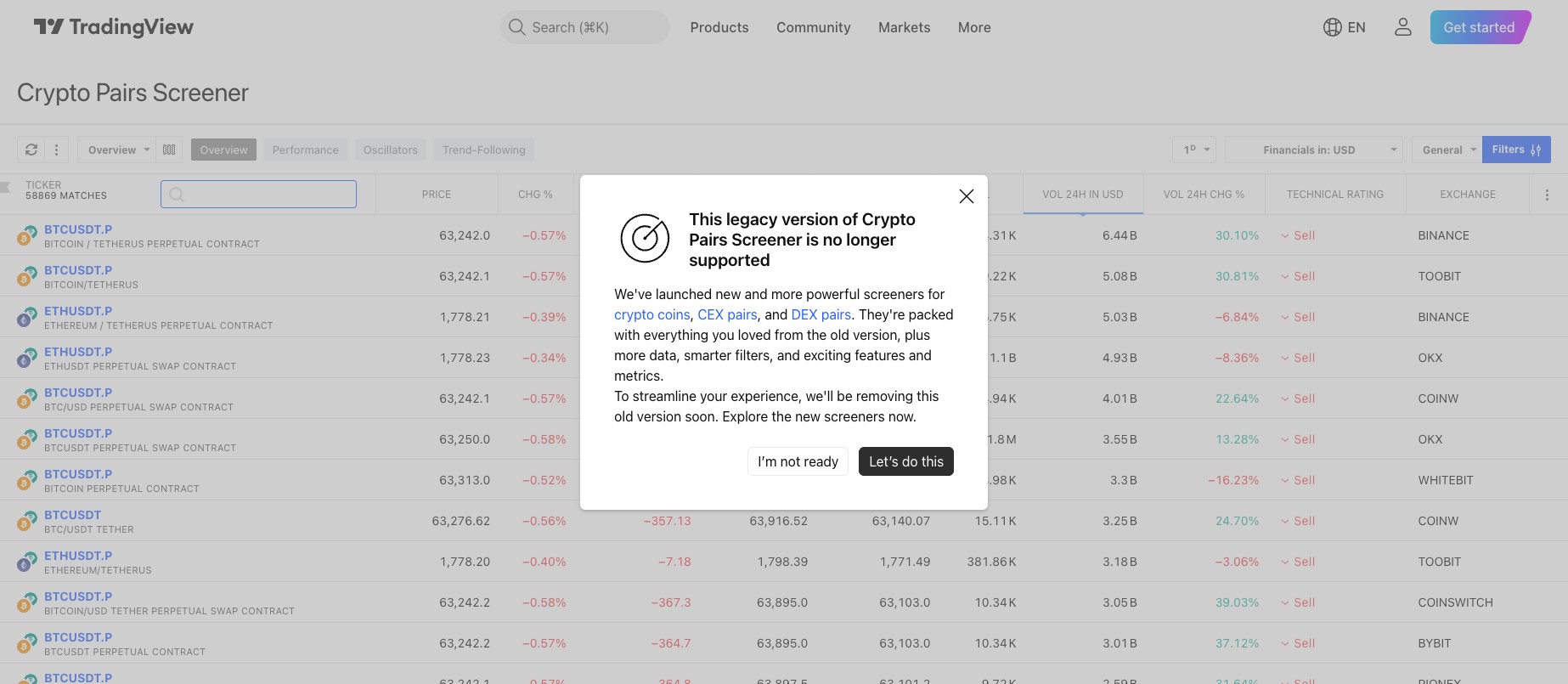
Crypto screeners filter large numbers of assets according to predefined conditions.
Instead of manually checking hundreds of coins, a screener can narrow the universe based on criteria such as:
- Market capitalization
- Volume
- Price change
- Trading volume
- RSI
- Volatility
- Liquidity
- Sector
- Blockchain
- Technical conditions
A screener should reduce research time—not replace research.
For example:
Screen: Find assets with unusually high volume.
Then:
Research: Determine why volume increased.
Then:
Validate: Check news, on-chain activity and market structure.
Then:
Trade: Only if the setup matches your predefined strategy.
What Are Crypto Trading Platforms and Exchange Tools?
Crypto exchanges are execution platforms where users can place orders, while trading terminals and APIs can provide additional control over execution.
Centralized exchanges commonly provide:
- Spot trading
- Market orders
- Limit orders
- Stop orders
- Charts
- Order books
- Trading history
- API access
- Derivatives on eligible platforms
The exact features depend on the exchange and jurisdiction.
Cryptsy’s crypto exchanges guide can be used as an internal resource for comparing exchange options.
Why execution quality matters
Two exchanges can show similar prices but produce different effective trading costs because of:
- Trading fees
- Spread
- Slippage
- Liquidity
- Withdrawal fees
- Funding costs
- Order-book depth
Therefore, the exchange with the lowest advertised trading fee is not necessarily the cheapest venue for every trade.
What Are Crypto Exchange APIs?
An exchange API allows software to communicate programmatically with an exchange or trading service.
APIs can provide functions such as:
- Market-data retrieval
- Order submission
- Account balances
- Trade history
- Open orders
- Position information
- Automated workflows
For example, Binance’s current developer documentation provides APIs covering supported assets and pairs, quotes, transactions, balances and market data.
Why do traders use APIs?
APIs become useful when traders want to:
- Build custom dashboards
- Automate repetitive tasks
- Connect portfolio software
- Run algorithmic strategies
- Collect historical data
- Monitor multiple markets
However, API keys create security risks.
If an exchange provides permission controls, use the minimum permissions required. A read-only dashboard should not need withdrawal permissions.
What Are Crypto Trading Bots?
Crypto trading bots are software programs that execute predefined trading rules automatically.
Common bot strategies include:
- Grid trading
- Dollar-cost averaging
- Rebalancing
- Arbitrage
- Market making
- Momentum strategies
- Technical-indicator strategies
A bot does not automatically make a strategy profitable.
Its performance depends on:
- Strategy design
- Market conditions
- Execution
- Fees
- Slippage
- Liquidity
- Risk controls
- API reliability
What should you check before using a trading bot?
Ask:
- Can you understand the strategy?
- Does the platform provide transparent performance information?
- Are fees clearly disclosed?
- Can API permissions be restricted?
- Can you stop the bot quickly?
- Does it support paper trading or backtesting?
- What happens during an exchange outage?
- How does it handle extreme volatility?
Avoid tools promising guaranteed returns or “risk-free” automated profits.
Can AI Tools Predict Crypto Prices?
AI can analyze large amounts of market and blockchain data, but no AI tool can reliably guarantee future crypto prices.
AI-powered tools may assist with:
- Data summarization
- Pattern recognition
- Sentiment analysis
- Anomaly detection
- Portfolio analysis
- On-chain research
- Strategy development
- Natural-language querying
But an AI-generated prediction remains a model output, not a guaranteed market outcome.
This distinction is especially important because crypto markets can change rapidly in response to liquidity, macroeconomic events, regulation, hacks, liquidations and unexpected news.
What Are Crypto Security and Verification Tools?
Security tools help users investigate assets, contracts and transactions before interacting with them.
Useful categories include:
- Blockchain explorers
- Smart-contract scanners
- Token-holder analysis
- Contract verification
- Liquidity analysis
- Wallet-risk analysis
- Phishing detection
- Transaction simulation
- Security-audit databases
The original article mentions CertiK and SlowMist. These types of security resources can be useful, but a security score should never be treated as proof that a token or protocol is completely safe.
What should traders verify before buying a new token?
Check:
- Contract address
- Blockchain
- Liquidity
- Holder concentration
- Contract permissions
- Minting capabilities
- Ownership status
- Token unlocks
- Audit history
- Trading volume
- Official project links
An audit also does not guarantee that a protocol cannot be exploited.
What Are Blockchain Explorers Used For?
Blockchain explorers allow users to inspect transactions and addresses directly on a blockchain.
They can help verify:
- Transaction status
- Wallet balances
- Token transfers
- Contract interactions
- Gas fees
- Block confirmations
- Token-holder information
For a trader, this can be particularly useful when an exchange says a withdrawal was completed but the funds have not appeared in the destination wallet.
Instead of relying solely on an exchange interface, the blockchain explorer can show whether the transaction was actually broadcast and confirmed.
What Are Crypto News and Sentiment Tools?
News and sentiment tools monitor information that can influence market expectations.
They can track:
- Regulatory announcements
- Protocol upgrades
- Exchange listings
- Token unlocks
- Security incidents
- Social-media activity
- Market narratives
- Macroeconomic news
Sentiment is useful context, but it should not be treated as a substitute for fundamental or technical analysis.
A sudden increase in social mentions may indicate growing attention without proving that the underlying asset has improved.
What Tools Are Useful for Cross-Border Crypto Transactions?
Cryptocurrency can be used in international payment and settlement workflows, but the exact benefits depend on the asset, network, exchange, jurisdiction and payment provider.
Useful tools include:
- Multi-currency exchanges
- Stablecoin infrastructure
- Crypto-to-fiat services
- International payment platforms
- Blockchain explorers
- Wallets
- Transaction monitoring systems
The original article links to a dollars-to-pesos conversion guide, which can be useful when calculating the fiat value of a crypto transaction.
Before sending funds internationally, check:
- Network fees
- Exchange rates
- Withdrawal fees
- Recipient address
- Supported networks
- Local regulations
- Tax implications
“Cheap” blockchain fees do not necessarily mean the overall transfer is cheaper after conversion and withdrawal costs.
Are Mobile Crypto Trading Apps Useful?
Mobile trading apps are useful for monitoring portfolios, checking markets, receiving alerts and executing trades when necessary.
Useful mobile features include:
- Price alerts
- Portfolio tracking
- Order management
- Two-factor authentication
- Market charts
- Watchlists
- Transaction history
The original article links to information about 24/7 trading capabilities and advanced mobile platforms.
However, mobile convenience also creates a risk: traders can make impulsive decisions more easily.
Notifications should therefore be used to inform a trading process, not encourage constant trading.
What Is PayFi and Does It Belong in a Crypto Trading Toolkit?
PayFi refers broadly to blockchain-based financial infrastructure designed around payments and financial services.
The original article specifically highlighted a project described as a PayFi platform and linked to a PayFi platform article.
However, the original claims about its launch date, funding, token price, token distribution and planned exchange listings should not be presented as current verified facts without checking the project’s current official documentation.
This is an important editorial distinction.
A crypto trading-tools article should not treat a particular token project as an established trading tool merely because it promotes payment infrastructure.
If a project is included, verify:
- Official product availability
- Current token contract
- Current price
- Current circulating supply
- Current listings
- Security audits
- Regulatory status
- Current company/project claims
Which Crypto Trading Tools Are Best for Beginners?
Beginners generally need fewer tools, not more.
A simple setup could be:
Tool 1: Market-data platform
Use it to research:
- Market cap
- Volume
- Supply
- Historical prices
Tool 2: Charting platform
Use it to learn:
- Trends
- Support/resistance
- Volume
- Basic indicators
Tool 3: Exchange
Use it for actual execution.
Tool 4: Portfolio tracker
Use it to understand total holdings and performance.
Tool 5: Security tool
Use it before interacting with unfamiliar tokens, wallets or smart contracts.
This workflow prevents beginners from jumping between ten dashboards without understanding what any of the numbers mean.
Which Crypto Trading Tools Are Useful for Experienced Traders?
Experienced traders may require more specialized infrastructure.
A professional-oriented stack might include:
- Advanced charting
- Multiple exchange accounts
- Exchange APIs
- Order-book analytics
- On-chain intelligence
- Derivatives data
- Custom dashboards
- Automated alerts
- Backtesting
- Algorithmic execution
- Portfolio/risk systems
For example:
TradingView → technical setup
CoinGecko/CoinMarketCap → market context
DeFiLlama → DeFi fundamentals
On-chain intelligence → wallet/activity analysis
Exchange/API → execution
Portfolio tracker → performance
This is more useful than trying to find one platform that does everything.
Which Tools Should Day Traders Use?
Day traders generally need tools that emphasize speed, liquidity, execution and monitoring.
A day-trading workflow may include:
- Real-time market data
- Fast charting
- Price/technical alerts
- Order-book information
- Exchange execution
- Position monitoring
- Risk controls
- Trade journaling
The most important metrics are often practical ones:
- Spread
- Slippage
- Fees
- Liquidity
- Order execution
- Latency
- Position size
A sophisticated indicator cannot compensate for poor execution.
Which Tools Should Long-Term Crypto Investors Use?
Long-term investors generally need less emphasis on rapid execution and more emphasis on fundamental research, portfolio management and security.
Useful categories include:
- Market-data platforms
- Protocol research
- On-chain analytics
- Tokenomics dashboards
- Portfolio trackers
- Wallet security
- Tax records
- News monitoring
For long-term investors, checking a chart every five minutes is usually less useful than understanding why the asset should continue to have demand.
What Tools Are Useful for Meme Coin Trading?
Meme coins often require a different research workflow because liquidity, social attention and wallet activity can change extremely quickly.
The original article links to a meme coin trading guide.
Useful tools can include:
- DEX screeners
- Real-time liquidity monitoring
- Wallet trackers
- Contract scanners
- Holder-distribution analysis
- Social monitoring
- Token-launch tracking
- Transaction explorers
Before trading an unfamiliar meme coin, check whether the token contract contains unusual permissions, whether liquidity is sufficient and whether ownership is concentrated.
High social engagement does not prove that a token is legitimate.
How Should You Choose Crypto Trading Tools?
Use the following decision framework.
| Your objective | Tool category to prioritize |
|---|---|
| Find coins | Market-data platform/screener |
| Study charts | TradingView/charting platform |
| Analyze DeFi | DeFi analytics |
| Study wallets | On-chain intelligence |
| Execute trades | Exchange/trading terminal |
| Automate trades | Bot/API |
| Track holdings | Portfolio tracker |
| Monitor price levels | Alerts |
| Investigate contracts | Security/blockchain tools |
| Record transactions | Portfolio/tax software |
This avoids the common mistake of choosing a platform simply because it has the largest feature list.
How Can You Build a Crypto Trading Tool Stack?
A practical workflow looks like this:
Step 1: Discover
Use market-data tools to identify assets.
Step 2: Filter
Use screeners to narrow the list.
Step 3: Analyze
Use charts and technical indicators.
Step 4: Verify fundamentals
Check protocol activity, tokenomics, development and ecosystem data.
Step 5: Investigate on-chain data
Check transactions, liquidity, wallets and protocol activity where relevant.
Step 6: Define risk
Determine entry conditions, invalidation levels and maximum acceptable exposure.
Step 7: Execute
Use an exchange or trading terminal.
Step 8: Monitor
Use alerts instead of continuously watching the screen.
Step 9: Record
Track the position in a portfolio tracker or trading journal.
Step 10: Review
Evaluate whether the strategy actually worked after fees and slippage.
This creates a repeatable process rather than a collection of disconnected tools.
What Is the Best Crypto Trading Tool?
There is no single best crypto trading tool for every purpose.
A better approach is to match the tool to the job:
- Market discovery: CoinMarketCap or CoinGecko
- Charting and alerts: TradingView
- DeFi analytics: DeFiLlama
- On-chain research: specialized blockchain intelligence platforms
- Execution: a reputable exchange
- Automation: exchange APIs or trading-bot software
- Portfolio management: portfolio tracking software
- Security: blockchain explorers, contract analysis and security tools
CoinMarketCap itself describes different tools for different research tasks, while TradingView specializes heavily in charting and alerts.
DeFiLlama’s current platform illustrates the same principle: its strength is detailed DeFi and protocol data rather than acting as a universal trading terminal.
Frequently Asked Questions About Crypto Trading Tools
What are crypto trading tools?
Crypto trading tools are applications, websites, APIs and platforms that help users research, analyze, execute, monitor or manage cryptocurrency trades.
What is the best crypto analysis tool?
The answer depends on the analysis required. TradingView is designed for charting and technical analysis, CoinMarketCap and CoinGecko provide broad market data, while DeFiLlama specializes in DeFi and protocol analytics.
What is the best crypto trading tool for beginners?
A beginner can usually start with a market-data platform, a charting platform, a reputable exchange, a portfolio tracker and basic security tools. More tools should be added only when they solve a specific problem.
Are crypto trading bots profitable?
Not necessarily. A trading bot only automates a strategy. Profitability depends on the strategy, market conditions, fees, slippage, execution and risk management.
Can AI predict crypto prices?
AI can analyze historical, market and on-chain data, but no AI model can guarantee future cryptocurrency prices. Predictions should be treated as uncertain model outputs.
What is the best crypto charting tool?
TradingView is a widely used charting platform that provides technical indicators, drawing tools, strategies and alerts. Its current alert system supports price, indicator, drawing, strategy and chart-pattern conditions.
What is an on-chain analysis tool?
An on-chain analysis tool examines blockchain-recorded information such as transactions, wallets, token transfers, protocol activity and liquidity.
What is DeFiLlama used for?
DeFiLlama is used to research decentralized-finance activity, including TVL, DEX volume, stablecoins, fees, revenue, protocol rankings and token unlocks.
What is a crypto portfolio tracker?
A portfolio tracker records crypto holdings and transactions so users can monitor total value, cost basis and performance. This differs from a watchlist, which is primarily used to monitor assets that the user may not own.
What is a crypto screener?
A crypto screener filters cryptocurrencies according to criteria such as market capitalization, volume, price movement, liquidity or technical indicators.
What is a crypto exchange API?
A crypto exchange API allows software to communicate with an exchange to retrieve data, account information or—where supported—submit trading instructions. API permissions should be restricted to the minimum required.
Are crypto trading tools free?
Some are free, while others use subscriptions, usage-based pricing, premium data plans or trading-related fees. Free tools can be sufficient for beginners, while advanced traders may require specialized paid data.
Do crypto trading tools guarantee profits?
No. Trading tools provide information, analysis or automation. They cannot eliminate market risk or guarantee profitable trades.
Do I need multiple crypto trading tools?
Not necessarily. A beginner can often operate with a market-data platform, charting tool, exchange and portfolio tracker. Additional tools should solve a specific research, execution or risk-management problem.
Which tools are useful for meme coin trading?
Meme-coin traders may use DEX screeners, wallet trackers, liquidity monitors, contract scanners and social-monitoring tools. Because these assets can be highly volatile, security and liquidity checks are particularly important.
Final Takeaway
Crypto trading tools are most useful when each one has a clearly defined job.
A sensible toolkit might look like:
Market data → TradingView/charting → fundamental or on-chain research → exchange execution → portfolio tracking → alerts and risk management
Beginners do not need an expensive collection of software. Start with reliable data, learn how to interpret charts and market information, understand exchange fees and security, and track your positions.
Experienced traders can add APIs, automation, derivatives analytics, wallet intelligence and custom dashboards when those tools improve a specific part of their process.
The most important principle is that a tool should improve your decision-making process, not replace it.
No chart indicator, AI model, trading bot or market signal can remove cryptocurrency’s underlying risks. The strongest toolkit is therefore not necessarily the one with the most features. It is the one that gives you reliable information, transparent analysis, controlled execution and a repeatable way to manage risk.