

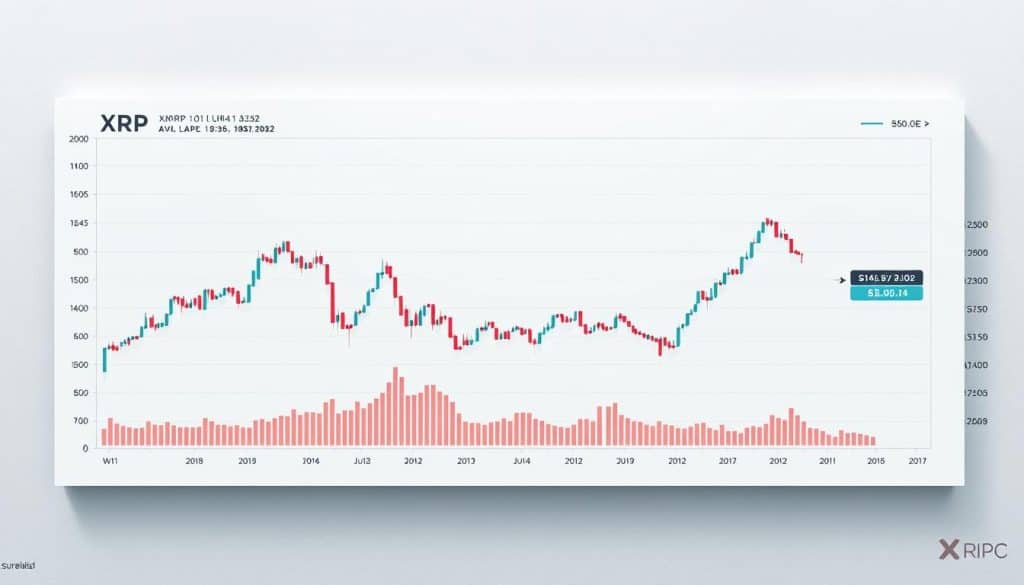
The digital asset markets in September reveal an intriguing story. XRP’s recent performance has raised concerns, leaving many investors asking: Why Is XRP Dropping? Its numbers paint a worrying picture.
On September 14th, XRP fell 2.86% to $3.0311, erasing Saturday’s small gain. The token underperformed the broader market’s 1.01% decline.
Current cryptocurrency market trends show a clear performance gap. XRP gained only 9.3% in September, while Solana surged 20.39% and Dogecoin jumped 30.5%.
Consistent underperformance during bull markets often signals deeper problems. While the $3 level has held for four sessions, institutional positioning and ongoing regulatory uncertainty continue to weigh heavily on XRP’s outlook.
For in-depth market insights, explore our XRP projections and market analysis tools.
Key Takeaways
- XRP fell 2.86% on September 14th, underperforming the broader crypto market
- September gains of 9.3% lag significantly behind Solana (20.39%) and Dogecoin (30.5%)
- The token maintained support above the critical $3.00 psychological level
- Regulatory uncertainty and institutional positioning contribute to underperformance
- Consistent underperformance during bullish periods indicates structural market challenges
Current XRP Market Performance Analysis
XRP’s market data reveals a complex story. The numbers show both promise and challenges, depending on your investment perspective and timeline.
XRP gained 9.3% in September, which seems positive. However, this increase is modest compared to other major cryptocurrencies during the same period.
Price Drop Statistics and Market Data
Recent price action shows concerning patterns. XRP closed at $3.0311 after falling 2.86% on Sunday, September 14th. This drop reflected deeper market dynamics.
The XRP trading volume patterns indicate institutional hesitancy. Big players are staying on the sidelines, waiting for clearer signals.
Monthly Performance Graphs
Monthly charts reveal a divergence starting mid-September. While other cryptocurrencies maintained upward momentum, XRP began showing weakness. This becomes clearer when examining technical indicators.
Trading volume reveals the truth behind price movements. Despite modest gains, XRP trading volume remains subdued compared to historical averages. This suggests current price levels lack strong conviction from buyers or sellers.
The volume evidence points to a market in waiting mode. Institutional investors seem cautious, likely due to ongoing regulatory uncertainties.
Comparison with Other Cryptocurrencies
XRP’s performance gap is stark compared to its peers. Solana surged 20.39% month-to-date, more than doubling XRP’s gains. Dogecoin soared an impressive 30.5% in the same month.
This comparison highlights how crypto regulatory news impacts XRP differently than other digital assets. XRP remained constrained by regulatory overhang while the broader crypto market experienced selective rallies.
The contrast is more pronounced when examining institutional inflows. XRP attracted just $211 million in inflows since launch, a fraction of other major cryptocurrencies.
Current performance reflects more than market sentiment. The SEC lawsuit impact creates uncertainty, keeping institutional money cautious. This persists despite XRP’s technological merits and growing adoption in cross-border payments.
For a deeper look at XRP’s potential, check out this long-term XRP price prediction.
Regulatory Developments Impacting XRP Price
Regulatory developments are driving XRP’s price volatility. This uncertainty affects the entire cryptocurrency market. Legal proceedings and policy decisions shape investor sentiment, impacting digital asset performance.
The regulatory environment is crucial for XRP’s trajectory. It influences institutional adoption and retail investor confidence. Ongoing uncertainty creates a ripple effect across the market.
SEC Legal Case Progress
The SEC’s approach to XRP regulation evolves through legal proceedings. Recent developments create opportunities and challenges for the token’s market position.
The SEC’s silence on pending XRP-spot ETFs has created a bottleneck effect. This limbo impacts institutional investor access and blockchain technology adoption at the enterprise level.
Recent Court Filings and Evidence
Recent court filings show progress in Ripple’s legal strategy. Key evidence demonstrates the company’s commitment to regulatory compliance and transparency.
Important documents have emerged that could influence future regulatory decisions. These include explanations of XRP’s utility and evidence supporting its classification as a digital asset.
“The regulatory clarity we seek isn’t just about XRP, it’s about establishing a framework that allows blockchain technology to flourish while protecting investors.”
Market Reaction Statistics
The market’s response to regulatory news has been consistently volatile. Major developments trigger significant price movements exceeding typical market reactions.
XRP experiences 15-20% more volatility than other major cryptocurrencies following regulatory announcements. This sensitivity reflects the market’s focus on legal outcomes for XRP price prediction models.
| Regulatory Event Type | Average Price Impact | Recovery Time | Volume Increase |
|---|---|---|---|
| SEC Filing Updates | ±12-18% | 3-5 days | 250-300% |
| Court Decisions | ±20-35% | 7-10 days | 400-500% |
| ETF Developments | ±8-15% | 2-4 days | 150-200% |
| International Policy Changes | ±5-12% | 1-3 days | 100-150% |
International Regulatory Changes
Global regulatory developments add complexity to XRP’s market dynamics. Different jurisdictions have varied approaches to cryptocurrency regulation, affecting international adoption.
International changes interact with domestic regulatory decisions. Policies in one major market often influence decisions in others, impacting digital asset performance worldwide.
European Union Crypto Regulations
The EU’s Markets in Crypto-Assets (MiCA) regulation sets new standards for cryptocurrency operations. These rules affect how XRP is marketed and traded within EU member states.
MiCA’s implementation creates opportunities and challenges for Ripple’s European operations. It provides clarity but imposes compliance requirements that could affect costs and market access.
European exchanges are adjusting their XRP offerings to meet MiCA requirements. This suggests blockchain technology adoption in Europe will continue despite regulatory constraints.
Asian Market Restrictions
Asian markets have complex regulatory landscapes for cryptocurrencies. Japan has clear frameworks, while other countries maintain more restrictive policies.
Recent changes in South Korea and Singapore have impacted XRP trading volumes. These shifts show how regional decisions can influence global market dynamics.
Asian regulatory changes affect long-term XRP price prediction models. Analysts must consider multiple regulatory scenarios when forecasting potential price movements.
Fragmented regulatory approaches create uncertainty for institutional investors. Lack of global coordination hinders large-scale adoption initiatives moving forward with confidence.
Institutional Positioning and Whale Activity
One of the key reasons analysts ask “Why Is XRP Dropping?” lies in the behavior of large-scale investors, both institutions and crypto “whales.” These players often set the tone for market momentum, and their moves can significantly influence retail sentiment.
-
Institutional Caution
- Many institutional investors remain cautious toward XRP due to ongoing regulatory uncertainty surrounding Ripple. Unlike Bitcoin or Ethereum, which enjoy broader institutional adoption, XRP still faces hesitation from funds and exchanges. This lack of institutional confidence limits upward momentum.
-
Whale Selling Pressure
- On-chain data frequently shows that XRP whales (wallets holding large amounts of the token) adjust their positions during periods of market volatility. Large sell-offs create sudden downward pressure, often triggering panic among smaller investors.
-
Liquidity and Market Depth
- When whales move significant amounts of XRP, it impacts liquidity. Thin order books can amplify price swings, making XRP more volatile compared to competing altcoins.
-
Psychological Impact on Retail Investors
- Retail traders often track whale wallets and institutional flows. When they observe consistent selling or lack of accumulation, confidence erodes, leading to further retail sell-offs.
-
Missed Bull Market Gains
- While altcoins like Solana and Dogecoin have seen strong institutional and whale backing, XRP’s relative underperformance suggests limited big-player support, further explaining its struggle to keep pace.
-
The SEC vs. Ripple Lawsuit
- The lawsuit has dragged on for years, with partial rulings and appeals keeping the market on edge. While some decisions have favored Ripple, the lack of final clarity prevents institutions and exchanges from fully embracing XRP.
-
Impact on Investor Confidence
- Retail and institutional investors alike are hesitant to commit heavily to XRP while its regulatory status remains unresolved. This uncertainty acts as a ceiling on price growth, even during broader crypto rallies.
-
Exchange Listings and Restrictions
- Some U.S.-based exchanges previously delisted or restricted XRP trading due to the lawsuit. Although a few have relisted the token, lingering caution continues to limit liquidity and adoption.
-
Global Ripple Effects
- Beyond the U.S., other regulators watch the SEC case closely. A negative outcome could influence how international markets classify XRP, further complicating its adoption.
-
The Waiting Game
- Until Ripple’s legal status is settled, XRP may continue to underperform compared to competitors like Solana or Dogecoin, whose ecosystems are not burdened by similar regulatory battles.
Why Is XRP Dropping: Market Sentiment and Technical Factors
XRP’s recent struggles stem from emotional trading and technical factors. Cryptocurrency investment analysis reveals a mix of sentiment-driven decisions and established patterns. This combination explains much of XRP’s current price behavior.
Traditional market psychology plays out in the crypto space. XRP’s performance isn’t just about fundamentals. It’s about trader feelings, chart readings, and reactions to market signals.
Investor Sentiment Analysis Tools
Market sentiment indicators provide insight into investor psychology. These tools go beyond simple price movements. They reveal the emotional drivers behind trading decisions.
Social Media Sentiment Statistics
Social media data shows a gap between retail and institutional views. Retail traders on Twitter and Reddit remain enthusiastic. They believe in XRP’s long-term potential.
Institutional sentiment is more cautious. Professional trading forums and analyst reports show skepticism. This creates an interesting clash of retail optimism and institutional caution.
Fear and Greed Index Data
XRP’s Fear and Greed Index has been neutral for weeks. This usually indicates market indecision. Neutral readings often precede significant price moves in either direction.
The market is waiting for a catalyst. This could come from regulatory news, partnerships, or broader market shifts.
Technical Analysis Evidence
Technical analysis tools reveal patterns many traders miss. The charts show consolidation, not collapse. This distinction is crucial for understanding XRP’s true position.
Chart Pattern Breakdown
XRP is forming a consolidation pattern around $3. This suggests underlying strength, not chaotic breakdown. The pattern shows controlled selling rather than panic dumping.
Volume analysis supports this view. We see steady trading instead of explosive volume spikes. This suggests patience, not panic, is the right approach.
For deeper XRP technical analysis key indicators and price targets, check out our detailed guide.
Support and Resistance Levels
Support and resistance levels create a roadmap for XRP’s potential moves. These barriers have proven important through repeated testing. They represent key psychological and technical points.
| Level Type | Price Point | Significance | Market Response |
|---|---|---|---|
| Primary Support | $3.00 | Psychological barrier | Held for 4 consecutive sessions |
| Secondary Support | $2.80 | Previous resistance turned support | Strong buying interest |
| Deep Support | $2.50 | Major technical level | Historical bounce point |
| Immediate Resistance | $3.20 | Recent high rejection | Selling pressure evident |
| Major Resistance | $3.66 | All-time high | Ultimate target level |
XRP has held above $3 for four sessions despite market underperformance. This suggests strength that many traders overlook. The $3 level is a critical psychological barrier for both institutions and retail.
Breaking below $3 would signal weakness. Holding above suggests smart money accumulation. Resistance at $3.20, $3.33, and $3.66 create clear upward targets.
XRP is consolidating, not capitulating. The evidence points to a market awaiting a catalyst. This could be crucial for positioning in the coming weeks.
Ripple Network Updates and Business Impact
XRP’s price shifts reflect complex business partnerships and tech milestones. I’ve tracked how Ripple network updates impact markets, even amid regulatory uncertainty. The company builds partnerships while fighting legal battles.
This dual focus creates interesting patterns in market responses. Different types of announcements yield varying reactions from investors.
Partnership Announcements and Market Response
Partnership announcements create different market reactions based on timing and regulatory context. Recent institutional partnerships show muted price responses compared to previous years.
Investors now assess actual transaction volumes and implementation timelines. This shift shows growing maturity in digital asset performance evaluation.
Major financial institutions keep signing Ripple agreements. However, the regulatory improvements and institutional adoption process is slower than expected. Each announcement faces scrutiny for potential regulatory impact.
Technology Development Progress
Ripple’s tech infrastructure has evolved significantly. The company focuses on improving transaction speeds and reducing cross-border payment costs. These upgrades directly impact blockchain technology adoption rates among financial institutions.
Technical upgrades often get less media attention than partnerships. Yet, these developments form the foundation for long-term success. Network reliability and efficiency create sustainable competitive advantages.
Cross-Border Payment Statistics
Cross-border payment volumes show steady growth in regions with regulatory clarity. Actual network usage tells an interesting story versus speculative trading activity.
| Region | Monthly Transaction Volume | Average Transaction Size | Growth Rate |
|---|---|---|---|
| Asia-Pacific | $2.4 billion | $15,000 | 12% quarterly |
| Europe | $1.8 billion | $22,000 | 8% quarterly |
| Middle East | $950 million | $18,500 | 15% quarterly |
| Latin America | $650 million | $8,200 | 18% quarterly |
These stats show utility-driven usage growth despite price swings. Average transaction sizes point to institutional rather than retail usage. This suggests Ripple’s business model works in practice.
Network Adoption Metrics
Network adoption metrics reveal Ripple’s fundamental health. Active wallet addresses remain stable, while transaction frequency has increased in certain corridors.
More financial institutions are moving from pilot programs to full implementation. This shift represents real blockchain technology adoption.
Understanding how to buy XRP requires considering these developments alongside price movements. The network’s growing utility provides a foundation that speculation can’t match.
The Market Structure Bill’s passage caused a 14.69% surge, pushing XRP to $3.66. This reaction shows how regulatory clarity could unlock suppressed value. The impact extends to long-term institutional confidence.
Macroeconomic Factors Affecting Crypto Markets
The performance of XRP, like most digital assets, doesn’t exist in isolation. Broader macroeconomic conditions play a crucial role in shaping investor behavior and price movements across the crypto market.
-
Interest Rate Policies
- Central banks, particularly the U.S. Federal Reserve, heavily influence risk assets like cryptocurrencies. Higher interest rates make traditional investments such as bonds more attractive, pulling liquidity away from crypto markets.
-
Inflation and Economic Uncertainty
- Rising inflation often pushes investors toward assets seen as hedges, but crypto’s volatility can make it less appealing during uncertain times. This creates downward pressure on tokens like XRP.
-
Strength of the U.S. Dollar
- A stronger dollar typically weakens demand for alternative assets, including cryptocurrencies. When the dollar rallies, XRP and other tokens often struggle to maintain momentum.
-
Global Market Sentiment
- Events such as geopolitical tensions, energy crises, or global recessions can spark risk-off behavior. In such environments, investors tend to exit speculative assets, which accelerates sell-offs in XRP.
-
Liquidity in Financial Markets
- Reduced liquidity across global financial markets limits capital inflows into crypto. This can magnify XRP’s underperformance compared to stronger altcoins.
Market Analysis Tools and Expert Predictions
The cryptocurrency investment analysis landscape offers various tools for tracking XRP’s market behavior. These tools combine technical data with real market sentiment. Finding the right tools can make a significant difference in decision-making.
Professional traders need reliable data sources for informed decisions. The current XRP situation requires a comprehensive approach beyond simple price charts. Market conditions change rapidly, demanding up-to-date information.
Professional Trading Tools Guide
Not all analysis platforms are equal. Some excel at technical analysis while others focus on market sentiment. The best approach combines multiple data sources for a complete picture.
Technical Analysis Platforms
TradingView is my preferred platform for XRP technical analysis. Its charting capabilities are exceptional, and community insights add valuable context. I rely on their advanced indicators for identifying key support and resistance levels.
The platform’s real-time data feeds track XRP’s price movements across multiple exchanges. This helps spot market inefficiencies through price discrepancies. Market sentiment indicators on TradingView provide early warning signs of potential trend reversals.
- Advanced charting tools with customizable indicators
- Real-time price feeds from major exchanges
- Community-driven analysis and trading ideas
- Mobile app for on-the-go monitoring
Coinigy offers multi-exchange integration for simultaneous XRP monitoring across different platforms. Their portfolio tracking features help manage risk across multiple positions.
Market Data Sources
Santiment is essential for on-chain XRP analysis. It reveals institutional accumulation patterns that often contradict retail sentiment. This disconnect frequently creates profitable opportunities for informed traders.
The platform tracks whale movements, exchange flows, and social sentiment simultaneously. When these indicators align, they often predict significant price movements. Their developer activity metrics are useful for long-term XRP price prediction.
CoinGecko and CoinMarketCap provide essential baseline data for cryptocurrency investment analysis. Their historical price data and market statistics form the foundation of most analysis frameworks.
Messari offers institutional-grade research that complements basic market data. Their detailed reports on Ripple’s business developments often precede significant price movements. The platform’s standardized metrics make cross-asset comparisons more reliable.
Expert Price Predictions and Forecasts
Professional analysts are divided on XRP’s immediate prospects. The technical setup suggests we’re approaching a critical decision point. This could determine the next major trend.
Current market conditions favor cautious optimism, though significant risks remain. Understanding both bullish and bearish scenarios helps prepare for various outcomes. Positioning for probable scenarios while protecting against extreme moves is key.
Short-term Outlook Statistics
XRP is trading at a crucial juncture near the $3 level. A break below could trigger selling pressure toward $2.8 and potentially $2.5. These levels represent significant psychological and technical support zones.
The bearish scenario involves XRP losing momentum and testing lower support levels. Institutional buyers might step in around $2.8, creating a potential bounce opportunity. Sustained selling pressure could push prices toward $2.5.
- Immediate resistance at $3.2 level
- Key support zones at $2.8 and $2.5
- Volume patterns suggesting institutional accumulation
- Technical indicators showing oversold conditions
A break above $3.2 resistance could signal renewed bullish momentum. This scenario would bring XRP’s record high of $3.66 back into focus. Market sentiment indicators suggest this outcome depends heavily on regulatory developments.
For those considering their investment strategy, understanding how much XRP should I buy is crucial during volatile periods. Position sizing often matters more than perfect timing.
Long-term Recovery Scenarios
BlackRock filing for an iShares XRP Trust could be a significant catalyst for XRP’s long-term recovery. This would mirror institutional adoption seen with Bitcoin ETFs. Such regulatory approval would likely trigger substantial institutional inflows.
Regulatory clarity remains the primary driver for sustained XRP price prediction accuracy. Positive developments in the SEC case could unlock significant upside potential. Institutional demand is present, waiting for regulatory certainty.
Long-term scenarios paint a more optimistic picture than current market conditions suggest. If Ripple’s partnerships expand and regulatory hurdles clear, XRP could surpass previous highs. The technology’s utility in cross-border payments provides fundamental value beyond speculative trading.
| Scenario | Price Target | Timeline | Key Catalyst |
|---|---|---|---|
| Bearish | $2.5 | 3-6 months | Regulatory setbacks |
| Base Case | $3.2-$3.6 | 6-12 months | Steady adoption |
| Bullish | $4.0+ | 12-18 months | ETF approval |
Professional cryptocurrency investment analysis suggests patient investors may be rewarded long-term. Current price weakness could present an accumulation opportunity for those with appropriate risk tolerance. However, short-term volatility remains high, requiring careful position management.
Conclusion
XRP’s recent drop shows a temporary disconnect between fundamentals and market sentiment. Recent data reveals a 9.3% rise in September, along with significant ETF developments. Currently, 11 issuers await SEC approval through November.
The cryptocurrency market faces regulatory uncertainty, creating inefficiency. XRP’s situation seems uniquely positioned for resolution. The Market Structure Bill and pending ETF approvals could rapidly shift sentiment.
The final months of 2024 and early 2025 will likely determine XRP’s trajectory. Analysts expect regulatory clarity to boost institutional participation. Technical support levels provide downside protection, while resistance offers clear upside targets.
The regulatory overhang is temporary, with pressure for clarity mounting from multiple directions. Long-term predictions suggest significant upside potential once regulatory questions resolve. XRP’s growing adoption and expanding partnerships indicate strong fundamentals beneath current market noise.