


CleanSpark’s Bitcoin mining business posted a $239 million net loss for the quarter, a sharp reversal from the $257 million net income it reported in the same period last year. The company’s revenue fell to $138 million, missing Yahoo Finance’s $142.2 million estimate, as CleanSpark leans harder into a multi-billion dollar pivot toward AI and high-performance computing infrastructure.
The loss amounted to $0.89 per share and came alongside a year-over-year revenue decline, from $198.6 million a year earlier to that figure. Bitcoin valuation changes accounted for roughly 87% of the swing between last year’s profit and this quarter’s loss by magnitude, a reminder of how exposed CleanSpark’s bottom line remains to crypto price swings even as it diversifies.
Q3 earnings fall short on revenue and profit
CleanSpark’s quarter showed weakness across nearly every headline metric. Key figures from the report:
- Revenue: down 30.5% year-over-year, below the Yahoo Finance estimate noted above
- Net loss: as noted above, per share
- Prior-year comparison: net income in the same quarter last year, as noted above
- Operating cash used: $409.3 million over the first nine months of the fiscal year
- Long-term debt: $1.78 billion as of June 30
The company has acknowledged it needs substantial additional capital to fund its newest data center commitment, a sign that the balance sheet pressure from mining’s downturn is now feeding directly into its expansion plans.
CleanSpark’s shift toward AI infrastructure
CleanSpark signed a 20-year data center lease agreement in Sandersville, Georgia, which it projects will generate approximately $6.6 billion in future revenue. The 175-megawatt lease won’t see phased deliveries begin until the fourth quarter of that year, meaning the payoff sits years beyond the current earnings slump.
The move reflects a broader industry retreat from pure mining economics. The Block reported that both CleanSpark and rival miner MARA posted double-digit revenue drops in the same period as both companies continue pushing into AI infrastructure. MARA’s own quarter told a similar story: CEO Fred Thiel said the company is aiming “to participate across multiple layers of the AI infrastructure value chain while staying disciplined on capital allocation,” a strategy CleanSpark’s Sandersville lease mirrors in scale if not in structure.
MARA has also framed the shift as complementary rather than a retreat from mining. Thiel has said the company does “not view Bitcoin mining and AI infrastructure as competing businesses,” a line that captures the industry’s current positioning: mining revenue funds the power and land assets that AI tenants now want to lease.
What this means for Bitcoin miners
CleanSpark’s stock fell 5.5% on Thursday following the earnings release, then recovered about 3% in pre-market trading on Friday. That partial rebound suggests investors are weighing the Sandersville lease’s long-term revenue promise against the near-term cash burn and rising debt load.
Cointelegraph reported that CleanSpark missed Wall Street revenue estimates as shares sank following the release, while CryptoSlate detailed how MARA, facing its own squeeze, sold nearly all its mined Bitcoin and pledged 18,750 BTC as collateral for AI infrastructure financing with no disclosed safety net. The pattern across the two largest publicly traded miners points to an industry using its Bitcoin treasuries and power contracts as leverage to fund AI ambitions rather than as pure holding strategies.
Other miners named in the sector, including TeraWulf and Core Scientific, have pursued comparable data center conversions, though none of the four outlets covering this story details how CleanSpark’s Sandersville projection compares against those companies’ own AI contract values. That gap leaves open how CleanSpark’s bet stacks up against peers making similar moves.
None of the four outlets covering this story specifies how CleanSpark plans to bridge the capital gap between its current cash burn and the start of Sandersville deliveries, beyond the company’s acknowledgment that it needs substantial additional capital. That funding question, more than the quarterly loss itself, is likely to shape how the stock trades heading into the next earnings report.
Primary-source check: what the lease actually commits
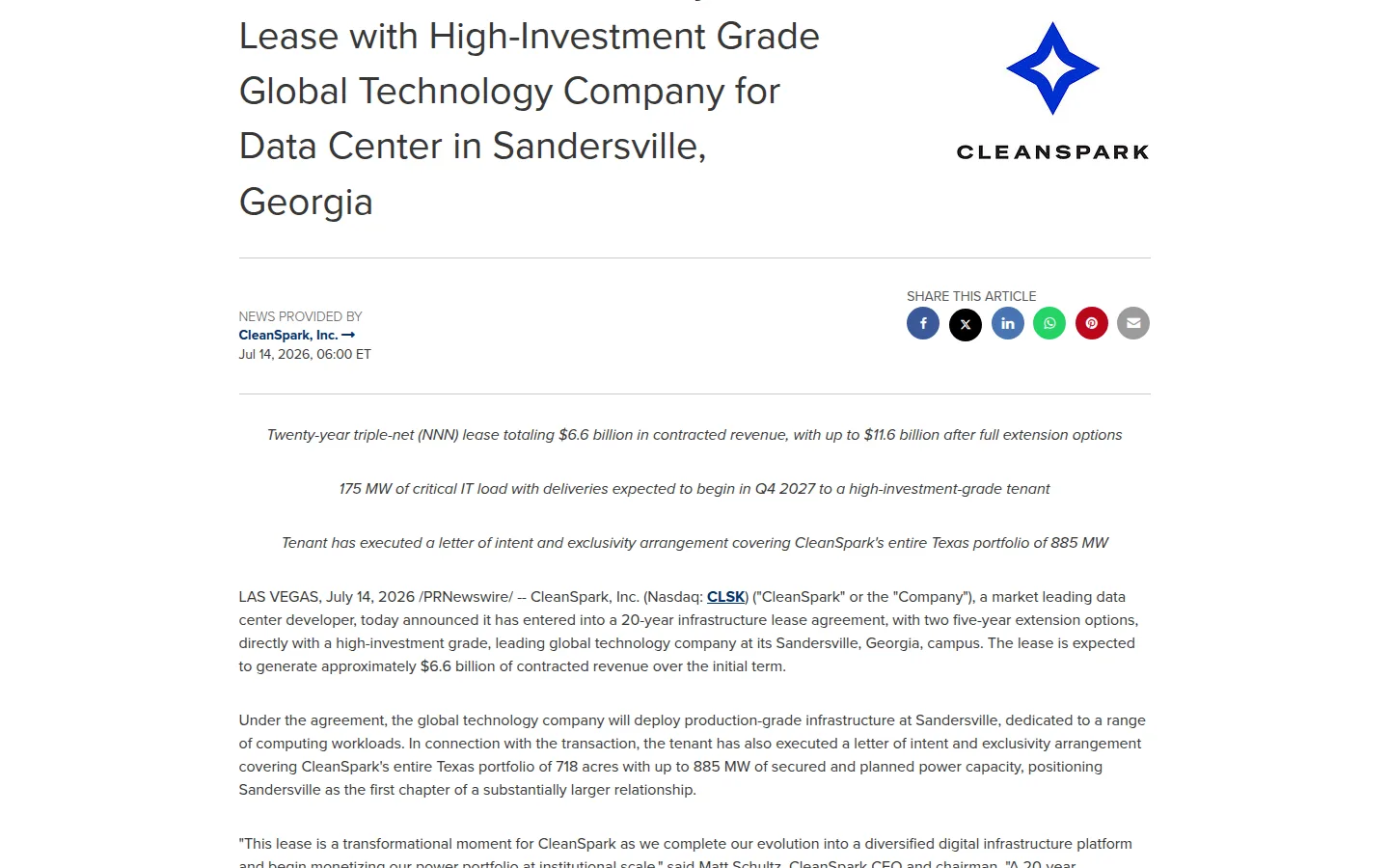
CleanSpark’s own announcement is the strongest source for the Sandersville contract. It describes a 20-year triple-net lease for 175 megawatts of critical IT load, with approximately $6.6 billion of contracted revenue over the initial term. The tenant can extend the agreement in five-year increments for as many as 15 additional years, which is how the stated potential value can rise to about $11.6 billion. Phased delivery is scheduled to begin in the fourth quarter of 2027.
Those numbers are contractual projections, not revenue already recognized in CleanSpark’s accounts. The tenant was described only as a high-investment-grade global technology company. The announcement does not identify it, disclose the final construction financing package, or remove development and execution risk. Readers should therefore separate three things: present bitcoin-mining results, capital required to build the site, and future lease revenue that depends on delivery.
How Cryptsy checked this report
Cryptsy compared the lease claims against CleanSpark’s investor-relations release and checked the financial context against its quarterly-results archive. Market-price reactions and analyst estimates remain secondary-source observations and can change quickly. The durable takeaway is narrower: CleanSpark is using power, land and data-centre development as a second business line, while bitcoin prices and construction funding still affect the risk profile.