

MEXC charges 0% maker fees and 0.05% taker fees on spot trading, one of the lowest published rates of any major exchange. Pay fees with MX and the taker rate drops 20%, to 0.04%, according to MEXC’s fee page on October 8, 2026. Crypto deposits are free. Futures makers also pay 0%.
Key Takeaways
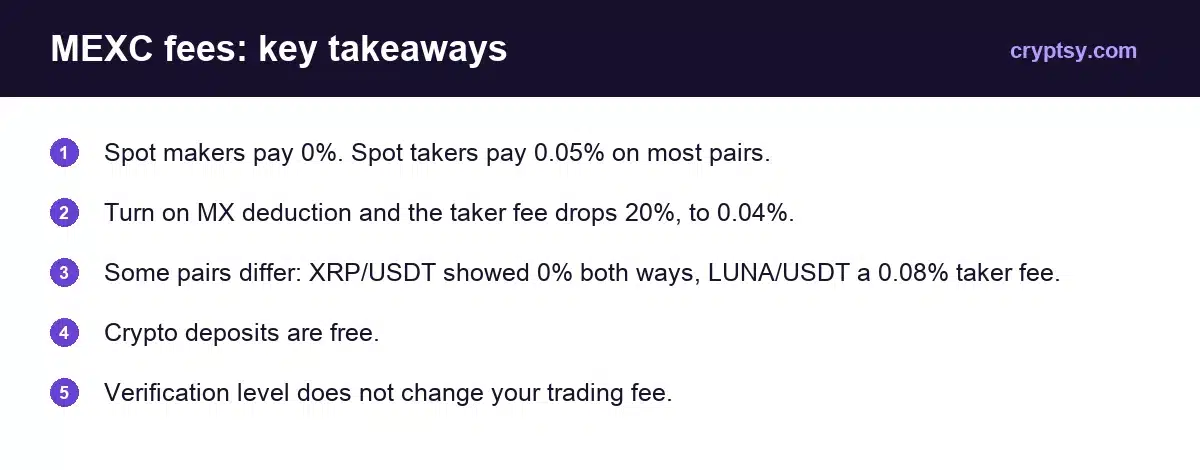
- Spot makers pay 0%. Spot takers pay 0.05% on most pairs.
- Turn on MX deduction and the taker fee drops 20%, to 0.04%.
- Some pairs differ: XRP/USDT showed 0% both ways, LUNA/USDT a 0.08% taker fee.
- Crypto deposits are free.
- Verification level does not change your trading fee.
How MEXC’s Spot Trading Fees Work
MEXC’s headline number is simple: makers pay nothing, takers pay 0.05%. That undercuts Binance’s 0.1% flat rate, Coinbase’s retail rates, and Kraken’s 0.40%/0.80% base tier by a wide margin. It’s one of the reasons MEXC gets recommended for high-frequency or algorithmic traders who care about basis points adding up over thousands of trades.
MX token holders get a discount on top. Switch on MX deduction and your spot fees are paid in MX at 20% off, for as long as there is MX in the account. MEXC’s fee page and its MX page both give 20% as the figure. Older guides mention a 50% discount for holding 500 MX. MEXC’s current pages do not list it.
| Fee Type | Maker | Taker |
|---|---|---|
| Spot (standard) | 0.000% | 0.050% |
| Spot (fees paid in MX) | 0.000% | 0.040% |
| Futures | 0.000% | Varies by contract |
For comparison, KuCoin’s base rate runs 0.1%/0.1%, meaningfully higher than MEXC’s on both sides.
MEXC Deposit Fees
Cryptocurrency deposits on MEXC are completely free, no exceptions by coin. Fiat purchases work differently. MEXC’s Help Center says its own card purchase route charges approximately 2%. Third-party providers set their own price, which MEXC shows in the Payment Details before you confirm.
If you’re funding your account with crypto you already hold elsewhere, there’s no reason to expect a surprise fee on the way in. The cost, if there is one, shows up on payment processing for fiat, not on the deposit itself.
MEXC Withdrawal Fees
Withdrawal fees on MEXC are set per coin and network, a flat network fee applied regardless of how much you’re withdrawing. Send $50 or $50,000 of the same asset on the same network, the fee is identical. This differs from percentage-based withdrawal models on some other platforms, and it means small withdrawals of low-value coins can feel proportionally expensive while large withdrawals barely notice the fee.
Exact amounts vary by asset and blockchain, so check the specific coin’s withdrawal page before sending, network fees on MEXC track roughly with what the underlying blockchain charges plus a small margin.
MEXC Fees vs Other Exchanges
MEXC’s 0% maker fee is genuinely rare among major exchanges. Most competitors, including Bybit and Binance, charge something on both sides even at the base tier. The tradeoff traders should weigh isn’t the fee line item alone, it’s coin selection, liquidity depth on less common pairs, and regulatory footprint, since MEXC operates with a lighter compliance posture in some regions than US-regulated exchanges like Coinbase or Kraken.
For a full picture of how the major platforms stack up beyond just fees, see our best crypto exchange guide.
Does KYC Level Affect MEXC’s Trading Fees?
No. MEXC’s fee schedule applies the same way regardless of your verification tier. What verification actually changes is your withdrawal ceiling, unverified accounts are capped far lower than fully verified ones, not the percentage you pay per trade.
What does a $1,000 trade cost on MEXC?
Using the spot rates on MEXC’s fee page on October 8, 2026:
- Buy $1,000 of Bitcoin with a limit order that waits on the book (maker): $0.
- Buy $1,000 with a market order (taker): 0.05% = $0.50.
- Same taker trade paying fees in MX: 0.04% = $0.40.
MEXC notes that rates can vary with platform events and your region, and a few pairs carry a special rate, so check the pair before you trade.
Which MEXC Pairs Have Different Rates?
The 0%/0.05% rate is the default, not a promise for every market. MEXC’s fee page tags pairs as “0 Fees” or “Special Rate” where they differ. On October 8, 2026 it showed:
| Pair | Maker | Taker | Taker with MX |
|---|---|---|---|
| BTC/USDT, ETH/USDT, SOL/USDT | 0% | 0.05% | 0.04% |
| XRP/USDT (0 Fees tag) | 0% | 0% | 0% |
| LUNA/USDT (Special Rate tag) | 0% | 0.08% | 0.064% |
Those tags move with promotions. MEXC says maker and taker rates “may vary with platform events or user region” and tells users to check their trade history for the rate actually charged.
MX deduction has limits too. The discount ends when your MX runs out, some pairs are excluded, and for futures you have to move MX into the futures wallet first.
Maker or Taker: Which One Are You?
MEXC’s own example makes it easy. Say the best ask for a coin is 100 USDT.
- Place a buy order at 99 USDT. It sits on the order book until someone sells to you. You are the maker and pay 0%.
- Place a buy order at 100 USDT. It fills straight away against an existing order. You are the taker and pay 0.05%.
Market orders are always taker orders. If you are not in a hurry, a limit order just inside the spread trades for free.
Frequently Asked Questions
What is MEXC’s trading fee?
0% maker and 0.05% taker on spot trading at the standard rate, dropping to 0.04% when you pay fees in MX.
Does MEXC charge deposit fees?
Crypto deposits are free. Card purchases cost approximately 2%, per MEXC’s Help Center. Third-party providers set their own price, shown before you confirm.
Is MEXC cheaper than Binance or KuCoin?
On headline spot fees, yes. MEXC’s 0%/0.05% beats Binance’s flat 0.1% and KuCoin’s 0.1%/0.1% base tier.
How do MX token holdings lower fees?
Turning on MX deduction pays your spot fees in MX at a 20% discount, which takes the taker fee from 0.05% to 0.04%. The discount stops when your MX runs out, and some pairs are excluded.
Does verification level change MEXC’s trading fees?
No. Verification affects withdrawal limits, not the trading fee percentage you pay.
Does MEXC charge the same fee on every pair?
No. Most spot pairs are 0% maker and 0.05% taker, but MEXC marks some pairs as zero-fee and others with a special rate. Check the fee page or the order screen for the pair you are trading.