

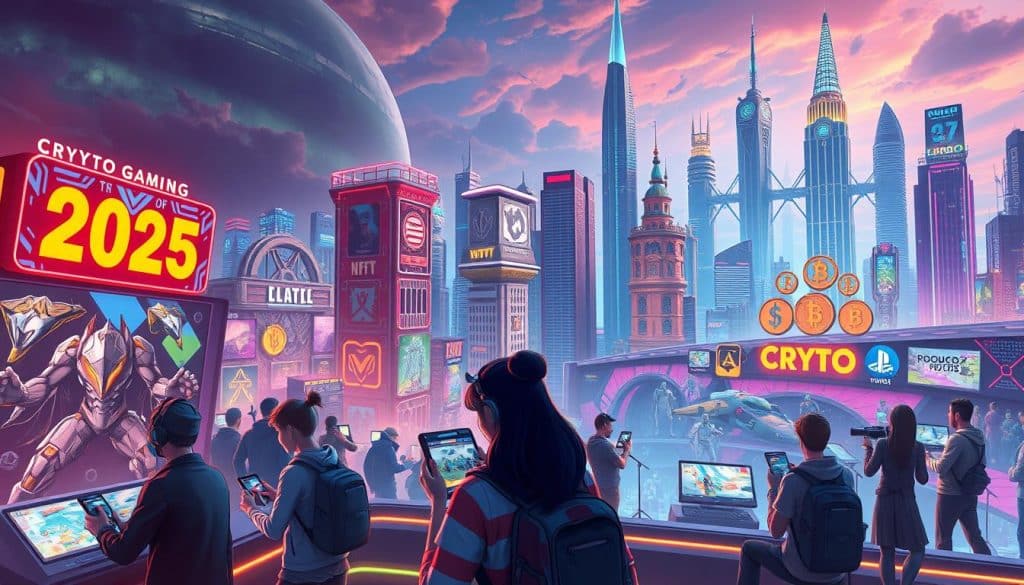
Crypto games have evolved beyond simple click-to-earn mechanics. In 2026, blockchain games can combine traditional gameplay with cryptocurrency rewards, NFTs, player-owned assets, and on-chain economies.
The best crypto games to play & earn are not necessarily the games with the highest advertised rewards. A better choice combines enjoyable gameplay, a sustainable economy, transparent reward mechanics, reasonable entry costs, active development, and enough liquidity to make digital assets useful.
Players can potentially earn crypto or NFT-based rewards by completing quests, winning competitions, trading assets, staking eligible tokens, or contributing to a game’s ecosystem. However, rewards are variable and playing a blockchain game does not guarantee a profit or a particular income level.
Before spending money, evaluate the game as both a game and a crypto ecosystem.
What Are Crypto Games to Play and Earn?
Crypto games are video games that use blockchain technology to give players access to digital assets, tokens, NFTs, or other on-chain rewards.
The term “play-to-earn” traditionally described games where players earned cryptocurrency or NFTs directly through gameplay. The industry has increasingly moved toward play-and-earn models, where gameplay comes first and blockchain ownership or rewards are integrated into the experience.
Common earning mechanisms include:
- Completing quests and missions
- Winning tournaments or player-versus-player matches
- Earning game tokens
- Collecting and trading NFTs
- Selling player-created assets
- Renting or lending eligible digital assets
- Participating in game economies
- Completing seasonal events
- Staking or locking game-related tokens where the game offers that functionality
The reward may have real market value, but that value can rise or fall substantially.
What Are the Best Crypto Games to Play and Earn in 2026?
There is no universally best crypto game because players have different priorities. For a practical shortlist, evaluate games according to:
| Factor | Why it matters |
|---|---|
| Gameplay | A game needs to remain enjoyable without relying entirely on rewards |
| Reward system | Determines how players actually earn |
| Token economy | Helps assess inflation and potential sustainability |
| NFT utility | Shows whether assets have a meaningful purpose |
| Entry cost | Determines how much capital a new player needs |
| Blockchain | Affects transactions, fees and asset infrastructure |
| Liquidity | Determines whether tokens or NFTs can realistically be traded |
| Development activity | Indicates whether the game is still being maintained |
| Community | Can support longevity and player retention |
| Security | Reduces exposure to wallet, contract and marketplace risks |
A game with a modest reward system and strong gameplay can be a better long-term choice than a game advertising unusually high returns.
How Does Play-to-Earn Crypto Gaming Work?
A typical blockchain game connects gameplay with one or more blockchain assets. For example:
- You create a game account and connect a compatible wallet if required.
- You play missions, battles, quests, races, or other activities.
- The game awards eligible tokens, NFTs, points, or other assets.
- Assets may be used in the game, traded, sold, or transferred depending on the rules.
- If the asset has an external market, its value may change over time.
Not every game follows this model. Some blockchain games use NFTs purely for ownership and do not promise direct financial rewards. Others may have tokens but limit how they are earned or withdrawn. The distinction matters because owning an in-game asset is not the same as earning a guaranteed financial return.
Best Types of Crypto Games
Crypto gaming now covers multiple genres rather than one specific type of game.
Strategy and Trading Games
Strategy games can combine traditional decision-making with blockchain economies. Players may manage resources, build teams, compete against other players, or trade game assets. These games are often attractive to players who want an economic layer without sacrificing strategic depth.
RPG and Adventure Games
Blockchain RPGs can use NFTs for characters, equipment, land, or other assets. Potential blockchain features include:
- Player-owned characters
- Tradable equipment
- NFT collectibles
- Token-based economies
- On-chain achievements
However, NFT ownership should complement the game rather than replace good gameplay.
Collectible and Card Games
Trading-card-style blockchain games use NFTs to represent cards or other collectible assets. Players may be able to:
- Collect cards
- Build competitive decks
- Trade assets
- Participate in tournaments
- Earn rewards
The value of collectible assets depends on demand, rarity, utility, and the health of the game’s ecosystem.
Battle and Competitive Games
Competitive blockchain games can reward players through tournaments, rankings, seasonal events, or digital assets.
The most sustainable models generally reward skill and participation rather than simply paying users for repetitive actions.
Metaverse and Virtual-World Games
Metaverse games provide persistent virtual environments where users can socialize, create content, build spaces, or trade digital assets.
Examples of blockchain-enabled virtual-world ecosystems include Decentraland and The Sandbox.
Their economic models can involve virtual land, user-generated content, collectibles, and marketplace transactions.
Casual and Free-to-Play Crypto Games
Some blockchain games reduce the financial barrier to entry by allowing users to start without buying expensive NFTs.
These can be useful for beginners because they allow players to evaluate:
- Gameplay quality
- Reward mechanics
- Wallet requirements
- Transaction costs
- Withdrawal processes
before committing significant capital.
How Can You Earn Crypto by Playing Games?
Crypto games can provide several different earning mechanisms.
Earn Through Gameplay
Some games distribute tokens, NFTs, or other rewards for completing activities.
Examples include:
- Winning matches
- Completing quests
- Reaching milestones
- Participating in events
- Completing seasonal objectives
The exact reward structure varies by game.
Earn Through NFTs
NFTs can represent characters, weapons, land, cards, skins, or other digital assets.
Depending on the game’s rules, players may be able to sell or trade these assets.
However, an NFT is only economically useful if there is sufficient demand and liquidity. Minting an NFT does not guarantee that somebody will buy it later.
Earn Through Competitive Events
Some games offer tournament prizes or other competitive rewards.
This creates a model closer to esports: skill and performance determine eligibility for rewards.
Earn Through Creating Content
Certain blockchain gaming ecosystems allow players or creators to build:
- Maps
- Items
- Experiences
- Wearables
- Digital environments
- Other user-generated assets
If the ecosystem supports a marketplace, creators may be able to sell those assets.
Earn Through Trading
Players may trade in-game assets when the game permits it.
But trading should be treated as speculative activity rather than guaranteed income.
Prices can fall, liquidity can disappear, and transaction fees can turn a profitable-looking trade into a loss.
Which Crypto Games Are Worth Trying?
Rather than presenting a static ranking based on outdated token prices, the following categories provide a more useful starting point.
Axie Infinity
Axie Infinity helped popularize blockchain gaming and remains an important case study in play-to-earn economics.
The ecosystem uses blockchain assets and has evolved considerably from its earlier reward model.
It is useful for players interested in:
- Creature-based gameplay
- Collectible assets
- Competitive battles
- Blockchain economies
The key lesson from Axie Infinity is that strong player demand and gameplay matter. A token economy cannot depend indefinitely on new players buying assets from earlier participants.
Illuvium
Illuvium is a blockchain-based RPG and creature-collection ecosystem focused on higher-end visuals and strategic gameplay.
It demonstrates the industry’s attempt to move from basic NFT mechanics toward more conventional game design.
Players should evaluate the current game modes, asset requirements, token economics, and availability before committing funds.
Guild of Guardians
Guild of Guardians is designed around team-based RPG gameplay and mobile accessibility.
The project illustrates another direction for blockchain gaming: integrating digital ownership into a format familiar to mainstream mobile players.
Before buying assets, check the current game economy, marketplace activity, and reward mechanics.
Decentraland
Decentraland is a virtual-world platform where users can interact with digital spaces and blockchain-based assets.
Its ecosystem is particularly relevant to players interested in:
- Virtual land
- Social experiences
- Digital collectibles
- User-created content
- Virtual commerce
The value of assets can be highly dependent on community activity and market demand.
The Sandbox
The Sandbox combines virtual worlds, user-generated experiences, and blockchain-based digital assets.
Its model is particularly relevant to creators who want to participate in building experiences rather than simply completing traditional game missions.
Star Atlas
Star Atlas focuses on a science-fiction setting and blockchain-based digital assets.
Its broader concept demonstrates how blockchain games can combine exploration, economies, collectibles, and persistent digital environments.
As with any developing game, users should check the current playable features rather than relying solely on long-term project plans.
How Much Can You Actually Earn Playing Crypto Games?
There is no reliable universal amount.
A player’s potential result depends on:
- Game rewards
- Token price
- NFT prices
- Skill level
- Time invested
- Entry costs
- Marketplace fees
- Blockchain transaction costs
- Competition
- Reward changes
- Tax obligations
Consider a simplified hypothetical example.
Suppose a player earns rewards worth $5 per week but spends $2 per week on transaction and game-related costs.
The simplified net amount is:
$5 − $2 = $3 per week
That equals approximately $156 per year if the same result continued for 52 weeks.
But this is only an illustration. Real crypto-game earnings can be much higher, lower, or negative, and token prices can change the fiat value of rewards substantially.
The most important calculation is net earnings
Instead of asking:
“How much crypto does this game give me?”
ask:
“What is the expected value of my rewards after entry costs, fees, time, and asset-price changes?”
That produces a much more useful measure of whether a game is economically worthwhile.
Are Free Crypto Games Really Free?
Not always.
A game may have no upfront purchase price but still involve costs such as:
- Blockchain transaction fees
- Marketplace fees
- NFT purchases
- Wallet fees
- Token swaps
- Optional in-game purchases
- Time spent earning rewards
A “free-to-play” blockchain game can therefore have an economic cost even when there is no initial payment.
Before connecting a wallet, check whether the game requires you to sign transactions or approve token spending.
What Are NFTs Used for in Crypto Games?
NFTs are blockchain-based tokens designed to represent unique assets.
In gaming, they can represent:
- Characters
- Weapons
- Equipment
- Land
- Cards
- Cosmetics
- Collectibles
- Creator assets
The important question is not simply whether a game has NFTs.
Ask:
What does the NFT actually do?
A useful NFT might provide gameplay functionality, access, customization, or genuine ownership of a transferable asset.
An NFT with no meaningful utility may have little value beyond speculation.
What Are Crypto Game Tokens Used For?
Game tokens can have different functions depending on the ecosystem.
They may be used for:
- In-game purchases
- Governance
- Marketplace transactions
- Staking
- Character upgrades
- Crafting
- Tournament entry
- Rewards
A token’s usefulness does not guarantee that its price will rise.
Watch token supply
Tokenomics matter because a game can distribute large amounts of rewards while demand remains limited.
Important metrics include:
- Total supply
- Circulating supply
- Emission schedule
- Unlock schedule
- Token sinks
- Utility
- Treasury allocation
- Team and investor allocations
- Governance structure
A game with rapidly increasing token supply can experience significant inflation if demand does not grow at a similar rate.
How Do You Evaluate a Crypto Game Before Playing?
Use this checklist before depositing money or purchasing NFTs.
1. Play the game first
If possible, experience the core gameplay before buying assets.
A game that is not enjoyable without financial rewards may have difficulty retaining players.
2. Read the tokenomics
Find out:
- How many tokens exist?
- How many are circulating?
- How fast are new tokens released?
- What creates demand?
- What removes tokens from circulation?
3. Check NFT utility
Determine whether NFTs have genuine gameplay or ecosystem functionality.
4. Check marketplace liquidity
An asset can have a displayed price without having enough buyers to sell at that price.
5. Review the team and development activity
Look for:
- Development updates
- Release history
- Public documentation
- Community communication
- Security disclosures
- Partnerships that can be independently verified
Do not treat celebrity endorsements or social-media followers as proof that a game is legitimate.
6. Verify the blockchain
Check which blockchain the game uses and understand its wallet and transaction requirements.
7. Review smart-contract risks
Where contracts are publicly available, examine whether they have undergone reputable security reviews or audits.
An audit can reduce some risks but does not guarantee that a protocol or game is safe.
8. Check withdrawal and marketplace rules
Understand:
- Minimum withdrawal amounts
- Network fees
- Marketplace fees
- Transfer restrictions
- KYC requirements
- Geographic restrictions
9. Research the community
Look for genuine discussion about gameplay, bugs, withdrawals, economy changes, and developer communication.
10. Start small
Never risk money you cannot afford to lose simply because a game promises cryptocurrency rewards.
What Are the Biggest Risks of Play-to-Earn Games?
Crypto gaming combines the risks of gaming platforms with cryptocurrency and blockchain risks.
Token-price risk
A reward worth $20 today could be worth substantially less tomorrow.
NFT liquidity risk
An NFT can have a listed market price without having a willing buyer at that price.
Game-economy risk
If rewards are greater than sustainable demand, the game’s economy can become heavily inflationary.
Smart-contract risk
Blockchain applications can contain vulnerabilities that result in asset losses.
Wallet security risk
A compromised private key or malicious transaction approval can expose digital assets.
Platform risk
Games can shut down, change their reward systems, lose funding, or stop development.
Regulatory and tax risk
Cryptocurrency and NFT rules vary by jurisdiction and can change over time.
Time risk
Even if a game provides positive token rewards, the effective hourly return may be poor.
This is one of the most overlooked issues in play-to-earn gaming.
If a player earns $10 after spending five hours completing repetitive tasks, the gross reward is equivalent to $2 per hour before costs and taxes.
That may be acceptable as entertainment, but it should not automatically be described as a profitable income strategy.
Is Play-to-Earn Still Worth It in 2026?
It can be, but players should approach it primarily as gaming with an optional economic component rather than guaranteed income.
The strongest blockchain games are likely to be those where players have reasons to participate beyond token speculation.
Look for games with:
- Strong core gameplay
- Active development
- Sustainable token economics
- Meaningful asset utility
- Healthy player communities
- Transparent marketplaces
- Reasonable entry costs
- Clear ownership and withdrawal rules
A game that depends entirely on continuously rising token prices has a more fragile economic model than one supported by genuine gameplay demand.
Crypto Gaming vs. Traditional Gaming
| Feature | Traditional games | Blockchain games |
|---|---|---|
| Gameplay | Primary focus | Primary focus, ideally |
| Digital ownership | Usually platform-controlled | Can use blockchain ownership |
| Tradable assets | Usually restricted | May be transferable |
| Cryptocurrency | Usually absent | May be integrated |
| NFTs | Rare | Common in some ecosystems |
| Secondary markets | Platform-dependent | Often blockchain-enabled |
| Wallets | Usually unnecessary | Often required for on-chain assets |
| Financial risk | Usually limited to purchases | Can include token and asset-price risk |
Blockchain does not automatically make a game better.
Its main difference is that blockchain can introduce portable ownership, verifiable scarcity, transferable assets, and programmable economic systems.
Whether those features improve a particular game depends on the implementation.
How Blockchain Changes Digital Ownership
Traditional games generally store player assets within the developer’s database.
Blockchain games can represent certain assets as tokens recorded on a public blockchain.
This can make ownership:
- Verifiable
- Transferable
- Potentially portable
- Visible on-chain
But “true ownership” has limits.
Owning an NFT does not necessarily mean you own the underlying game, intellectual property, artwork copyright, or the right to use the asset outside the ecosystem.
Always read the game’s terms and NFT license.
Emerging Crypto Gaming Trends in 2026
Better gameplay over token speculation
The industry continues to move toward games that need to be enjoyable independently of financial rewards.
More sophisticated economies
Developers are experimenting with token sinks, controlled emissions, crafting systems, marketplace fees, and other mechanisms designed to balance supply and demand.
Greater use of account abstraction and simpler wallets
Reducing blockchain complexity can make Web3 games more accessible to mainstream players.
Interoperability experiments
Some ecosystems are exploring ways to make assets usable across multiple applications or games.
True interoperability remains technically and economically difficult, however. An NFT being technically transferable does not mean another game has to support it.
AI-assisted game development
AI tools can help developers create dialogue, environments, characters, and dynamic content.
The long-term effect on blockchain games will depend on implementation rather than the presence of AI alone.
More emphasis on sustainable economies
Developers and players have learned that rewards funded primarily by new-user growth can become unstable.
Future games are more likely to focus on economic systems supported by genuine player demand.
How to Avoid Crypto Gaming Scams
Be especially cautious if a game:
- Guarantees profits
- Promises a fixed daily return
- Requires an urgent deposit
- Uses fake celebrity endorsements
- Requires you to send crypto directly to an unknown wallet
- Requests your seed phrase or private key
- Uses an unexplained withdrawal fee to unlock your balance
- Claims an NFT will definitely increase in value
- Hides the game’s terms or tokenomics
- Makes unrealistic claims about partnerships or player numbers
Never give a game’s developer, moderator, support agent, or another player your private key or seed phrase.
A legitimate service does not need your wallet’s recovery phrase to verify ownership.
A Simple Crypto Gaming Strategy for Beginners
If you are new to blockchain gaming, a conservative approach is:
- Choose a game with gameplay you genuinely enjoy.
- Start with a free or low-cost entry option where available.
- Create a separate wallet for experimental gaming activity.
- Fund it only with an amount you can afford to lose.
- Learn how the game’s token and NFT economy works.
- Calculate transaction and marketplace fees.
- Avoid buying assets solely because their price has increased.
- Test withdrawals before committing significant funds.
- Track your transactions for tax purposes.
- Reassess the game if its economy or development direction changes.
This approach treats rewards as an optional benefit rather than guaranteed income.
Frequently Asked Questions About Crypto Games to Play & Earn
What are the best crypto games to play and earn in 2026?
The best crypto games depend on what you want from the experience. Look for games with strong gameplay, active development, transparent tokenomics, useful digital assets, reasonable entry costs, and functioning marketplaces. Examples of major blockchain gaming ecosystems to research include Axie Infinity, Illuvium, Guild of Guardians, Decentraland, The Sandbox, and Star Atlas, but availability and game features can change.
Can you really earn money by playing crypto games?
Yes, some blockchain games distribute tokens or NFTs that can have market value. However, earnings are not guaranteed. Token prices, NFT liquidity, game rewards, transaction fees, entry costs, and the amount of time required can determine whether a player actually makes a profit.
What is the difference between play-to-earn and play-and-earn?
Play-to-earn emphasizes financial rewards for gameplay, while play-and-earn generally prioritizes the gaming experience and treats blockchain rewards as an additional feature. Play-and-earn models aim to make the game useful and enjoyable even when token rewards fluctuate.
Are crypto games free to play?
Some are free or offer free entry, but blockchain games can still involve wallet, transaction, marketplace, NFT, or token costs. Always check the complete cost of participating rather than relying on the phrase “free to play.”
Which crypto games let you earn NFTs?
Many blockchain games use NFTs for characters, equipment, land, cards, collectibles, or creator assets. The exact earning mechanics vary. Check the game’s official documentation to determine whether NFTs are earned through gameplay, purchased, crafted, or obtained through special events.
Do you need a crypto wallet to play blockchain games?
Not always. Some games hide or simplify blockchain functionality through custodial accounts or integrated wallets. Games involving on-chain ownership or transfers may require a compatible wallet.
Are NFT games profitable?
NFT games can generate rewards or allow players to trade digital assets, but profitability is not guaranteed. NFT prices depend on supply, utility, demand, and liquidity. Players can lose money even when an asset has a nominal market price.
What blockchain is best for crypto games?
There is no universally best blockchain for gaming. Developers may prioritize transaction fees, speed, scalability, wallet support, ecosystem size, security, or developer tooling. Evaluate the blockchain together with the game rather than assuming one network makes a game better.
How do crypto games make money?
Crypto games can generate revenue through NFT sales, marketplace fees, token-related activity, in-game purchases, subscriptions, licensing, creator economies, and other monetization methods. A sustainable game should have an economic model that does not depend entirely on continuously recruiting new players.
Are play-to-earn games safe?
Safety varies widely. Risks include scams, malicious smart contracts, wallet compromises, volatile tokens, NFT illiquidity, game shutdowns, and fraudulent marketplaces. Research the developer, contracts, official links, tokenomics, and withdrawal process before committing funds.
Can you lose money playing crypto games?
Yes. You can lose money through token-price declines, NFT price declines, transaction fees, scams, hacks, poor liquidity, game shutdowns, or purchases that cannot be resold at the expected price.
What is the best way to start with crypto gaming?
Start with a game that has low or no entry costs, learn its mechanics, use a dedicated wallet, and avoid committing significant funds until you understand the economy. Never share your seed phrase or private key.
Final Takeaway
The best crypto games to play and earn in 2026 are games that remain valuable as games even when cryptocurrency rewards fluctuate.
Blockchain can give players new forms of digital ownership and economic participation, but it also introduces financial and technical risks that do not exist in most traditional games.




















