


Last updated: September 28, 2026.
To participate in an IDO (Initial DEX Offering), you set up a self-custody wallet, fund it with the token the launchpad accepts, register on the launchpad, qualify for an allocation (usually by holding or staking the launchpad’s own token), and then claim your tokens when the sale closes. The whole process takes from a few days to a few weeks, depending on the launchpad’s registration window and KYC checks.
IDOs are high risk. Most new tokens fall below their sale price after launch, and fake launchpads are a common scam. This guide walks through each step and the safety checks that matter most.
Key Takeaways
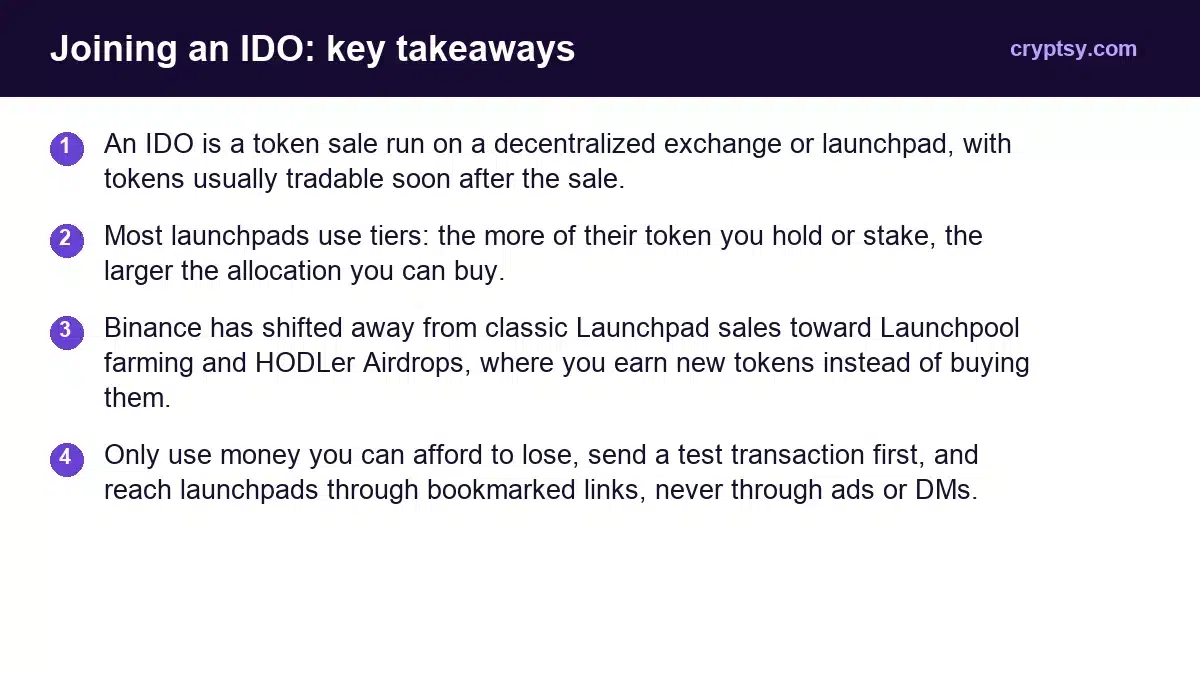
- An IDO is a token sale run on a decentralized exchange or launchpad, with tokens usually tradable soon after the sale.
- Most launchpads use tiers: the more of their token you hold or stake, the larger the allocation you can buy.
- Binance has shifted away from classic Launchpad sales toward Launchpool farming and HODLer Airdrops, where you earn new tokens instead of buying them.
- Only use money you can afford to lose, send a test transaction first, and reach launchpads through bookmarked links, never through ads or DMs.
What Is an IDO?
An Initial DEX Offering is a way for a crypto project to sell its token to the public through a decentralized launchpad instead of a centralized exchange. Buyers commit funds (often USDC, USDT, ETH or BNB) during a sale window, and the project distributes its tokens when the sale ends. Liquidity is then added to a decentralized exchange so the token can trade.
| Type | Where it runs | Who controls access | Typical requirement |
|---|---|---|---|
| IDO | Decentralized launchpad or DEX | The launchpad’s smart contracts and tier rules | Self-custody wallet, often launchpad-token staking and KYC |
| IEO | A centralized exchange (e.g. Binance Launchpad) | The exchange | Exchange account with KYC, often a balance of the exchange’s token |
| ICO | The project’s own website | The project | Varies; the least vetted format |
What You Need Before Joining an IDO
- A self-custody wallet that supports the launchpad’s chain, such as MetaMask or Rabby for EVM chains, or Phantom for Solana.
- Funds on the right chain: the sale currency (often USDC or USDT) plus a little of the native token for gas.
- Identity documents if the launchpad requires KYC, usually a government ID and a selfie check.
- The launchpad’s token, if its tier system requires you to hold or stake it.
- A separate “IDO wallet” with only the funds you plan to use, so a malicious approval can’t reach your main holdings.
How to Participate in IDOs: Step by Step
Step 1: Pick a Launchpad and Check It Is Real
Choose an established launchpad on the chain you use. Find its official site through the project’s verified X account or a data site such as CoinGecko, then bookmark it. Scam sites copy launchpad designs and buy search ads, so never follow a link from a DM or a sponsored result.
Step 2: Set Up and Fund Your Wallet
Create or use a dedicated wallet, move the sale currency onto the right chain, and keep extra native tokens for gas. If you need to move funds between chains, use a reputable bridge; our guide to the best crypto bridge platforms covers the safer options.
Step 3: Register and Complete KYC
Connect your wallet on the launchpad, create an account and complete KYC if required. Many launchpads block residents of certain countries, including the United States for many sales, so read the eligibility rules before you buy the launchpad’s token.
Step 4: Qualify for an Allocation
Most launchpads use a tier system. You hold or stake the launchpad’s token for a set period, and your tier decides how much you can buy, or whether you enter a lottery. Some sales add whitelist tasks such as joining a community or completing a quiz. Staking the launchpad token exposes you to that token’s price, which is an extra risk on top of the IDO itself.
Step 5: Commit Funds During the Sale Window
When the sale opens, approve the sale currency and commit your allocation. Approve only the amount you are spending, not an unlimited approval. Double-check that the contract address matches the one the launchpad published.
Step 6: Claim Your Tokens and Track the Vesting Schedule
After the sale, claim your tokens from the launchpad. Many IDOs release only part of your tokens at launch and vest the rest over weeks or months. Note the unlock dates, because large unlocks often bring selling pressure.
How to Participate in IDOs Safely
- Only use money you can afford to lose. Many new tokens trade below their sale price within months.
- Research the team and token supply. Anonymous teams, a large team or investor share with short vesting, and no working product are red flags.
- Check the contract. Look up the token on a block explorer such as Etherscan and confirm it matches the official announcement.
- Use a separate wallet and limited approvals, and revoke old approvals afterwards.
- Ignore guarantees. No legitimate sale promises returns; “guaranteed 100x” is a scam signal.
- Never share your seed phrase. No launchpad, support agent or KYC process will ever need it.
How to Join an IDO Launchpad: Choosing One
Launchpads differ by chain, token requirements and the kind of projects they list. Compare them on these points before committing:
| What to check | Why it matters |
|---|---|
| Track record | How past sales have traded after launch, visible on CoinGecko or CoinMarketCap |
| Tier requirements | How much of the launchpad token you must hold or stake, and for how long |
| Project vetting | Whether the launchpad audits contracts and checks teams |
| Chains supported | Whether you can participate from the chain you already use |
| Country restrictions | Many sales exclude US and other residents |
| Refund policy | Some launchpads offer refunds if a token falls below the sale price shortly after launch |
Well-known launchpads include Polkastarter, DAO Maker and Seedify for cross-chain and gaming projects, and exchange platforms such as Binance’s. Requirements and listings change often, so check each platform’s current rules.
Binance Launchpool vs Launchpad
Binance Launchpad is a token sale: you commit BNB or another asset and buy a new token before it lists, often through a lottery or a pro-rata allocation based on your BNB balance. Binance Launchpool is farming: you stake BNB or stablecoins for a set period and earn the new token as a reward, without buying it. According to Binance Academy, Launchpool keeps your staked assets intact, which makes it the lower-risk way to get new tokens. In 2025 and 2026, most new Binance listings have been distributed through Launchpool and HODLer Airdrops rather than classic Launchpad sales.
Common IDO Mistakes to Avoid
- Buying the launchpad token at a peak just to reach a tier, then losing more on that token than the IDO makes.
- Ignoring vesting: a token that looks cheap at launch can fall as locked supply unlocks.
- Signing unlimited approvals on unfamiliar contracts.
- Chasing hype from paid promoters instead of reading the tokenomics.
- Forgetting taxes: in many countries, selling IDO tokens is a taxable event. Keep records of every buy and sale.
Looking for lower-risk ways to earn on crypto while you wait for sales? See the best places to stake stablecoins and the best DeFi platforms of 2026.
Frequently Asked Questions
How do I participate in an IDO?
Set up a self-custody wallet, fund it on the right chain, register on a launchpad, complete KYC if required, qualify for an allocation through the launchpad’s tier system, commit funds during the sale window, and claim your tokens afterwards.
How do I participate in IDOs safely?
Use a separate wallet with limited token approvals, reach launchpads only through bookmarked official links, verify the token contract on a block explorer, research the team and vesting schedule, and never invest more than you can afford to lose.
How much money do I need for an IDO?
It depends on the launchpad. Allocations can be small, but many platforms require you to hold or stake their own token to qualify, which often costs more than the allocation itself. Add gas fees on top.
What is the difference between Binance Launchpool and Launchpad?
Launchpad is a token sale where you buy a new token before listing. Launchpool is farming, where you stake BNB or stablecoins and earn the new token as a reward without spending your staked assets.
Are IDOs profitable?
Some are, many are not. New tokens are volatile, and many trade below their sale price after launch as vested tokens unlock. Treat IDOs as high-risk bets, not reliable income.
Can US residents participate in IDOs?
Often not. Many launchpads and token sales exclude US residents because of securities rules. Check each sale’s eligibility terms before buying any launchpad token.




















