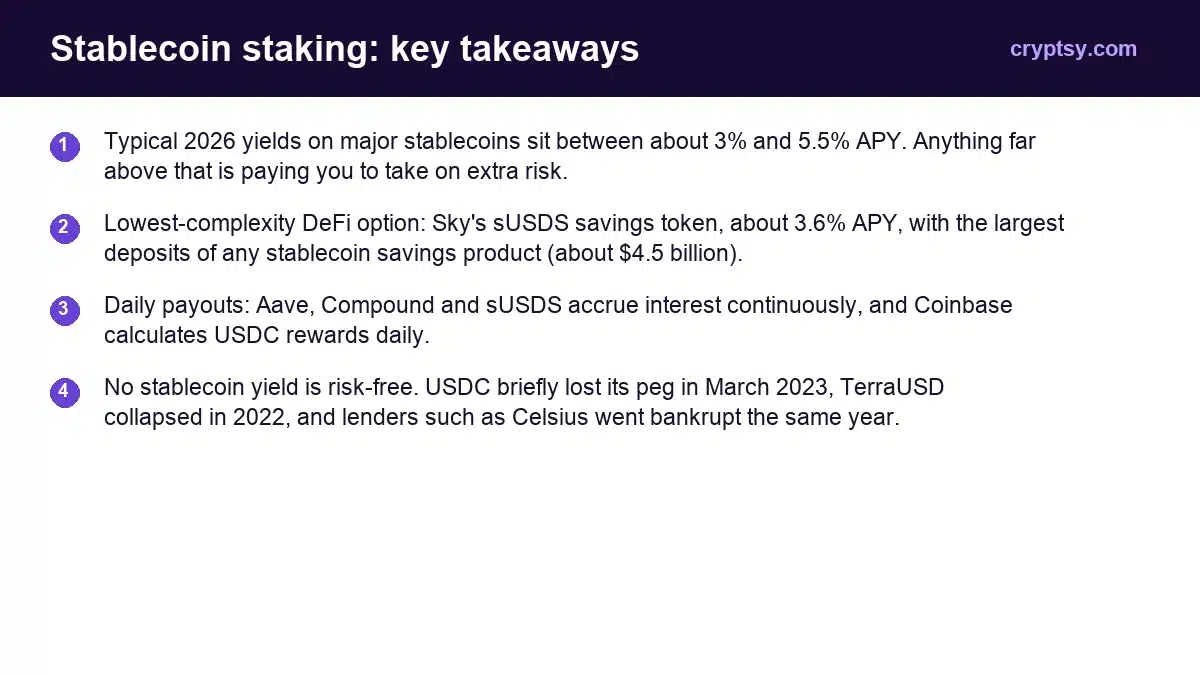
Stablecoin yield products can depeg and carry provider, protocol, custody, liquidity, and market risk; steady returns are not guaranteed.
The cited USDT, USDC, and DAI market-cap figures are time-sensitive. Current availability and APY claims for staking platforms require independent verification.
APY rates vary and require current independent verification. Established exchanges and specialized DeFi protocols require current verification.
Crypto staking rewards and DeFi staking returns are variable and not categorically safer than other cryptocurrency products.
Key Takeaways
- Stablecoins can depeg and do not eliminate issuer, custody, liquidity, protocol, or investment risk
- APY rates require current independent verification for every platform
- Major stablecoins have combined market cap exceeding $227 billion
- Stablecoin products do not guarantee predictable income or freedom from price risk
- Platform availability, risk, and comparative yields require current verification
- TVL and investor-confidence claims require dated, traceable evidence
Current Stablecoin Staking Market Landscape
Stablecoin-product maturity, compliance, security, and investor-confidence claims require dated evidence.
Current total-value-locked and deposit figures for staking platforms require independent verification.
Market Growth Statistics and Recent Trends
Any growth or total-value-locked claim for the stablecoin staking sector requires a dated, traceable source and is not established here.
Institutional participation, portfolio-allocation, and yield-effect claims in these staking market trends require dated, traceable evidence.
Forecasts for total staked stablecoin value require dated, traceable evidence. Market development depends on technology, demand, and the regulatory environment.
Regulatory Developments Affecting Staking
Any SEC position on staked cryptocurrencies depends on the asset, product, facts, and current authority; no general exemption or adoption effect is established here.
Legislative proposals, their application to staking providers, and any consumer-protection or adoption effects require current legal evidence.
European requirements and effects on market conditions or institutional participation require current jurisdiction-specific evidence.
Major security incidents, including the Terra Luna collapse in 2022, show why staking products require independent review of risk, transparency, custody, and asset handling.
Provider audit, monitoring, bug-bounty, reserve, and risk-control claims require current primary evidence and do not eliminate loss risk.
Proof-of-reserves, insurance, and asset-segregation claims are provider-specific and require verification of scope, date, and legal effect.
Do not infer current safety, confidence, or industry-wide improvement from general claims; evaluate each product and provider separately.
Stablecoin Staking Platforms: Verification Checklist
Stablecoin products may pay interest or rewards, but they retain depeg, custody, smart-contract, liquidity, and provider risk. This article does not establish a best-platform ranking.
- Binance Earn: Verify current product availability, terms, supported assets, rates, and exchange risk.
- Aave: Verify current markets, mechanics, audits, rates, and smart-contract risk.
- Coinbase: Verify current product availability, custody, compliance status, terms, and rates.
- Curve Finance: Verify current pool mechanics, incentives, audits, liquidity, and loss risks.
Current rates, security evidence, custody, withdrawal terms, and loss scenarios require provider-specific verification; this checklist does not establish suitability.
Stablecoin Product Due-Diligence Factors
No stablecoin staking platform is ranked or recommended here. The following claims require current provider-specific verification:
Key factors to evaluate:
- APY and Rewards: Verify the source and calculation of any yield, fees, incentives, and loss exposure without assuming sustainability.
- Security and legal evidence: Verify audits, controls, incident history, legal entity, and applicable regulatory status; none guarantees protection.
- Liquidity: Verify withdrawal rights, queues, lock-ups, minimums, network fees, and suspension terms.
- Asset and network support: Verify current contracts, issuers, networks, custody, and depeg risks.
Verification cannot establish safety, suitability, or future returns.
Centralized-Exchange Stablecoin Claims to Verify
Centralized exchange products require current verification of access, interface, security, custody, returns, and technical complexity.
Current earning programs, access terms, features, and rates for exchange staking options require verification.
Binance Earn and Flexible Savings
Binance stablecoin-product availability, flexible or locked options, access, and returns require current official verification.
Flexible-product deposit, withdrawal, liquidity, and APY terms require current independent verification.
Locked-product commitments, reward differences, promotional rates, availability, and renewal behavior require current verification.
Coinbase Prime and Institutional Staking
Coinbase retail and institutional staking, rates, Prime features, and limits require current official verification.
Coinbase compliance, insurance, institutional ties, and investor-appeal claims require current legal and provider evidence.
Coinbase Prime promotes portfolio and custody services, but current product and institutional-volume claims require independent verification.
Kraken Staking and Earn Programs
Kraken reward, earn-program, on-chain, off-chain, stablecoin, custody, and validator claims require current official verification.
Kraken transparency, security, fee-disclosure, and fund-protection claims require current independent evidence.
Kraken flexible, fixed-term, update, demand, and analytics features require current product verification.
Current APY Rates Comparison
Current exchange APY, minimum, and supported-asset data require official verification:
| Exchange | Flexible APY | Locked APY (30 days) | Minimum Amount | Supported Stablecoins |
|---|---|---|---|---|
| Binance | Not independently verified | Not independently verified | Verify current minimum | Verify current assets |
| Coinbase | Not independently verified | Not independently verified | Verify current minimum | Verify current assets |
| Kraken | Not independently verified | Not independently verified | Verify current minimum | Verify current assets |
| Gemini | Not independently verified | Not independently verified | Verify current minimum | Verify current assets |
Rate drivers and relationships with liquidity or lock periods require current evidence.
Platform Security Features
Cold storage, insurance, security, and compliance claims for centralized exchange products require current provider-specific evidence and do not guarantee fund protection.
Binance SAFU existence, legal effect, value, coverage, and cold-storage claims require current official verification.
Coinbase FDIC pass-through eligibility, cybersecurity insurance, cold storage, audit, and testing claims require current legal and technical verification.
Kraken proof-of-reserves, audit, reporting, fund-protection, and monitoring claims require current independent evidence.
Each exchange’s insurance, regulatory status, security history, rates, and withdrawal terms require current verification. This article does not rank their relative importance or recommend a provider.
Stablecoin Product Verification Checklist
This article does not provide instructions to acquire, transfer, deposit, or stake assets. Before any transaction, verify:
- Provider and product: Verify the legal entity, official domain, contract, jurisdiction, custody, current availability, and incident history.
- Asset and network: Verify the issuer, contract address, network, wallet compatibility, depeg risk, fees, and transfer restrictions without relying on this article.
- Custody and authorization: Determine who controls funds and keys, what permissions a contract requests, and how withdrawal, insolvency, and loss are handled.
- Claims and terms: Verify rates, fees, lock-ups, withdrawal rights, tax treatment, and loss scenarios using current primary evidence.
Verification cannot make a product safe or prevent partial or total loss.
DeFi Stablecoin Product Claims to Verify
DeFi staking protocols may use smart contracts for lending or liquidity provision. Current returns, custody, and access terms require verification.
DeFi products replace some centralized counterparties with smart-contract, oracle, governance, liquidity, and other risks; they do not eliminate counterparty or loss risk.
Aave Protocol Lending Markets
Aave stablecoin markets, supported assets, supply mechanics, and rates require current primary-source verification.
Aave interest-rate, utilization, and Safety Module mechanics and risk effects require current primary-source verification.
Aave market and aToken mechanics, interest accrual, and availability require current primary-source verification when comparing a crypto lending platform.
Aave’s cumulative lending volume requires dated, traceable evidence and is not a substitute for evaluating current protocol risk.
Compound Finance Interest Rates
Compound Finance market, rate, interest, and token-reward mechanics require current primary-source verification.
COMP distribution and any effect on effective returns require current verification and do not guarantee additional yield.
Whether and how Compound’s current token mechanics accrue or compound interest, and the associated performance and incident history, require primary-source verification.
Curve Finance Liquidity Pools
Curve Finance pool, trading-fee, liquidity, and CRV-reward mechanics require current primary-source verification.
Curve slippage, volume, fee income, and veCRV reward claims require current verification and are not guaranteed.
Curve gauge, emissions, locking, and optimization mechanics require current primary-source verification; no infrastructure-leadership claim is established here.
| Protocol | Average APY | Token Rewards | Security Audits |
|---|---|---|---|
| Aave Protocol | Not independently verified | Requires current verification | Requires current verification |
| Compound Finance | Not independently verified | Requires current verification | Requires current verification |
| Curve Finance | Not independently verified | Requires current verification | Requires current verification |
| Combined use | Not independently verified | Requires current verification | Requires current verification |
Smart Contract Risk Assessment
Smart contract risks need careful evaluation when picking DeFi protocols. Audit histories and findings for Aave, Compound, and Curve require current verification from primary sources.
Bug-bounty scope and past incident performance require current evidence and do not establish protocol safety.
Risk assessment should consider code maturity, total value locked, and incident history. Performance and incident claims require current primary-source verification.
Protocol Token Rewards
Protocol token governance, reward, and yield effects for AAVE, COMP, and CRV require current verification; token values can fall.
Token distribution, Safety Module, incentive, and COMP reward schedules require current primary-source verification.
Curve veCRV governance, locking, and reward mechanics require current verification; alignment and outcome claims are not established here.
USDC Product Claims to Verify
The cited USDC market-cap figure is time-sensitive. Current USDC product availability and returns require verification and are not necessarily stable.
USDC issuer, reserve, institution, network, and product-flexibility claims require current primary-source verification.
Circle Yield and Institutional Products
Circle Yield availability, eligibility, infrastructure, and USDC product claims require current official verification; no secure-yield conclusion is established here.
Circle’s product eligibility, minimums, and service terms require current verification from official documentation.
Circle partnerships, oversight, and reserve-report claims require current primary evidence and verification of their scope.
Gemini Earn USDC Programs
Gemini Earn availability, USDC product terms, charter status, and any consumer protection require current official verification.
Gemini custody, segregation, counterparty-risk, and rate claims require current legal and product evidence.
Any effect of a New York charter, audit, or compliance status on a USDC product requires current legal verification and does not guarantee protection.
Celsius Status Requires Current Evidence
This article does not establish Celsius Network’s current legal entity, bankruptcy status, product availability, custody, or USDC interest rates. Verify any claim against current court records, regulatory records, and official terms.
No recovery, trust, risk-management, or future-product claim is established here. Do not treat a prior or restructured entity as an available or suitable product without current independent evidence.
Interest Rate Comparisons
USDC product rates and risks vary; comparative claims about centralized and DeFi returns require dated evidence.
| Platform | Annual Percentage Yield | Minimum Amount | Platform Type | Risk Level |
|---|---|---|---|---|
| Circle Yield | Not independently verified | Verify current minimum | Institutional | Requires assessment |
| Gemini Earn | Not independently verified | Verify current minimum | Centralized Exchange | Requires assessment |
| Coinbase Prime | Not independently verified | Verify current minimum | Institutional | Requires assessment |
| Aave Protocol | Not independently verified | Verify current minimum | DeFi Protocol | Requires assessment |
Rate drivers and comparative stability for institutional or DeFi products require dated evidence.
Withdrawal Terms and Conditions
Withdrawal terms vary across USDC staking platforms. Verify current processing and lock-up conditions before choosing a product.
Circle Yield withdrawal notice and processing terms require current verification from official documentation.
Gemini Earn availability, withdrawal limits, penalties, and processing times require current verification from official documentation.
Whether a platform imposes early-withdrawal penalties or term commitments requires current product-specific verification. This article does not establish any withdrawal terms.
USDC processing, congestion, and priority-withdrawal claims require current network and provider evidence.
DAI Staking Through MakerDAO and Partner Platforms
The cited DAI market cap is time-sensitive. Current DAI governance, decentralization, network, collateral, stability, and yield-product claims require primary-source verification.
DAI yield products, MakerDAO mechanisms, and third-party automation require current verification and carry DeFi risk.
MakerDAO Savings Rate Mechanism
Current DAI Savings Rate contract, deposit, yield, and funding mechanics require primary-source verification.
DSR governance, voting, and rate mechanics require current verification; historical rates require dated, traceable evidence.
DSR deposit, withdrawal, access, and return terms require current primary-source verification; neither access nor predictable returns are guaranteed.
The DSR is not risk-free; contract, governance, liquidity, and depeg risks remain.
Yearn Finance DAI Vaults
Yearn Finance strategy, vault, compounding, and comparative-performance claims for DAI staking require current verification.
Yearn strategy, lending, liquidity, yield-farming, fee, and comparative-return claims require current verification.
Automation, market adaptation, gas-cost, and portfolio-performance claims require current evidence.
Investors exploring cryptocurrency strategies should verify current Yearn Finance functionality and risk before use.
DAI Stability Fee Impact
The current stability fee, DAI supply mechanics, DSR mechanics, and any effect on rates or yields require dated primary evidence; no causal relationship is established here.
Any relationship between fee changes and DSR rates requires dated, traceable evidence.
Verify current protocol mechanics and governance proposals before assessing possible rate changes.
Governance Participation Claims
DAI and MKR governance, voting rights, parameter effects, and yield implications require current primary-source verification.
Participation and MKR incentive claims require current platform and protocol verification.
Governance scope, collateral decisions, and risk-parameter processes require current verification and do not guarantee ecosystem protection.
Decentralized DAI products require current verification of access, transparency, governance, yields, and risks; no unique advantage is established here.
Yield Farming vs Staking: Strategic Comparison
Staking and yield farming use different mechanisms and risks; current product behavior requires verification.
Reward sources, validation, fees, protocol tokens, and return predictability vary by product and require current evidence.
Risk and Reward Analysis
Staking and yield-farming returns vary with market and protocol conditions. Both carry risks, including slashing, smart-contract failures, and token-price changes.
The relative complexity and risk of staking and yield farming depend on the specific protocols, contracts, custody, leverage, liquidity, fees, and market conditions; no general ranking is established here.
Consider these risk factors when evaluating staking strategies:
- Validator performance and uptime requirements
- Network slashing conditions and penalties
- Lock-up periods and withdrawal restrictions
- Token price fluctuations during staking periods
The following yield-farming claims require product-specific verification and do not establish a general comparison with staking:
- Smart contract audit quality and security
- Protocol governance changes affecting rewards
- Liquidity pool composition and balance shifts
- Impermanent loss from token price divergence
Capital Efficiency Differences
Capital efficiency, locks, flexibility, returns, and minimum periods vary by product and require current verification.
Yield-farming allocation and withdrawal flexibility require current protocol verification and do not guarantee manager benefit.
Opportunity-cost, DeFi yield, gas-fee, and profit effects depend on current product and network conditions.
Impermanent Loss Scenarios
Impermanent-loss outcomes depend on pool mechanics, token-price paths, fees, incentives, rebalancing, and exit conditions. This article does not establish when or whether a loss is realized.
Example: providing liquidity to an ETH/USDC pool with ETH at $2,000. If ETH rises to $3,000, the pool rebalances. This results in fewer ETH tokens and more USDC.
Impermanent-loss and staking-risk mechanics vary; token quantity and rewards require current protocol verification.
Time Horizon Considerations
Investor-preference, exit, flexibility, and DeFi yield claims require product-specific evidence.
Long-term staking does not guarantee stable, predictable, or better rewards.
Market-cycle effects on yield-farming options, trading, and staking consistency require dated evidence.
Consider your situation when choosing between yield farming vs staking:
- Available time for portfolio management and monitoring
- Technical knowledge of DeFi protocols and risks
- Risk tolerance for potential capital loss
- Need for liquidity and fund accessibility
- Tax implications of different reward structures
The decision depends on product mechanics, loss risk, liquidity needs, tax circumstances, and individual objectives. Labels such as conservative or aggressive do not establish that staking or yield farming is suitable, predictable, or likely to provide higher returns.
Staking Tool and Analytics Claims to Verify
Analytics tools and risk assessment frameworks can display selected data, but their coverage, accuracy, and timeliness require verification. They do not optimize or guarantee returns.
Current aggregation, data-timing, coverage, and outcome claims for staking platforms and portfolio management tools require verification.
Analytics tools and risk frameworks may inform review, but no evidence here links their use to investment success.
DeFiPulse and TVL Tracking
DeFiPulse coverage, availability, TVL methodology, and DeFi analytics require current verification; TVL does not establish security.
TVL is one limited metric and does not by itself establish protocol health, trust, or investment suitability.
DefiLlama and DeFiPulse coverage, cross-chain analytics, filters, and historical data require current verification; neither replaces independent risk assessment.
Zapper and Portfolio Management
Zapper dashboard, protocol, wallet, reward, liquidity, and token coverage require current product verification.
Zapper allocation, monitoring, and APY tracking features require current verification and do not establish better decisions or returns.
Zapper transaction-history, fee, gas, and net-return calculations require current verification; independently validate any output before using it for staking decisions.
Zapper network support, including Ethereum, Polygon, and Arbitrum, and any unified portfolio management view require current verification.
APY Vision and Yield Comparison
APY.vision yield comparison tools, data timing, coverage, and filters require current product verification.
DeFi Rate coverage, history, comparison, and staking-tool features require current verification and do not guarantee better returns.
Current APY tracking, alert, and coverage features require product verification; they do not guarantee better earnings.
Audit, insurance, governance, return, sustainability, and portfolio-filter features require current tool and protocol verification.
Risk Assessment Frameworks
Risk assessment should not treat audit scores or auditor identity as proof of security.
Protocol age does not establish stability or team competence; yield, risk, and DeFi analytics claims require evidence.
Nexus Mutual or other coverage, due-diligence, recourse, cost, and terms require current legal and product verification.
Governance participation and transparency do not establish sustainability, decentralization, or healthy development.
| Risk Factor | Evidence to Check | Limitation |
|---|---|---|
| Smart Contract Audits | Scope, date, findings, remediation | Audits do not guarantee safety |
| Protocol Age | Current incident and change history | Age does not guarantee stability |
| TVL | Methodology and dated changes | TVL does not establish safety |
| Insurance Coverage | Current policy, exclusions, and limits | Coverage and recovery are not guaranteed |
Due diligence may include team-background evidence, tokenomics analysis, and competitive positioning. Anonymous teams, unsupported yield claims, and limited transparency warrant further investigation, but applying a framework does not avoid DeFi staking loss or failure.
Market Forecast and Analysis Claims Requiring Evidence
Stablecoin-product growth, institutional involvement, regulatory effects, and market maturation require named, dated evidence.
Expert analysis and forecasts about future products, returns, and market development require named, dated sources.
Institutional allocations to staking strategies and effects on platform operations require named, dated evidence.
Yield Forecasts and Market Outlook
Any market outlook or yield-growth forecast requires a named, dated, traceable source.
Centralized-exchange and DeFi yields vary; claims that competition will narrow differences require evidence.
Market conditions can change yields, and using multiple platforms does not guarantee steady income or lower overall risk.
Institutional Adoption Impact
Institutional adoption, pension or insurance participation, capital flows, and demand effects require named, dated evidence.
Claims that corporate treasuries use or explore stablecoin staking, or that institutional interest affects platform development or compliance, require named, dated evidence and are not established here.
Claims linking institutional demand to custody, security, reporting, infrastructure, or retail benefits require evidence.
Federal Reserve Policy Effects
Any relationship between Federal Reserve policy and stablecoin-product yields requires dated empirical evidence; direct causation is not established here.
Claims of a strong link between traditional rates and crypto yields, or of predictive value, require dated analysis.
Effects of monetary policy on platform strategy, user behavior, staking, or trading require dated evidence.
Emerging Platform Trends
Claims about liquid-staking-derivative market growth or future trends, including product flexibility, require dated, traceable evidence and are not established here.
Cross-chain popularity, automation, portfolio management, banking integration, and adoption claims require current evidence.
Real-world-asset, tokenization, and traditional-investment yield products require current legal and product verification.
| Platform Type | Estimated 2026 Yields | Institutional Interest | Risk Level |
|---|---|---|---|
| Centralized Exchanges | Not independently verified | Not independently verified | Requires assessment |
| DeFi Protocols | Not independently verified | Not independently verified | Requires assessment |
| Liquid Staking Platforms | Not independently verified | Not independently verified | Requires assessment |
| Yield Farming Platforms | Not independently verified | Not independently verified | Requires assessment |
Market and regulatory claims require current primary verification before choosing a product.
Claims about links between traditional finance and DeFi, user benefits, and staking market predictions require named, dated evidence.
Future of Stablecoin Staking and Passive Crypto Income
Future stablecoin-product growth, blockchain adoption, and institutional activity are Unknown without dated evidence.
Future trends may include:
- Institutional adoption: product, custody, and transparency effects require evidence.
- Real-world assets: availability, legal status, and yield claims require verification.
- Regulation: investor protection and compliance effects require current legal analysis.
Stablecoin products may pay rewards, but security, transparency, liquidity, and sustainability require current verification.
Conclusion
Stablecoin products may pay rewards but carry depeg, custody, protocol, liquidity, and provider risk. Compare terms and independently verify current rates.
DeFi protocols like Aave and Curve require technical knowledge, and their current yields require independent verification. They also carry smart contract risks; diversification does not guarantee success.
Diversifying across centralized and DeFi options does not guarantee returns or reduce every risk. Review the risks of investing in stablecoins before staking.
Verify APY, regulation, platform security, and any DeFiPulse or Zapper coverage before relying on them.
Starting small does not remove risk, and stablecoin products do not offer categorically reliable income.
Platform selection and diversification cannot guarantee success or returns.