


Last updated: September 28, 2026. Figures checked against DefiLlama and each bridge’s official documentation on that date.
The best crypto bridge platforms in 2026 are Across for fast transfers between Ethereum layer 2s, Stargate V2 for moving native stablecoins and ETH across major chains, Circle CCTP for native USDC, and Portal (Wormhole) for reaching Solana, Sui and other non-EVM chains. Which one is best depends on the route, the asset and how much security risk you accept.
Bridges are also the riskiest part of crypto infrastructure. DefiLlama’s hack tracker logs about $750 million lost to bridge-related exploits in 2026 so far, compared with roughly $37 million in all of 2024. Choosing a bridge is a security decision first and a fee decision second.
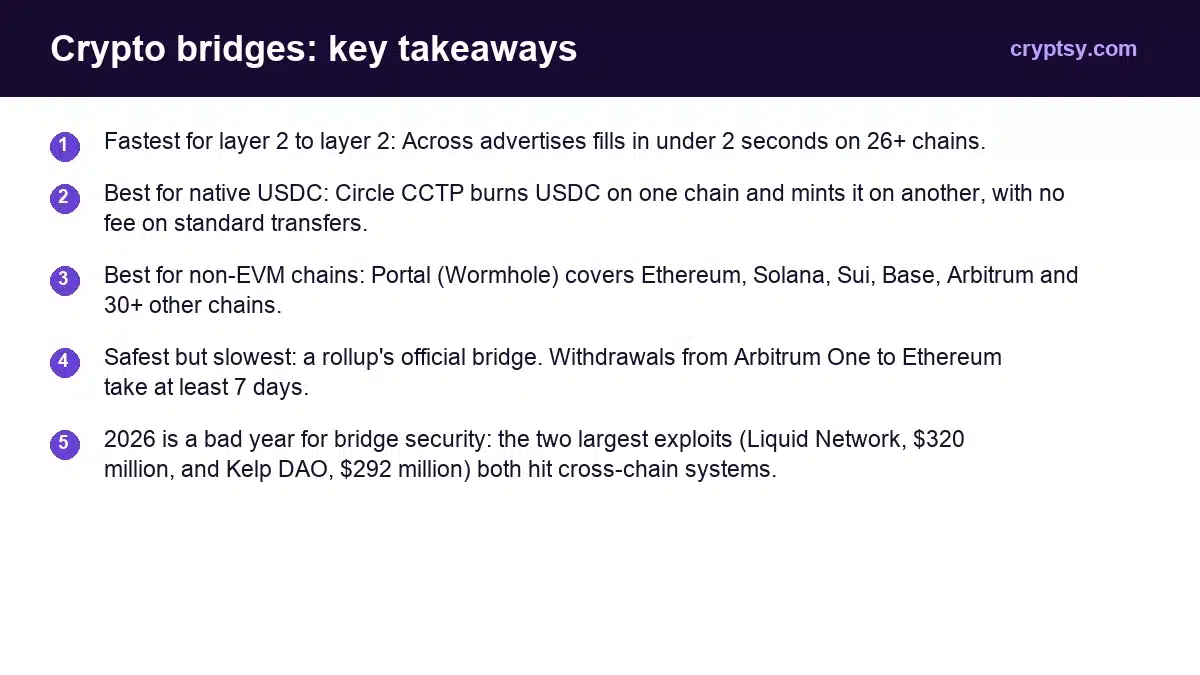
Key Takeaways
- Fastest for layer 2 to layer 2: Across advertises fills in under 2 seconds on 26+ chains.
- Best for native USDC: Circle CCTP burns USDC on one chain and mints it on another, with no fee on standard transfers.
- Best for non-EVM chains: Portal (Wormhole) covers Ethereum, Solana, Sui, Base, Arbitrum and 30+ other chains.
- Safest but slowest: a rollup’s official bridge. Withdrawals from Arbitrum One to Ethereum take at least 7 days.
- 2026 is a bad year for bridge security: the two largest exploits (Liquid Network, $320 million, and Kelp DAO, $292 million) both hit cross-chain systems.
Best Crypto Bridge Platforms Compared (2026)
| Bridge | Best for | How it moves funds | Speed | Fees | Chains |
|---|---|---|---|---|---|
| Across | Ethereum L2 to L2, fast ETH and stablecoin moves | Intents: a relayer pays you on the destination chain, then is repaid | Under 2 seconds (advertised) | Relayer and gas fee, shown before you confirm | 26+ |
| Stargate V2 | USDC, USDT and ETH between major chains | Liquidity pools on LayerZero messaging; “Bus” batches or “Taxi” sends alone | Taxi sends right away; Bus waits to batch | Variable fee per route | 13 plus Hydra chains |
| Circle CCTP | Native USDC only | Burn on source chain, mint on destination | Standard waits for finality; Fast Transfer settles after soft finality | No fee on standard transfers; onchain fee for Fast Transfer; gas on both chains | See Circle’s supported-chains list |
| Portal (Wormhole) | Solana, Sui and other non-EVM chains | Lock or burn on source chain, mint on destination via Wormhole guardians | Varies by chain finality | Portal charges $0; you still pay gas | Ethereum, Solana, Sui, Base, Arbitrum and 30+ more |
| Orbiter Finance | Cheap rollup-to-rollup ETH and stablecoin moves | A “Maker” receives your deposit and pays out from its own wallet on the destination | Not stated in official docs | Fixed withholding fee (e.g. 0.0014 ETH) plus trading fee (e.g. 0.03% for ETH) | Rollups plus several non-EVM chains |
| Official rollup bridges | Largest amounts, lowest trust assumptions | The rollup’s own contracts on Ethereum | Arbitrum deposits 15 to 30 min; withdrawals 7+ days | Gas only | One rollup each |
Sources: Across docs, Stargate V2 docs, Circle CCTP, Portal Bridge, Orbiter Finance docs and Arbitrum docs, checked September 2026. Fees change with gas prices, so always read the quote on screen before you confirm.
The Best Crypto Bridges in 2026, Reviewed
1. Across Protocol: Fastest Bridge Between Ethereum Layer 2s
Across is an intent-based bridge. You state what you want to receive on the destination chain, and an independent relayer sends it to you from its own funds. The relayer is repaid later from Across’s liquidity. That is why Across can advertise fills in under 2 seconds across 26+ chains, and why more than $40 billion has moved through it according to its documentation.
Across suits everyday moves of ETH, USDC and USDT between Arbitrum, Optimism, Base and other rollups. One caution for 2026: in July, an attacker used forged Solana deposit events to drain about $4.5 million from a relayer’s operating funds. Across said its core smart contracts were not compromised, and the relayer software was patched.
2. Stargate V2: Best for Native Stablecoins and ETH
Stargate V2 moves native assets such as USDC, USDT and ETH from pool to pool, using LayerZero for the cross-chain message. It supports 13 chains plus “Hydra” chains, where Stargate locks assets on the source chain and mints a matching asset on chains without native liquidity. You choose between “Taxi”, which sends your transfer on its own, and “Bus”, which batches transfers with other users to cut cost.
LayerZero-based systems are only as strong as their verifier setup. The $292 million Kelp DAO exploit in April 2026 hit Kelp’s own rsETH bridge, which relied on a single LayerZero verifier (DVN). LayerZero said the incident was isolated to that configuration, and Kelp has since sued LayerZero. Stargate itself was not the target.
3. Circle CCTP: Best Way to Move USDC
Circle’s Cross-Chain Transfer Protocol does not wrap USDC. It burns USDC on the source chain, Circle signs an attestation, and native USDC is minted on the destination chain. You receive real USDC, not a bridged IOU, so there is no wrapped token that can lose its peg if a bridge is hacked.
Standard CCTP transfers carry no Circle fee; you pay only gas on both chains. Fast Transfer settles after soft finality for an onchain fee.
4. Portal (Wormhole): Best for Non-EVM Chains
Portal is Wormhole’s token bridge app. It connects Ethereum, Solana, Sui, Base, Arbitrum and 30+ other chains, supports 100+ tokens, and charges no Portal fee beyond network gas. It is the practical choice when one side of the transfer is not an EVM chain.
Wormhole’s history matters here. In February 2022 its Portal bridge lost about $326 million to a signature-verification flaw, one of the largest crypto hacks on record; the funds were replaced. Portal currently holds about $1.87 billion in TVL according to DefiLlama.
5. Orbiter Finance: Low-Cost Rollup Transfers
Orbiter uses a “Maker” model. You send funds to a Maker’s address on the source chain, and the Maker pays you from its own wallet on the destination chain. Disputes go to an arbitration mechanism. Fees are a fixed withholding fee (for example 0.0014 ETH or 1.5 USDC) plus a trading fee (for example 0.03% for ETH or 0.3% for USDC), adjusted to destination gas prices.
Because Orbiter pays out from Maker wallets instead of a pooled contract, DefiLlama shows almost no TVL for it. That is a feature of the design, not a sign the bridge is idle. Watch for fake copies of its site: lookalike domains such as “orbtierfinance.com” appear in search results.
6. Official Rollup Bridges: Safest for Large Amounts
Every major rollup runs its own bridge: the Arbitrum Bridge, the Base Bridge and the Optimism Bridge, among others. They rely only on the rollup’s own contracts on Ethereum, which makes them the lowest-trust option. DefiLlama lists the Arbitrum Bridge at about $3.48 billion TVL and the Base Bridge at about $3.03 billion.
The trade-off is time. Arbitrum deposits arrive in roughly 15 to 30 minutes, but withdrawals back to Ethereum wait out a challenge period of at least 7 days. For large sums, many users deposit through the official bridge and withdraw through a fast bridge such as Across.
How Crypto Bridges Work
Blockchains cannot read each other’s state, so a bridge has to prove on chain B that something happened on chain A. There are three common designs.
- Lock and mint: your tokens are locked in a contract on chain A and a wrapped copy is minted on chain B. If the lock contract is drained, the wrapped copies lose their backing. Portal and Stargate’s Hydra chains work this way.
- Burn and mint: the issuer destroys tokens on chain A and creates them on chain B. Circle CCTP and Chainlink CCIP token transfers use this model, which avoids pooled liquidity.
- Liquidity networks and intents: a relayer or market maker pays you on chain B from its own funds and settles later. Across and Orbiter work this way, which is why they are fast.
Want the bigger picture on why assets need to move between chains at all? See our guide to layer 1 vs layer 2 cryptocurrencies.
Which Crypto Bridge Is Cheapest and Fastest?
There is no single cheapest bridge. Cost depends on the route, the token, gas prices and the amount. As a rule of thumb:
- Moving USDC: Circle CCTP standard transfers have no protocol fee, only gas.
- Small ETH moves between rollups: Orbiter’s fixed fee plus 0.03% is often cheap; compare it with an Across quote.
- Speed above all: intent-based bridges such as Across fill in seconds.
- Large amounts to a rollup: the official bridge costs only gas and carries the least trust risk.
Bridge aggregators compare several bridges and show the best quote for a route. They save time, but you are trusting whichever bridge the aggregator picks, so check its name before you sign.
Crypto Bridge Security in 2026
Bridges hold large pools of assets behind a small set of signers, verifiers or proof checks, which makes them prime targets. DefiLlama’s hack data shows bridge-related losses of about $1.9 billion in 2022, $302 million in 2023, $37 million in 2024 and $38 million in 2025, before rising to about $750 million in 2026 so far.
| Date | Bridge | Loss | Cause |
|---|---|---|---|
| Mar 2022 | Ronin Bridge | $624M | Validator keys compromised |
| Oct 2022 | Binance Bridge | $570M | Proof verifier bug |
| Feb 2022 | Portal (Wormhole) | $326M | Signature verification flaw |
| Sep 2026 | Liquid Network | $320M | Software bug allowed unbacked L-BTC to be minted and redeemed |
| Apr 2026 | Kelp DAO rsETH (LayerZero) | $292M | Forged cross-chain message via a single-verifier setup |
| Aug 2022 | Nomad | $190M | Forged proofs |
| Jul 2023 | Multichain | $126M | Validator keys compromised; the bridge shut down |
Source: DefiLlama hacks database, September 2026, plus incident reports from CoinDesk and LayerZero. In the Liquid Network case, the attacker returned 3,400 BTC and Blockstream said it would cover the rest of the 1:1 peg.
How to Bridge Crypto Safely
- Type the bridge address yourself or use a bookmark. Fake bridge sites appear in search results and copy real designs.
- Send a small test amount first, especially on a route you have not used before.
- Prefer native assets over wrapped ones. Native USDC through CCTP carries no wrapped-token depeg risk.
- Check the bridge’s recent incidents on DefiLlama or its own status page before moving a large amount.
- Revoke old token approvals to bridge contracts you no longer use.
- Don’t leave funds in a bridge. Move them to a wallet you control; our guide to cold storage methods covers the options.
Crypto Bridges by the Numbers (TVL, September 2026)
Total value locked shows how much sits in a bridge’s contracts. It is a useful size signal for lock-and-mint bridges, but it undercounts intent-based bridges like Across and burn-and-mint systems like CCTP, which hold little idle liquidity.
| Bridge | Type | TVL |
|---|---|---|
| LayerZero V2 | Messaging / bridge | $8.02B |
| Arbitrum Bridge | Official rollup bridge | $3.48B |
| Base Bridge | Official rollup bridge | $3.03B |
| Portal (Wormhole) | Lock and mint | $1.87B |
| Chainlink CCIP | Burn and mint / messaging | $1.82B |
| Optimism Bridge | Official rollup bridge | $714M |
| Stargate V2 | Liquidity pools | $199M |
| Across | Intents | $22M |
Source: DefiLlama protocol data, September 28, 2026.
Why People Bridge Crypto
A legitimate reason to bridge crypto is to move assets to a chain with lower fees, faster transactions or an app you want to use. Common examples are moving stablecoins to a rollup to earn yield (see the best places to stake stablecoins), reaching a DeFi protocol on another chain (see the best DeFi platforms of 2026), or cutting trading costs on a low-fee exchange.
For a closer look at the protocols behind cross-chain transfers, read our overview of top cross-chain bridges.
Frequently Asked Questions
What is the best crypto bridge in 2026?
It depends on the route. Across is the fastest option between Ethereum layer 2s, Circle CCTP is best for native USDC, Stargate V2 suits native stablecoins and ETH on major chains, and Portal (Wormhole) is the main choice for Solana and other non-EVM chains.
What is the fastest crypto bridge?
Intent-based bridges are the fastest. Across advertises fills in under 2 seconds because a relayer pays you on the destination chain before the transfer settles. Official rollup bridges are the slowest: Arbitrum withdrawals to Ethereum take at least 7 days.
What is the cheapest way to bridge USDC?
Circle CCTP. Standard transfers carry no Circle fee, so you pay only gas on the source and destination chains, and you receive native USDC rather than a wrapped token.
Are crypto bridges safe?
Bridges carry more risk than most crypto apps. DefiLlama records about $750 million in bridge-related losses in 2026 so far, led by Liquid Network ($320 million) and Kelp DAO ($292 million). Use well-known bridges, send a test amount first, and prefer native assets.
How long does bridging crypto take?
From a few seconds to over a week. Intent-based bridges like Across fill in seconds, lock-and-mint bridges wait for the source chain to finalize, and official optimistic rollup bridges hold withdrawals to Ethereum for at least 7 days.
What is a legit reason to bridge crypto?
Moving assets to a chain with lower fees, faster transactions or specific DeFi and NFT apps. For example, users bridge ETH or stablecoins from Ethereum to a layer 2 to pay a fraction of the gas.