Coinbase has opened a multi-asset derivatives catalogue to eligible professional investors in the United Kingdom, giving approved clients access to more than 170 contracts spanning cryptoassets, equities, commodities and foreign exchange. The launch follows the investment-services authorisation Coinbase announced in July 2026 and is not a retail product: applicants must qualify as professional clients and pass the platform’s eligibility and suitability checks.
The new offering includes perpetual and dated futures, with leverage reaching as high as 50 times on some contracts. That headline figure describes the maximum available on selected products, not a recommendation or a uniform setting across the catalogue. Leverage magnifies gains and losses, while liquidation rules can close a position after a relatively small adverse price move.
What Coinbase’s UK authorisation changes
Coinbase said when announcing its UK investment-services authorisation that institutional and advanced traders would gain access to derivatives tied to crypto, equities and commodities. The licence also supports Coinbase’s wider plan to place traditional investments and digital assets inside one account, although the permissions and customer protections differ by product.
The derivatives launch turns that regulatory permission into an operating product for a narrower audience. Eligible professional investors can trade contracts across several asset classes through Coinbase Advanced rather than moving between a crypto venue, a securities broker and a foreign-exchange platform. Availability still depends on onboarding, classification and product-specific restrictions.
The regulatory boundary matters. The Financial Conduct Authority’s COBS 22.6 rules continue to block firms from selling, distributing or marketing cryptoasset derivatives to UK retail clients. The FCA has separately allowed retail access to certain exchange-traded notes, but that change did not remove the retail prohibition for crypto derivatives. A UK user seeing Coinbase advertise equities should not assume the leveraged crypto contracts are available under the same rules.
Deribit is part of Coinbase, not a new rival
The earlier draft of this story framed Deribit as a competitor facing a new Coinbase challenge. That is incorrect. Coinbase completed its acquisition of Deribit on August 14, 2025, so Deribit is now part of the Coinbase group. The UK launch expands the parent company’s distribution and product reach; it does not create a rivalry between two independent businesses.
Deribit brought a large institutional options franchise to Coinbase, while the new UK catalogue covers a broader mix of perpetuals and futures across crypto and traditional-market references. The platforms can still have different legal entities, interfaces, customer eligibility rules and regional availability. Corporate ownership does not mean every Deribit product automatically becomes available to a UK Coinbase account.
Why the leverage deserves attention
A 50-times position requires only a small amount of margin relative to its notional exposure. In simplified terms, a two-percent move against a fully leveraged position can consume an amount equal to the initial margin before fees, maintenance requirements and the platform’s liquidation process are considered. Actual outcomes depend on the contract, collateral, margin mode and execution price.
Professional classification also should not be confused with a guarantee of safety. Derivatives introduce funding costs, basis risk, counterparty and operational dependencies, and the possibility that a fast market moves through an expected exit price. Contracts tied to equities, commodities or foreign exchange can also trade differently from the cash markets they reference, especially outside the underlying venue’s normal hours.
What remains to be measured
Coinbase’s announcement establishes the size and scope of the launch, but it does not yet show UK trading volume, active-client numbers, spreads or liquidation rates. Those operating metrics will matter more than the contract count when judging whether professional investors adopt the service.
The immediate significance is regulatory and structural: Coinbase can now offer eligible UK professionals a broad leveraged product set under its expanded investment-services permissions. The corrected competitive picture is equally important. The company is combining its own distribution with the Deribit business it already owns, while UK retail clients remain outside the crypto-derivatives offering.
Regulatory evidence: this is not a retail launch
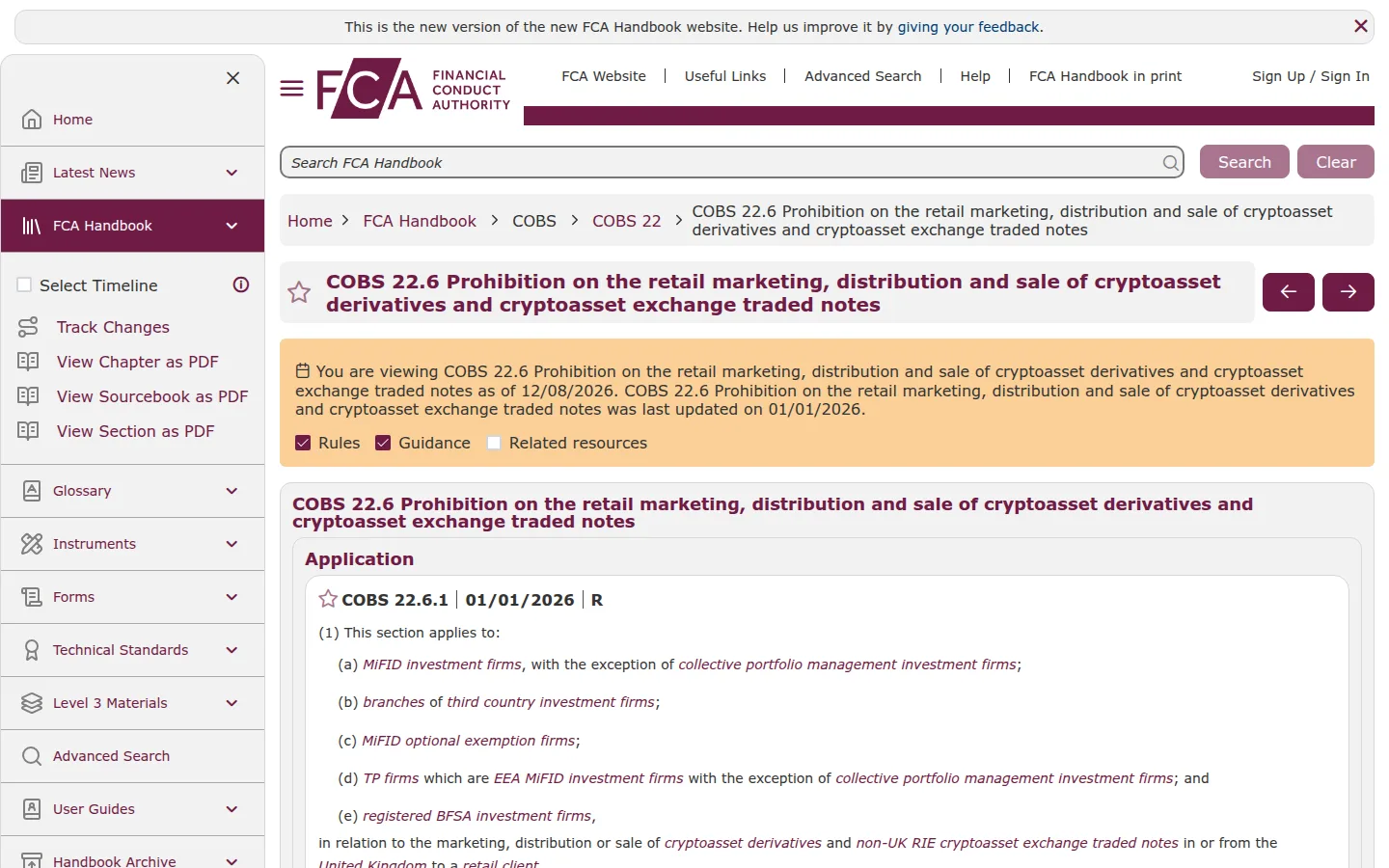
The FCA rule is the decisive boundary for this story. It prohibits firms from selling, distributing or marketing derivatives that reference certain cryptoassets to retail clients. Coinbase’s offer is therefore limited to clients it classifies as eligible professionals after its own onboarding and suitability process. A user having a UK Coinbase account does not by itself make the derivatives catalogue available.
Coinbase’s UK investment-services announcement explains the permission behind the broader product set. Its Deribit acquisition notice confirms that Deribit joined Coinbase in August 2025, correcting the idea that the two are independent rivals.
What professional investors should verify before trading
- Client classification: which legal entity serves the account and why the customer meets the professional-client test.
- Contract terms: settlement asset, expiry or funding mechanism, index methodology and maximum position size.
- Margin rules: initial and maintenance margin, liquidation price, collateral haircuts and whether portfolio margin applies.
- Market access: which of the advertised contracts are actually enabled for that client and jurisdiction.
Leverage of up to 50 times is a maximum on selected products, not a standard exposure level. At that scale, a small adverse move can consume the posted margin before fees and slippage are considered. Professional status changes the regulatory treatment; it does not remove market, liquidity, operational or counterparty risk.