


Vitalik Buterin’s priorities for Ethereum have shifted sharply toward defending the network against quantum computers and using artificial intelligence to check its own code. Buterin laid out the changes in an updated ‘Strawmap’ posted to X on Aug. 10, 2026, directly comparing the network’s current direction to the roadmap he published in 2023.
“What’s most striking, however, is that some completely new things are in the strawmap that are not in this diagram, because they were not in the 2023 roadmap at all. These reflect changing priorities,” Buterin wrote. The comparison, reported by Decrypt, shows post-quantum security, enhanced privacy, and AI-assisted formal verification all rising to the top of the list.
Quantum resistance moves to the front of the queue
Quantum computers capable of breaking today’s public-key cryptography remain years away by most estimates, but Ethereum’s roadmap now treats the threat as a near-term engineering priority rather than a distant contingency. The Ethereum Foundation has already formed a dedicated post-quantum team and laid out a phased plan to replace cryptographic components that a sufficiently powerful quantum machine could defeat, according to the Strawmap. New additions named in the update include LeanSPHINCS, a post-quantum signature scheme, alongside signature aggregation tools meant to keep the network efficient once those heavier quantum-resistant signatures are in use.
“Ethereum will be quantum-safe. Ethereum will put users’ privacy first. Ethereum will be secure. Ethereum will be censorship-resistant. Ethereum will be highly performant and scalable while satisfying the above. And Ethereum will be Lean,” Buterin wrote, summarizing the network’s guiding principles under the new plan. Unchained reported that quantum safety was explicitly up-prioritized relative to the earlier roadmap, one of several reshuffled items Buterin flagged in his post.
The second technical thread running through the update is AI-assisted formal verification, a method of mathematically proving that code behaves as intended rather than testing it against a limited set of scenarios. Ethereum researchers rely on STARKs, a cryptographic proof system, to verify computations securely across the network. Buterin tied the two together directly: “This can only be safe with formal verification, which is itself only feasible with modern AI tools.” The plan calls for STARK proofs and AI tools to validate code across Ethereum’s execution, consensus, and data layers, a scope that The Block described as putting privacy and quantum resistance front and center in the new roadmap.
Privacy and scaling get a rework too
Native privacy also climbed the priority list. “Ethereum will put users’ privacy first as development continues,” Buterin wrote, and the Strawmap frames privacy as a design requirement rather than an optional layer built by outside developers. On scaling, the update steers away from trying to maximize throughput for every kind of activity across a single unified system. Instead, it favors specialized scaling mechanisms built for specific use cases, alongside newly named additions such as native rollups and blob and gas futures.
Some earlier priorities were dropped or replaced outright. Buterin’s post listed verifiable delay functions and many planned EVM improvements as deprioritized, while earlier data-structure plans such as Verkle trees have given way to newer constructions he described as a path from unified binary tries to what he called PBT, and state expiry has been replaced with new state types. That kind of substitution, rather than pure addition, runs through the update: Ethereum isn’t only adding features. It’s discarding ones that no longer fit.
A simpler spec, five years out
Buterin framed the Strawmap as a coordination plan spanning through 2029, and the simplification goal matters as much as any single feature. Ethereum’s protocol has accumulated complexity across execution, consensus, and data layers since the Merge, and formal verification paired with AI tooling is pitched as a way to make that complexity auditable rather than simply documented. None of the outlets covering this story details how Ethereum’s approach compares to quantum-resistance work at rival layer-1 networks, leaving the comparative timeline for post-quantum migration across the industry unaddressed for now.
ETH itself showed no reaction to the announcement, trading near $1,875, down about 2.6% over 24 hours at the time of the post. That gap between a five-year technical roadmap and same-day price indifference is notable on its own: markets are treating this as long-horizon infrastructure work, not a near-term catalyst. The Defiant also covered Ethereum ecosystem activity the same day, though its report on Robinhood Chain’s transaction volume was a separate story from Buterin’s roadmap post.
What happens next depends on how quickly the Ethereum Foundation’s post-quantum team can turn LeanSPHINCS and signature aggregation from proposals into shipped code, and on whether STARK-based formal verification proves practical across all three of Ethereum’s core layers. Buterin’s post set the destination through 2029. The harder work of building toward it starts now.
Read the original roadmap evidence
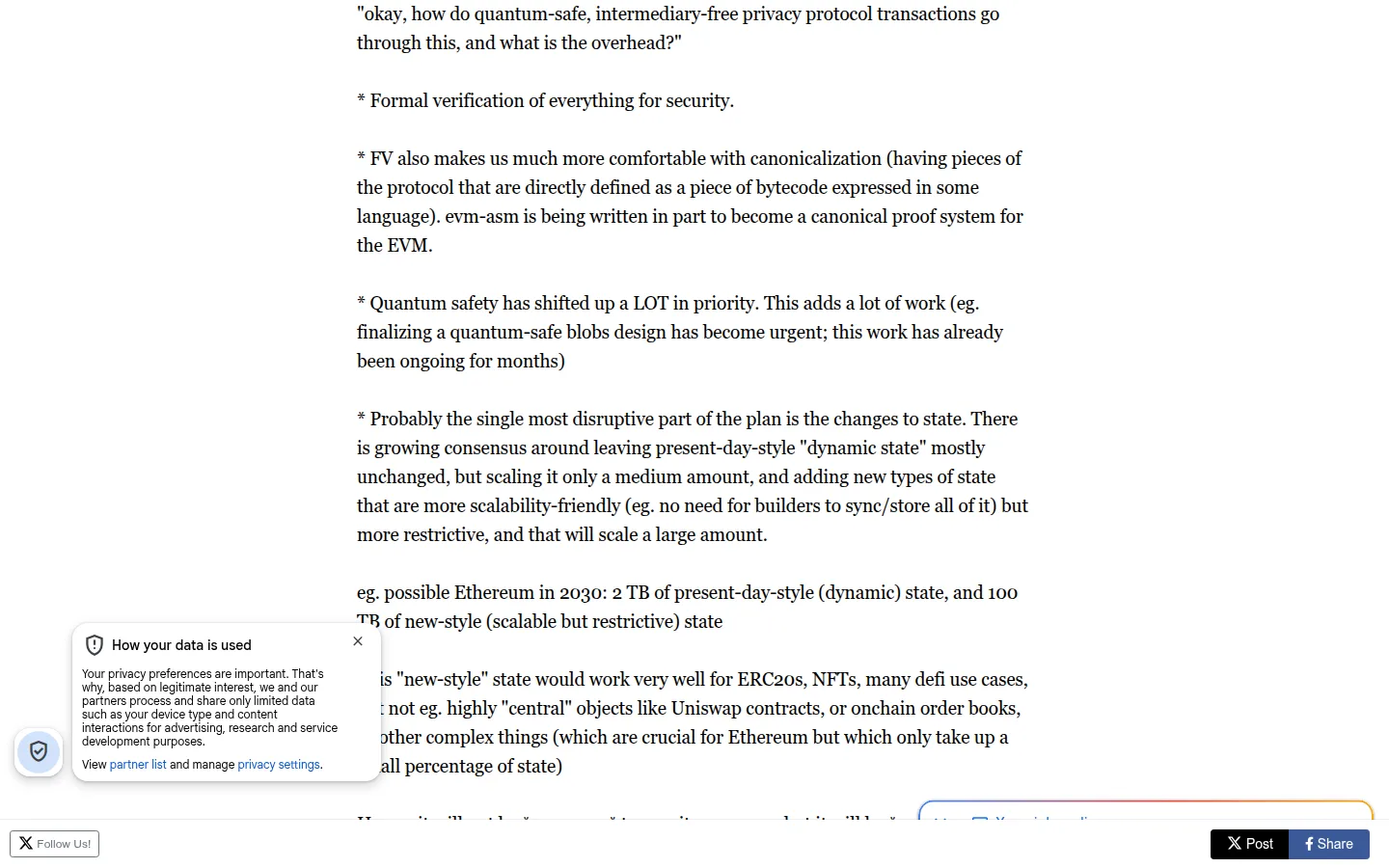
The original thread is more precise than treating every item as a promised upgrade. Buterin calls it a “strawmap”: a planning and coordination document that compares current priorities with the 2023 roadmap. It identifies formal verification across the protocol and says quantum safety has moved much higher, but it is not a release schedule, a completed specification or proof that a quantum-resistant migration is ready for mainnet.
Readers can also inspect the evolving outline at strawmap.org. A roadmap item still has to pass research, specification, implementation, testing and Ethereum’s social-governance process. Different components can move at different speeds, and inclusion on the map does not guarantee a particular fork date.
Why quantum safety and formal verification are linked
Post-quantum signatures are generally larger and more computationally demanding than the signatures Ethereum uses today. Replacing cryptographic assumptions without making clients or wallets unusable requires careful protocol design. Formal verification can reduce implementation risk by proving selected properties of code and specifications, while AI tools may help engineers write or review those proofs. AI output is not itself a security proof and still requires rigorous checking.
No evidence in the roadmap shows that present-day quantum computers can break Ethereum accounts. The risk is prospective: protocol migrations take years, and encrypted or signed data collected today may remain valuable later. Moving the work forward is preparation, not a claim that an attack is imminent.