Last updated: October 1, 2026. Program details come from each project’s own announcements and the news reports linked below.
NFT and gaming token staking means locking an NFT or a game’s token in a smart contract to earn rewards. In 2026, most of the big passive programs have ended or shrunk. ApeCoin’s NFT staking closed in December 2025, Ronin replaced passive RON staking in May 2026, and Axie Infinity now cuts AXS staking rewards by 5% every nine days. What remains pays mostly in points, airdrops or game revenue, not fixed yield.
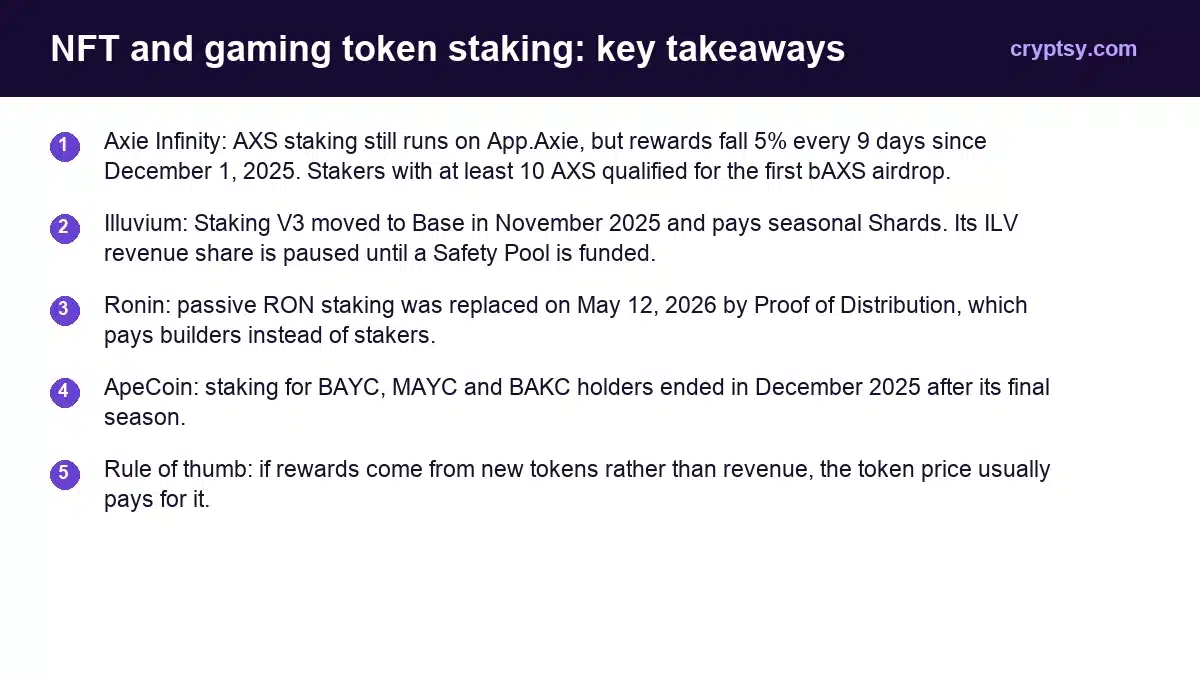
Key Takeaways
- Axie Infinity: AXS staking still runs on App.Axie, but rewards fall 5% every 9 days since December 1, 2025. Stakers with at least 10 AXS qualified for the first bAXS airdrop.
- Illuvium: Staking V3 moved to Base in November 2025 and pays seasonal Shards. Its ILV revenue share is paused until a Safety Pool is funded.
- Ronin: passive RON staking was replaced on May 12, 2026 by Proof of Distribution, which pays builders instead of stakers.
- ApeCoin: staking for BAYC, MAYC and BAKC holders ended in December 2025 after its final season.
- Rule of thumb: if rewards come from new tokens rather than revenue, the token price usually pays for it.
What is NFT staking?
You deposit an NFT into a project’s staking contract, or link it to a staking page, and earn rewards while it stays there. The NFT usually cannot be sold or used elsewhere until you unstake. Rewards are often paid in the project’s own token, or in points that may turn into tokens later.
Gaming token staking works the same way with a fungible token such as AXS or ILV. You lock the token and earn more of it, or a share of what the game earns.
Where the rewards come from
- Emissions: the project creates or unlocks new tokens and hands them to stakers. This is the most common source, and it adds supply.
- Revenue share: the project pays out part of what the game earns. This is more sustainable but usually smaller.
- Points and airdrops: you earn points that may convert into tokens later. The value is unknown until it happens.
Gaming staking programs in 2026: what changed
| Program | What you stake | Status (October 2026) | Reward source |
|---|---|---|---|
| Axie Infinity | AXS or bAXS | Running, rewards cut 5% every 9 days | Remaining staking allocation, plus bAXS airdrops |
| Illuvium Staking V3 | ILV (on Base) | Running, revenue share paused | Seasonal Shards; ILV revenue share when resumed |
| Ronin | RON | Passive staking replaced May 12, 2026 | Builders now earn RON via Proof of Distribution |
| ApeCoin NFT pools | BAYC, MAYC, BAKC plus APE | Ended December 2025 | None |
Axie Infinity (AXS and bAXS)
Axie has distributed about 95% of its total AXS staking rewards, per its staking revamp post. To stretch the rest, rewards drop by 5% every nine days starting December 1, 2025. That halves the payout roughly every four months, but it never hits zero.
Axie also launched bonded AXS (bAXS), a token worth 1 AXS that can only be spent inside Axie, per its bAXS launch post. You can stake bAXS to earn AXS with full voting power. Converting bAXS back to AXS costs a fee that depends on your Axie Score. In Axie’s own example, a Mythkeeper-level player converting 100 bAXS gets 82.5 AXS, and the 17.5 AXS difference goes to the Axie Treasury.
- Where to stake: App.Axie only. The old stake.axieinfinity.com page was retired.
- Airdrop rule: wallets with at least 10 AXS staked at the February 5, 2026 snapshot shared a 100,000 bAXS airdrop, weighted by Axie Score and stake.
Catch: the yield shrinks every nine days, and bAXS rewards lose value if you convert them out.
Illuvium (ILV) Staking V3
Illuvium rebuilt staking on Base in November 2025, per its Staking V3 announcement. Stakers now earn two things:
- Shards: seasonal loyalty points earned daily. Seasons run six months, and Shard output drops 2.97% every Monday.
- Revenue Distribution: ILV paid out each time the game generates 150 ETH in revenue. Illuvium says this resumes only once its Safety Pool is fully funded under proposal ICCP-22.
Locking for 30 to 365 days raises your Shard rate from 1x to 2x. Stakers from the older Ethereum version got an extra “OG Boost” of up to 2x for 120 days. Moving ILV from Ethereum to Base uses Illuvium’s LayerZero bridge.
Catch: Shards are points, not tokens, and their future value has not been set.
Ronin (RON): passive staking replaced
Ronin, the chain behind Axie Infinity and Pixels, became an Ethereum layer 2 on May 12, 2026, per CoinDesk. With the switch, Ronin replaced passive staking with a “Proof of Distribution” model that rewards builders based on network activity. The 90 million RON that had been set aside for staking rewards moved to the Ronin Treasury.
Ronin said the change cuts RON inflation from over 20% to below 1%. That is the trade-off in plain numbers: stakers lost their yield, and holders got far less dilution.
Watch out: some staking trackers still show a RON reward rate. Check Ronin’s own channels before trusting any APY figure for RON.
ApeCoin NFT staking: ended
ApeCoin staking let holders of Bored Ape (BAYC), Mutant Ape (MAYC) and Bored Ape Kennel Club (BAKC) NFTs earn APE from December 2022. The pools later moved to ApeChain, and a third and final season of 25 million APE was set for the program, per The Bored Ape Gazette. That final season ended in December 2025.
If you still have APE in an old staking contract, unstake and claim from the official ApeCoin site. Never use a link sent by DM.
Why so many programs ended
Staking rewards paid in a game’s own token are new supply. When players sell those rewards, the price falls, and the APY has to rise to look attractive, which adds even more supply. Axie, Ronin and ApeCoin all moved away from open-ended passive rewards for this reason, toward rewards tied to playing, building or revenue.
APY vs your actual return
A staking APY is paid in tokens, not dollars. If you earn 20% more tokens in a year but the token falls 50%, your position is worth 40% less than when you started. Before staking, ask how much of the reward comes from revenue and how much from new tokens.
How to judge a gaming staking program
- Find the reward source. Emissions, revenue, or points. Revenue is the only one that does not dilute you.
- Check the lockup and exit rules. Note lock lengths, cooldowns and any fee for converting rewards out.
- Check the chain and bridge. Ronin’s bridge was drained of $625 million in 2022, still the largest DeFi bridge exploit on record per CoinDesk. Moving tokens between chains adds risk.
- Read the latest official post. These programs change often. Ignore APY figures in old articles, including old versions of this one.
- Use the official site only. Fake staking pages are a common way to drain NFT wallets.
Where to look instead for staking yield
If you want staking income rather than gaming perks, network staking (ETH, SOL) and stablecoin lending have clearer reward sources. See our guide to the best crypto staking platforms and our comparison of stablecoin staking rates.
Not financial advice
This guide explains how NFT and gaming staking programs work. It is not investment advice. Gaming tokens are highly volatile, and staking rewards can stop with little notice.
Frequently Asked Questions
What is NFT staking?
NFT staking means locking an NFT in a project’s staking contract to earn rewards, usually the project’s token or points. The NFT generally cannot be sold while it is staked.
Can you still stake AXS in 2026?
Yes. AXS and bAXS staking runs on App.Axie. Since December 1, 2025, rewards fall by 5% every nine days, so the payout keeps shrinking over time.
Did ApeCoin staking end?
Yes. Staking for BAYC, MAYC and BAKC holders ended in December 2025 when the third and final season of rewards finished.
Can you still stake RON on Ronin?
Passive RON staking was replaced on May 12, 2026, when Ronin became an Ethereum layer 2. Rewards now go to builders through a Proof of Distribution model, and 90 million RON set aside for staking moved to the Ronin Treasury.
How does Illuvium staking work now?
Illuvium Staking V3 runs on Base. Stakers earn seasonal Shards, with up to 2x for longer locks, and an ILV revenue share that is paused until Illuvium’s Safety Pool is funded.
Is NFT and gaming staking worth it?
Only if you already want to hold the token or NFT for the game itself. Rewards are paid in volatile tokens or points, so a high APY can still lose money if the price falls.