


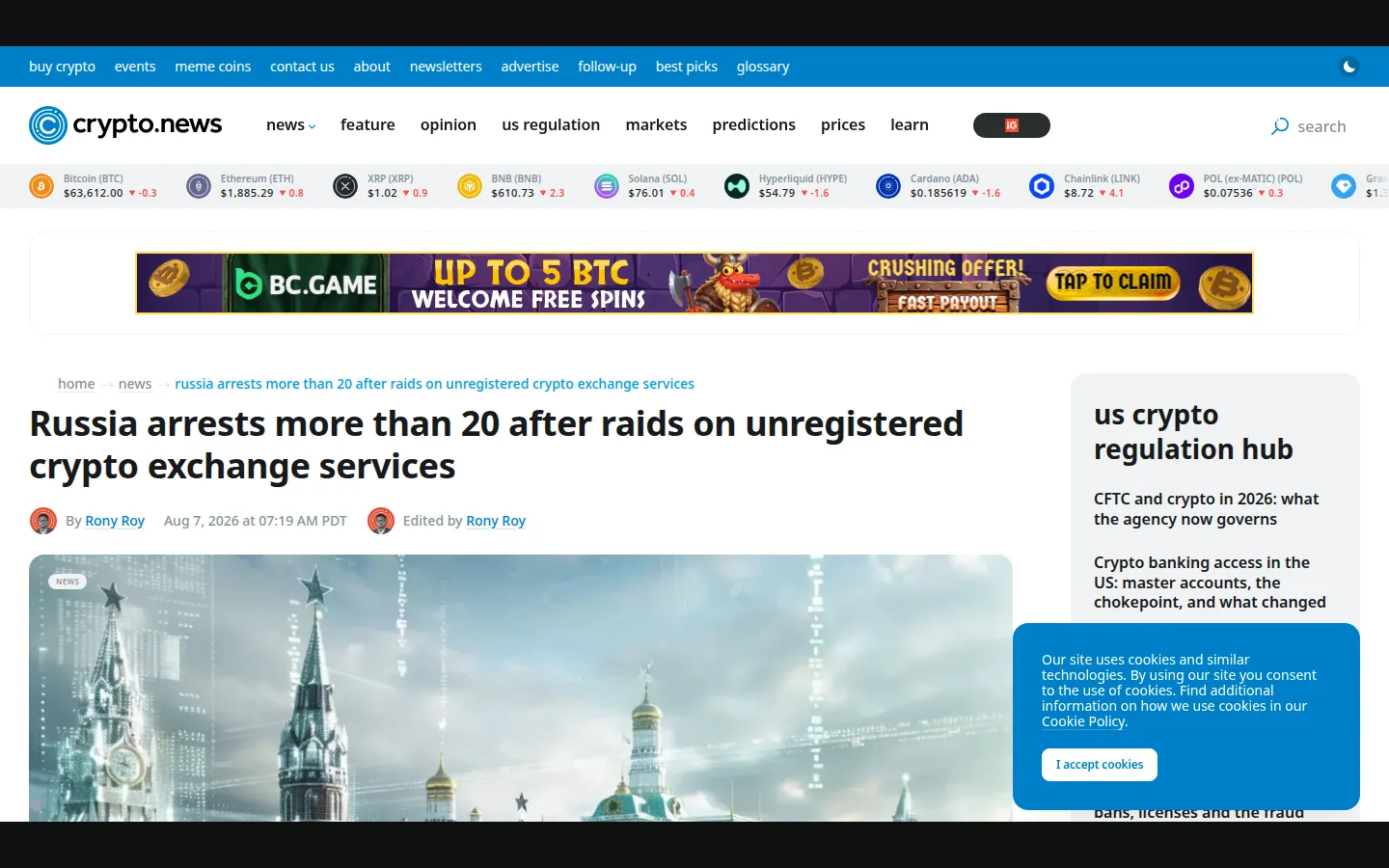
Russia’s Federal Security Service raided nine unregistered crypto exchange points inside the Moscow International Business Center on August 7, dismantling a network authorities say laundered proceeds from Russia-based fraud into digital assets. The FSB and Russia’s Interior Ministry carried out the coordinated operation in Moscow City, targeting exchange points allegedly used to convert scam money into crypto for cross-border transfer, according to Cointelegraph.
More than 20 individuals were detained during the raids, including couriers as young as 18. Suspects face large-scale fraud charges under Article 159 of Russia’s Criminal Code, which carries sentences of up to ten years. crypto.news reports the detainees were mostly workers and couriers rather than the alleged scheme’s organizers.
How the network allegedly operated
Investigators allege the network laundered proceeds from Ukraine-based phone scam operations by funneling stolen funds through the nine unregistered Moscow exchange points and converting them into cryptocurrency. From there, the FSB alleges the converted funds were transferred to coordinators in Ukraine, using the exchanges as cash-out infrastructure rather than legitimate trading venues.
Investigators are now tracing transaction trails to identify victims, many of them elderly or otherwise vulnerable people who unknowingly sent money into the scam pipeline before it reached the exchange points.
None of the outlets covering this story has named the specific exchange brands operated at the nine locations, nor disclosed any seized asset figures or wallet addresses tied to the case.
Russia’s crackdown on unregulated crypto trading
The raids land three weeks before Russia’s first comprehensive cryptocurrency law takes effect on September 1. President Vladimir Putin signed that law on August 6, legalizing regulated retail crypto trading while keeping crypto payments banned and capping retail purchases at $3,700 a year, according to Decrypt and The Block. At the signing, Putin said of Bitcoin: “For example, Bitcoin, who can ban it? Nobody.”
The timing puts the Moscow raids in sharp contrast with the incoming legal framework. As regulated retail trading becomes law, unregistered exchange points like the ones hit in Moscow City remain outside it and subject to criminal enforcement. Unchained notes the new law is meant to bring retail trading into a licensed, regulated system rather than the informal exchange points the FSB targeted.
None of the eight outlets covering this story names a comparable prior Russian raid of this scale.
What happens next for the detainees
The detained individuals face prosecution under the fraud statute, with penalties of up to ten years in prison should charges proceed to conviction. Investigators say they are continuing to trace transaction records to identify additional victims and determine the full scope of funds moved through the exchange points before they reached Ukrainian coordinators.
Neither the FSB nor Russia’s Interior Ministry has released seizure figures, wallet attribution, or the identities of the alleged organizers behind the exchange network, leaving those details for a future official statement or court filing.
The available reporting therefore supports the detention count and the locations searched, but not a final loss figure or attribution to identified ringleaders. Until investigators publish wallet evidence, seizure records, or court documents, the laundering allegations should be treated as the authorities’ account rather than a completed judicial finding.
Source evidence and reporting limits
This article is based on reports from Cointelegraph and crypto.news. Cryptsy did not locate a public FSB statement, charging document, court judgment, wallet list or seizure inventory that independently establishes every detail as of August 12, 2026. The detention count, number of searched locations and description of the alleged payment route should therefore be read as the authorities’ account repeated by those publications—not as findings of guilt.
That evidence gap matters in a crypto-laundering story. On-chain attribution normally becomes stronger when investigators publish transaction identifiers, wallet addresses, asset-freeze records or a clear methodology connecting funds to named actors. None of those materials was available in the sources reviewed for this update. The article consequently does not estimate the value moved, identify the alleged organisers, or infer that every worker detained controlled the scheme.
What would materially update the story
The next reliable evidence would be an official case number, formal charges, a court order, a named exchange operator or an attributable wallet and seizure record. Until one appears, the practical conclusion is limited: Russian authorities reportedly targeted unregistered exchange points they say were used as laundering infrastructure. It is not yet possible from the public record reviewed here to audit the full money trail or determine criminal responsibility.