
QUICK ANSWER
- Focus on cryptocurrencies with strong adoption, utility, and active development.
- Compare market trends, liquidity, and long-term growth potential.
- Follow major ecosystem updates, partnerships, and regulatory news.
- Build a diversified portfolio instead of relying on a single coin.
Pro Tip: Review your portfolio regularly and use secure wallets to protect your crypto investments.
Last updated: July 2026
Bitcoin, Ethereum, Chainlink, Litecoin, and Cardano make sense to hold right now as some of the top cryptocurrencies to invest in 2026, not because they promise the biggest gains, but because each has a regulatory or institutional development landing in 2026 that reduces uncertainty. This list prioritizes staying power over speculation. If you want higher-risk, higher-reward picks instead, see our high-return coins guide.
Why “Today” Matters for This List
Crypto sentiment has been choppy through mid-2026. Fear and greed readings have swung between neutral and fear multiple times in the past month alone, which tells you this isn’t a euphoric top or a capitulation bottom. It’s a market waiting on catalysts. Check the crypto fear and greed index before you place any trade, because the mood shifts week to week right now.
Three things make 2026 a different environment than the last cycle.
- Regulation is moving, even where it’s stalling. The Senate Banking Committee advanced the CLARITY Act 15-9 in May 2026 and it now awaits a full Senate floor vote. On the stablecoin side, the GENIUS Act’s July 18, 2026 deadline for federal licensing and capital rules has already passed, and regulators missed it. The framework still takes effect by January 18, 2027, or 120 days after final rules are published, whichever comes first, so the rules are coming, just later than Congress originally set.
- Institutional money is already parked, not just circling. US spot Bitcoin ETFs hold roughly $77.7 billion in combined assets, and over 3.5% of all circulating Bitcoin sits on public company balance sheets.
- Staking yield is now a regulated product, not a gray area. The SEC and CFTC issued a joint interpretive release in March 2026 classifying protocol staking rewards as non-securities, which opened the door for staking ETFs.
None of that guarantees a price move. It does mean the assets below have institutional infrastructure behind them that didn’t exist a year or two ago. That’s the filter for this list: coins with real 2026 developments backing them, not coins riding a narrative.
How to Choose the Best Cryptocurrencies to Invest in 2026
Choosing the best cryptocurrencies to invest in 2026 requires looking beyond hype and short-term price movements. Investors should focus on projects with strong fundamentals, adoption potential, and long-term market relevance.
Key factors to evaluate include:
- Market adoption: Look for cryptocurrencies with growing users, real-world applications, and strong ecosystem development.
- Technology and innovation: Projects with scalable networks, useful features, and active development teams may have stronger growth potential.
- Tokenomics: Analyze supply limits, inflation rates, staking models, and how demand may affect future value.
- Institutional support: ETFs, partnerships, and corporate adoption can reduce uncertainty and improve market confidence.
- Regulatory outlook: Coins with clearer regulatory positions may face fewer barriers as crypto adoption expands.
- Liquidity and market position: Established cryptocurrencies with strong trading volume are generally easier to buy, sell, and manage.
A strong crypto investment decision combines research, risk assessment, and a clear understanding of the project’s long-term purpose rather than relying only on potential returns. Two investors can look at the exact same coin and reach opposite conclusions, because their time horizon and risk tolerance differ. A retiree parking 2% of a portfolio in Bitcoin is making a different bet than a 25-year-old putting 20% of savings into a small-cap token. Match the coin to the plan, not the other way around.
Where to Buy the Best Cryptocurrencies in 2026
The best place to buy cryptocurrencies depends on factors such as security, available assets, fees, and user experience. Investors should choose platforms that offer strong protection and reliable trading features.
When selecting a crypto exchange, consider:
- Security features: Look for platforms with strong account protection, encryption, and secure asset storage options.
- Supported cryptocurrencies: Confirm the exchange lists the coins you want to invest in.
- Trading fees: Compare transaction fees, withdrawal costs, and spreads before choosing a platform.
- Regulatory compliance: Platforms that follow local regulations may provide additional trust and transparency.
- User experience: A simple interface and reliable customer support are important, especially for beginners.
Investors should also consider using a secure crypto wallet for long-term holdings and avoid keeping large amounts of assets on exchanges unnecessarily. A hardware wallet that never touches an exchange server removes an entire category of risk: if the exchange gets hacked or freezes withdrawals, coins sitting in cold storage are untouched. That single habit prevents more losses than any coin pick on this page.
Top Cryptocurrencies to Invest in 2026
These picks lean toward established, liquid, lower-volatility assets. None of them are the moonshot plays. That’s the point.
| Coin | Ticker | Why It’s Here Now |
|---|---|---|
 Bitcoin Bitcoin | BTC | IBIT alone holds roughly $46B, corporate treasury adoption, Strategic Bitcoin Reserve follow-up plan pending |
 Ethereum Ethereum | ETH | Staking ETFs live, 30%+ of supply staked, staking rewards now non-securities |
 Chainlink Chainlink | LINK | SWIFT and UBS pilots live for tokenized asset settlement, Mastercard also a partner |
 Litecoin Litecoin | LTC | Classified as a commodity, first US spot altcoin ETF (LTCC), trading since late 2025 |
 Cardano Cardano | ADA | CME futures live, multiple spot ETF filings, no-lockup staking yield |
 Bitcoin (BTC)
 Bitcoin (BTC)
Bitcoin is the anchor. It’s the one asset on this list that barely needs a pitch anymore. Total net assets across the US spot Bitcoin ETF complex sat at roughly $77.7 billion in mid-July 2026, with BlackRock’s IBIT alone holding about $46 billion of that, close to 59% of the entire category. Public companies now hold over 3.5% of the entire 21 million BTC supply on their balance sheets, a number that keeps climbing every quarter.
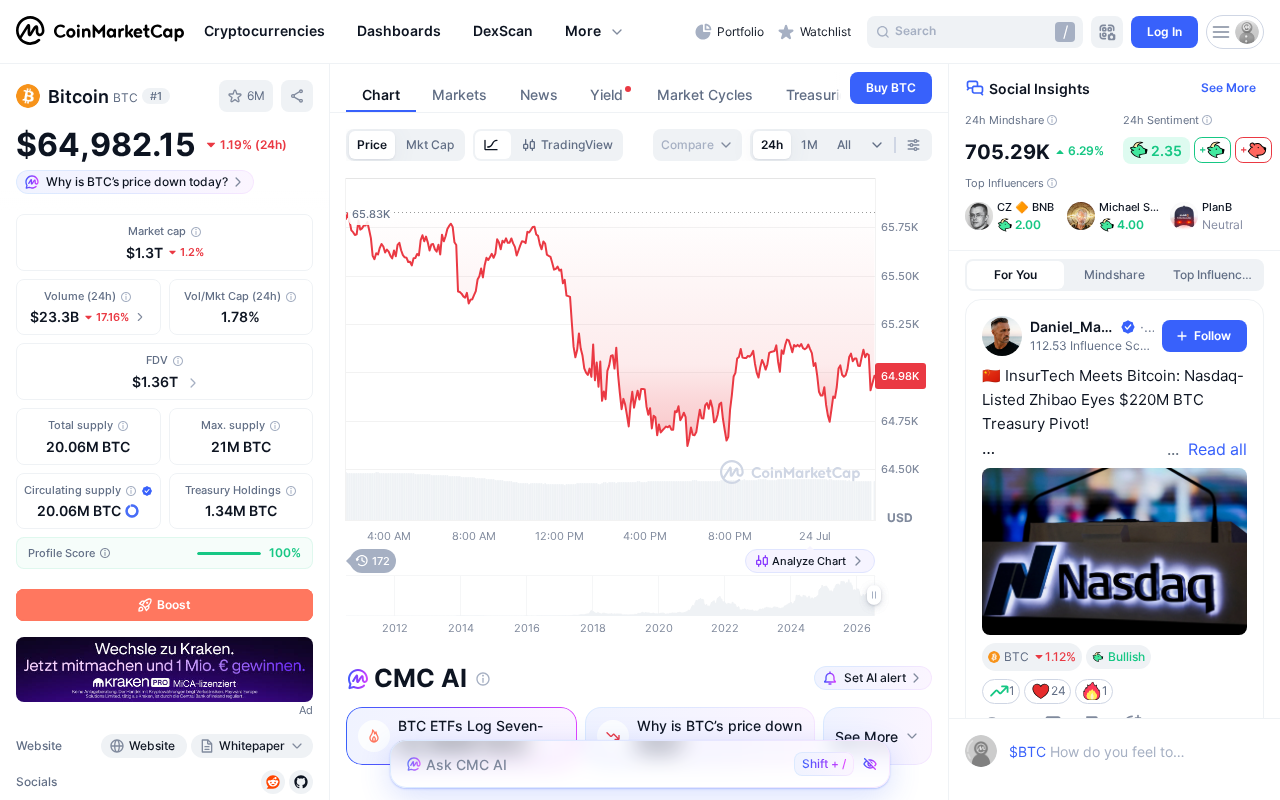
The bigger 2026 story is the Trump administration’s Strategic Bitcoin Reserve. The original policy blueprint landed in mid-2025, and a follow-up evaluation from the Treasury Department was due within 60 days of the reserve’s creation. As of mid-2026 that evaluation is still undelivered, held up by a dispute between Treasury and Commerce over which agency has legal authority to manage Bitcoin as a federal asset. Whether or not that plan moves the price, it signals something no cycle before this one had: a sitting US administration treating Bitcoin as a reserve asset worth planning around, even while the bureaucracy sorts out who runs it.
Ethereum (ETH)
 Ethereum (ETH)
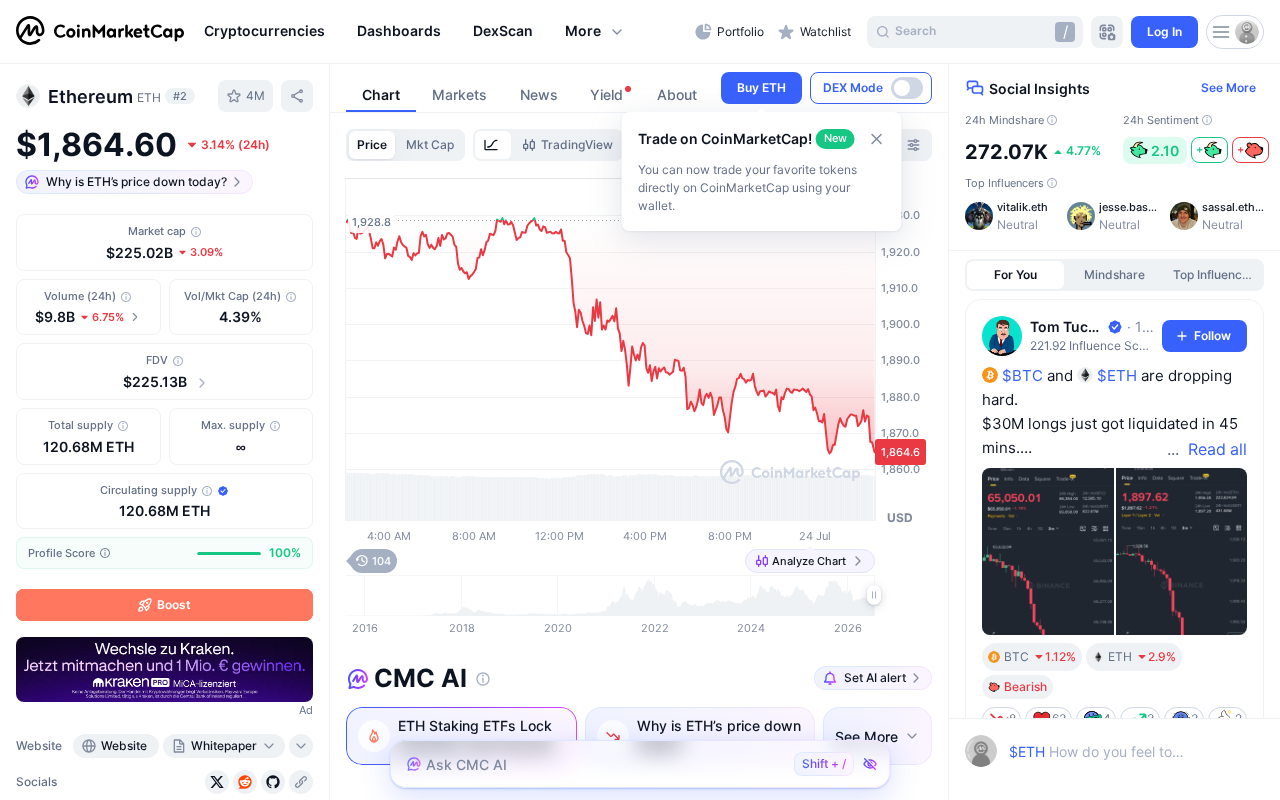
Ethereum’s pitch in 2026 is yield, not just smart contracts. More than 36 million ETH is now staked, over 30% of total supply, securing roughly $120 billion in network value. Native staking pays somewhere between 3.5% and 4.2% APY, and that yield is no longer stuck in self-custody.
BlackRock launched its iShares Staked Ethereum Trust (ticker ETHB) on Nasdaq in March 2026, staking 70-95% of holdings and distributing monthly payouts. Grayscale passed through actual on-chain staking rewards to ETF shareholders for the first time in January 2026, the first US spot crypto ETP to ever do that. Staking-enabled products now make up roughly 36% of all ETH ETF inflows this year. For a full breakdown of how staking works and where to do it, read our crypto staking guide.
Chainlink (LINK)
 Chainlink (LINK)
Chainlink isn’t a coin most beginners name first, but it’s become the plumbing for institutional crypto adoption. SWIFT has run interoperability pilots with UBS using Chainlink’s infrastructure to settle tokenized fund subscriptions and redemptions on-chain while cash settlement still runs through SWIFT’s existing network. UBS adopted Chainlink’s Digital Transfer Agent standard to manage tokenized fund subscriptions through the existing Swift network. Mastercard is also on the partner list.
Analysts tracking tokenization estimate tens of trillions of dollars in assets could move onchain over the next several years, and Chainlink’s infrastructure is positioned as the connective layer for that shift. It’s a slower, more infrastructure-driven bet than a speed or fee narrative, which is exactly why it fits this list instead of the high-growth one.
Litecoin (LTC)
 Litecoin (LTC)
Litecoin has quietly cleared two regulatory hurdles that most altcoins are still waiting on. The SEC and CFTC classified LTC as a commodity, removing the securities overhang that has followed newer tokens for years. Canary Capital’s spot Litecoin ETF (ticker LTCC) began trading on Nasdaq in late October 2025, the first US spot altcoin ETF to reach the market, and it has kept trading through 2026 with Grayscale and CoinShares filings also pending.
Litecoin isn’t trying to be a growth story. It’s a payments-focused coin with over a decade of uptime, a fixed halving schedule, and now a regulated wrapper institutions can actually buy. That combination of age, clarity, and low drama is the entire reason it belongs on a stability-focused list.
Cardano (ADA)
 Cardano (ADA)
Cardano’s case in 2026 is built on staking mechanics and a fast-moving ETF pipeline. ADA staking pays roughly 2-4.5% APY with no lockup period and no slashing risk, spread across more than 3,000 stake pools. That’s a meaningfully different risk profile than validator-based staking on other networks.
CME listed ADA futures in February 2026, starting a formal SEC review clock that puts the earliest spot ETF approval window around August 2026. Grayscale, 21Shares, VanEck, and Canary Capital all have active ADA ETF filings in front of regulators right now. If even one clears, it would be the first regulated, institutional-scale access point for ADA in the coin’s history.
How These Five Compare on Risk
Bitcoin and Ethereum carry the deepest institutional plumbing and the most liquidity, which makes them the closest thing on this list to a core holding. Litecoin sits a step behind on infrastructure but ahead on regulatory clarity, since it’s already classified as a commodity. Chainlink and Cardano are the two still waiting on a catalyst: Chainlink on tokenization adoption actually scaling, Cardano on an ETF decision. None of that makes either a bad pick. It just means the path to a re-rating looks different for each one, and that’s worth knowing before you size a position.
Where Solana, XRP, and Bittensor Fit In
Solana, XRP, and Bittensor aren’t on this list, and that’s deliberate. They’re faster-moving, higher-volatility plays built around growth narratives, speed and consumer apps for Solana, cross-border payments for XRP, and the AI compute narrative for Bittensor. All three deserve consideration if you’re comfortable with more downside risk in exchange for more upside. We cover them in depth, along with the case for each, in our high-return coins guide. This page is about a different question: what to hold given where the market sits today, not what could 10x.
What to Watch Before You Buy
A few dates and signals matter more than usual right now.
- The GENIUS Act deadline already passed. July 18, 2026 was the statutory deadline for federal regulators to publish final stablecoin licensing and capital rules. They missed it, issuing only preliminary proposals. The framework still takes effect by January 18, 2027, or 120 days after final rules land, so watch for volatility in stablecoin-adjacent names as that date approaches instead.
- CLARITY Act floor vote: The bill cleared committee 15-9 in May 2026 but still needs a full Senate vote. Passage would be the clearest market-structure signal crypto has had in years.
- ADA and Litecoin ETF decisions: ADA’s spot ETF window opens around August 2026, and further Litecoin ETF filings from Grayscale and CoinShares are moving through SEC review. Approval or denial will move sentiment on altcoins broadly, not just the coin in question.
Sentiment can flip fast on any one of these headlines. Check the fear and greed index the day you’re about to trade, not the day you read this article. And whichever coins you land on, buy them through a platform built for this. Our best crypto exchange guide and our breakdown of exchange and trading trends both cover what to look for in fees, security, and coin availability heading into the back half of 2026.
Best Crypto Investment Strategies for 2026
Successful crypto investing in 2026 requires discipline, patience, and effective risk management. The table below summarizes some of the most popular strategies.
| Strategy | How It Works | Best For |
|---|---|---|
| Long-Term Holding (HODLing) | Hold quality cryptocurrencies for years to benefit from long-term growth. | Long-term investors |
| Dollar-Cost Averaging (DCA) | Invest a fixed amount at regular intervals regardless of market price. | Beginners and risk-conscious investors |
| Portfolio Diversification | Spread investments across Bitcoin, Ethereum, DeFi, AI, and other crypto sectors. | Investors seeking balanced risk |
| Research-Based Investing | Analyze market trends, tokenomics, adoption, and regulatory developments before investing. | Fundamental investors |
| Strategic Profit Taking | Sell a portion of holdings after reaching predefined profit targets. | Investors looking to preserve gains |
Using a combination of these strategies can help investors manage market volatility while building a stronger long-term crypto portfolio. A beginner might run DCA into Bitcoin and Ethereum on a fixed schedule while a more experienced investor layers in research-based positions on Chainlink or Cardano and sets profit-taking targets ahead of time, before emotions are involved. The strategy matters less than sticking with it through the choppy stretches this list already flagged.
A practical example: an investor with $500 a month to deploy might split it 40% Bitcoin, 30% Ethereum, 20% split across Chainlink, Litecoin, and Cardano, and 10% held back as cash for the next dip. That’s not a recommendation, it’s an illustration of how diversification and DCA work together instead of as competing ideas. Rebalance quarterly, not weekly. Chasing every swing in the fear and greed index turns a long-term plan into a series of short-term guesses.
High-Risk Cryptocurrencies With High Growth Potential
High-risk cryptocurrencies can provide significant upside opportunities but also carry a greater chance of losses. These assets are usually linked to emerging technologies, smaller market caps, or early-stage projects.
Some high-growth crypto categories include:
- AI Crypto Projects: Tokens focused on artificial intelligence, decentralized computing, and data networks.
- DeFi Platforms: Projects building decentralized financial services such as lending, trading, and asset management.
- Real-World Asset (RWA) Tokens: Cryptocurrencies focused on bringing traditional assets like real estate and financial products onto blockchain networks.
- Layer-2 Solutions: Networks designed to improve blockchain speed, scalability, and transaction costs.
- Gaming and Web3 Projects: Platforms combining blockchain technology with digital ownership and interactive experiences.
While these cryptocurrencies may offer higher return potential, investors should carefully research each project, evaluate risks, and avoid investing more than they can afford to lose. High growth potential often comes with higher uncertainty and volatility. A useful rule of thumb: size these positions as money you could lose entirely without changing your financial plans, and treat the five coins in the main table above as the core of the portfolio, not the satellite.
Frequently Asked Questions
What are the top 10 crypto to invest in right now?
The top cryptocurrencies to consider often include established projects such as Bitcoin, Ethereum, Solana, Cardano, Chainlink, and other leading blockchain networks. Investors should evaluate factors like adoption, technology, market demand, and risk before investing, and weigh how each project’s 2026 developments (ETF status, staking rules, partnerships) affect its near-term outlook.
Which crypto has 1000x potential?
Cryptocurrencies with 1000x potential are usually early-stage projects with small market caps, innovative technology, and strong growth opportunities. However, these investments carry extremely high risks, and many speculative projects may fail entirely. They belong in the high-risk category covered above, not in a core, stability-focused portfolio.
What are the big 5 cryptos?
The “big 5” cryptocurrencies typically refer to major assets with strong market presence, such as Bitcoin, Ethereum, Solana, Cardano, and XRP. These coins are widely recognized for their adoption, liquidity, and established ecosystems, though this list favors Chainlink and Litecoin over Solana and XRP for their lower volatility profile.
What cryptocurrencies make sense to invest in right now in 2026?
Bitcoin and Ethereum remain the two anchor assets given their ETF inflows and institutional treasury adoption. Chainlink, Litecoin, and Cardano round out a stability-focused list thanks to 2026 developments in tokenization partnerships, commodity classification, and ETF filings.
Why does the current market matter for crypto investing decisions?
2026 has brought regulatory developments like the CLARITY Act clearing Senate committee and staking rewards being classified as non-securities, plus a GENIUS Act stablecoin rulemaking deadline that regulators already missed. These changes are reshaping legal uncertainty around specific coins in real time, which is different from previous cycles driven mostly by speculation.
Is Bitcoin still a good investment in 2026?
Bitcoin remains the most institutionally adopted crypto asset. US spot Bitcoin ETFs held roughly $77.7 billion in combined net assets as of mid-July 2026, with BlackRock’s IBIT holding about $46 billion of that on its own, and more than 3.5% of total BTC supply is held by public companies. A Strategic Bitcoin Reserve follow-up plan from the federal government is also pending, though it has been delayed by an interagency dispute over which department controls it.
Can you earn yield on Ethereum and Cardano in 2026?
Yes. Ethereum staking pays roughly 3.5% to 4.2% APY and is now available through regulated staking ETFs like BlackRock’s ETHB. Cardano staking pays around 2% to 4.5% APY with no lockup period through any of its thousands of stake pools.
How is this different from a high-growth altcoin list?
This list favors established, lower-volatility coins with institutional backing over speculative growth plays. Coins like Solana, XRP, and Bittensor carry more upside potential but also more risk, and are covered separately in our high-return coins guide.
What regulatory dates should crypto investors watch in 2026?
July 18, 2026 was the deadline for GENIUS Act stablecoin licensing rules, and regulators missed it, issuing only preliminary proposals; the framework now takes effect by January 18, 2027, or 120 days after final rules land. The CLARITY Act cleared Senate committee in May 2026 and awaits a full floor vote. Cardano and Litecoin ETF decisions are also moving through SEC review this year.