

Coinbase Advanced Trade is cheaper than Robinhood for most trade sizes, often by half or more. Coinbase’s basic app, the one most people open by default, is the most expensive of the three options. Robinhood beats Coinbase’s basic app easily, but loses to Coinbase Advanced Trade once you know where to click.


How Coinbase Fees Work
Coinbase runs two different products with two very different price tags. Most new users only ever see one of them.
Coinbase.com (Basic App): Spread Plus a Fee
The standard Coinbase app, the one you get after downloading and signing up, bakes a spread of roughly 0.50% into the price you see on screen. You never see this fee listed separately. It’s already inside the quote.
On top of that spread, Coinbase adds a second fee. For trades under $200, it’s a flat charge: $0.99 under $10, $1.49 from $10 to $25, $1.99 from $25 to $50, and $2.99 from $50 to $200. Above $200, the flat fee switches to a percentage, typically around 1.49% if you’re funding from a bank account or your Coinbase USD balance, and up to 3.99% if you’re paying by debit card or using instant funding.
Coinbase One, a $4.99 a month subscription, removes that second fee on trades up to $10,000 a month. The 0.50% spread still applies. It’s not free, just cheaper.
Coinbase Advanced Trade: Maker and Taker Tiers
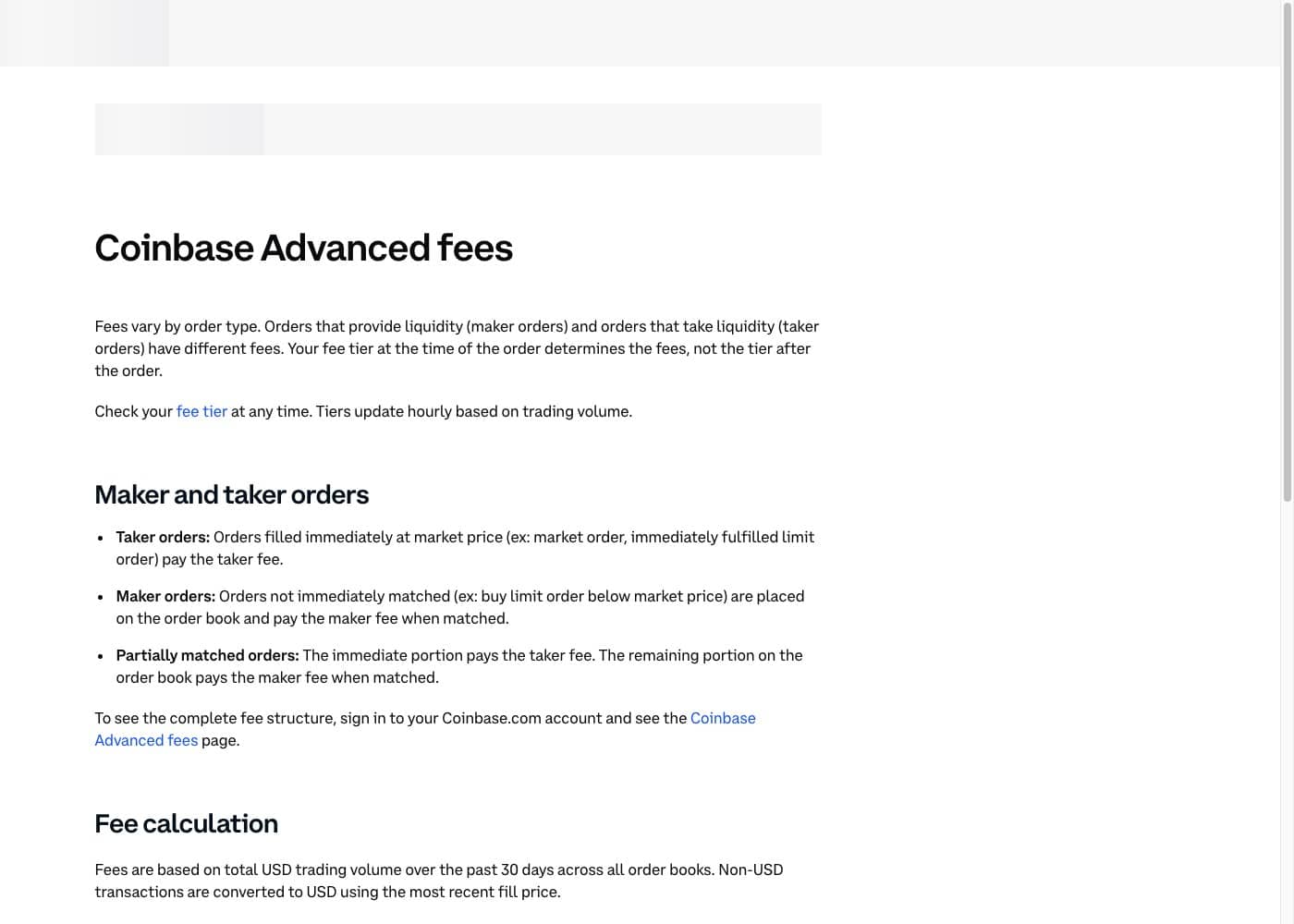
Advanced Trade is Coinbase’s order book product. It’s built into the same app and account, no separate signup required, just a toggle. There’s no spread here because you’re trading directly against the order book instead of buying at a quoted price.
Instead, you pay a maker or taker fee based on your trailing 30-day trading volume:
- $0 to $10,000: 0.40% maker, 0.60% taker
- $10,000 to $50,000: 0.25% maker, 0.40% taker
- $50,000 to $100,000: roughly 0.15% maker, 0.25% taker
- $250,000,000 and up: 0.00% maker, 0.05% taker
Maker orders sit on the order book until someone else fills them. Taker orders fill immediately at market price. Makers pay less because they add liquidity instead of pulling it.
How Robinhood Crypto Fees Work
Robinhood advertises “$0 commission” crypto trading, and technically that’s true. There’s no separate commission line item. But Robinhood still makes money on every trade through a built-in fee baked into the execution price, similar in concept to Coinbase’s spread.
Robinhood’s fee is tied to your trailing 30-day crypto trading volume through its Smart Exchange Routing system:
- Under $50,000 in 30-day volume: 0.85%
- $50,000 to $5,000,000: 0.25%
- Above $5,000,000: 0.10%
That 0.85% rate covers the vast majority of Robinhood users, since most people aren’t trading $50,000 a month in crypto. For a full breakdown of how Robinhood prices individual coins and what its fee schedule covers, see our Robinhood crypto fees guide.
Coinbase vs Robinhood Fees at a Glance
| Fee Type | Coinbase | Robinhood |
|---|---|---|
| Default app fee | ~0.50% spread plus $0.99 to $2.99 flat fee under $200, or 1.49% to 3.99% over $200 | Built into price, ~0.85% for trades under $50,000 in 30-day volume |
| Active trader fee | Advanced Trade: 0.40% maker / 0.60% taker under $10,000 volume, down to 0.00% / 0.05% at the top tier | 0.25% from $50,000 to $5,000,000 volume, 0.10% above $5,000,000 |
| Withdrawal to external wallet | No platform fee, network fee only | No platform fee, network fee only ($5,000 daily transfer cap) |
| Staking commission | 25% on ETH, up to 35% on other assets (lower with Coinbase One) | 25% flat on ETH, SOL, and ADA |
| Fee-reducing subscription | Coinbase One from $4.99/month | None |
Real Math: A $100 Trade vs a $10,000 Trade
Numbers settle arguments better than marketing copy does. Here’s what each platform actually charges on a small trade and a large one, assuming this is your only crypto trade for the month on each platform.
| Trade Size | Coinbase.com (basic app) | Coinbase Advanced Trade | Robinhood |
|---|---|---|---|
| $100 | ~$3.49 (3.49%) | ~$0.60 taker / $0.40 maker (0.40% to 0.60%) | ~$0.85 (0.85%) |
| $10,000 | ~$199 (1.99%, bank funding) | ~$60 taker / $40 maker (0.40% to 0.60%) | ~$85 (0.85%) |
On a $100 trade, Coinbase’s basic app costs almost six times what Coinbase Advanced Trade charges for the identical trade on the identical platform. Robinhood lands in the middle. On a $10,000 trade, the gap widens in dollar terms. The basic Coinbase app costs roughly $199, Robinhood costs about $85, and Advanced Trade costs $40 to $60.
The pattern holds at both trade sizes. Advanced Trade wins. Robinhood beats Coinbase’s default app. The default app loses every time.
Withdrawal and Transfer Fees
Neither platform charges a markup to move crypto to an external wallet. Both pass through the actual blockchain network fee and nothing more.
Coinbase estimates the network fee at the time of your withdrawal and shows it before you confirm. The final cost can shift slightly if network congestion changes between the estimate and the actual send, but Coinbase doesn’t add its own cut on top.
Robinhood works the same way: no platform withdrawal fee, just the network fee. The catch with Robinhood is a $5,000 daily transfer cap and a limit of 10 crypto transactions per day, restrictions Coinbase doesn’t impose. If you move large amounts of crypto off-platform regularly, that cap matters more than the fee itself.
Staking Fees Compared
Both platforms take a cut of your staking rewards before they hit your account. Neither shows you the pre-fee yield by default, the APY you see is already net of their commission.
Coinbase charges 25% of rewards on ETH and up to 35% on assets like SOL, ADA, DOT, ATOM, AVAX, and MATIC. A Coinbase One subscription lowers that: Basic brings it to 31.75%, Preferred to 28.50%, and Premium to 25.25%.
Robinhood keeps it simpler: a flat 25% commission across its supported staking assets, currently ETH, SOL, and ADA. For ETH specifically, that matches Coinbase’s rate. For everything else Coinbase supports, Robinhood’s flat 25% beats Coinbase’s standard 35%.
Verdict: Which Is Cheaper for You
If you’re a casual trader who just opens an app and buys crypto without digging into settings, Robinhood is cheaper than Coinbase. That’s the comparison most people are actually running when they ask this question, and Robinhood wins it clearly. A $100 buy costs about $0.85 on Robinhood versus $3.49 on Coinbase’s default app.
But that’s not really a Coinbase versus Robinhood question. It’s a “did you find Coinbase Advanced Trade” question. Switch the toggle, and Coinbase drops below Robinhood at every volume level tested here, from a $100 buy to a $10,000 buy. There’s no extra signup, no subscription requirement, just a different tab in an app you may already have installed.
For active or high-volume traders, both platforms scale down further, and the gap narrows. Robinhood’s rate drops to 0.25% past $50,000 in monthly volume, while Coinbase Advanced Trade is already at or below that in its $10,000 to $50,000 tier. Above roughly $50,000 in monthly volume, the two stay close enough that your specific volume tier decides the winner more than the platform brand does.
The short version: casual users who never leave the default app should expect to pay more on Coinbase than Robinhood. Anyone willing to use Advanced Trade should expect the opposite. For a wider view of exchanges built around low fees from the start, see our guide to the best low-fee and free crypto exchanges, or browse our full crypto exchange comparison if neither platform fits what you need.
Frequently Asked Questions
Is Robinhood cheaper than Coinbase for crypto?
Robinhood is cheaper than Coinbase’s basic app, charging roughly 0.85% on trades under $50,000 in monthly volume versus Coinbase’s combined spread and fee of around 3.49% on a $100 trade. Coinbase Advanced Trade, however, undercuts Robinhood at every tested trade size, starting at 0.40% to 0.60%.
Does Coinbase charge withdrawal fees?
Coinbase does not charge a platform fee to withdraw crypto to an external wallet. You only pay the blockchain network fee, which Coinbase estimates and displays before you confirm the transaction.
Does Robinhood charge crypto withdrawal fees?
No. Robinhood doesn’t charge a platform withdrawal fee either, only the network fee for the blockchain you’re using. Robinhood does cap transfers at $5,000 per day with a limit of 10 transactions daily.
What is Coinbase Advanced Trade and is it cheaper?
Coinbase Advanced Trade is Coinbase’s order book trading interface, available in the same app and account as the basic app. It charges maker and taker fees starting at 0.40% and 0.60% instead of the basic app’s roughly 0.50% spread plus flat or percentage fee, making it significantly cheaper for the same trade.
Does Robinhood charge fees for staking crypto?
Yes. Robinhood takes a flat 25% commission on staking rewards for its supported assets, currently ETH, SOL, and ADA. That’s the same rate Coinbase charges on ETH, but lower than Coinbase’s standard 35% on assets like SOL and ADA.
Which is better for large crypto trades, Coinbase or Robinhood?
For a single $10,000 trade, Coinbase Advanced Trade costs roughly $40 to $60 versus Robinhood’s approximately $85, making Coinbase cheaper. At much higher monthly volumes, Robinhood’s rate falls to 0.25% and then 0.10%, closing most of the gap, so the cheaper platform depends on your exact trading volume.