


Crypto options trading means buying or selling contracts that give the right, but not the obligation, to buy or sell a cryptocurrency at a set price by a set date. A call is the right to buy. A put is the right to sell. You pay a premium for that right, and as a buyer the premium is the most you can lose.
There are three main places to trade them: Deribit, the largest crypto options exchange; CME, through a futures broker; and options on spot Bitcoin ETFs such as IBIT, through a regular stock broker.
This is not financial advice. Options are complex and most expire worthless. Only trade with money you can afford to lose.
Key takeaways
- A call profits when the price rises above the strike plus the premium. A put profits when it falls below the strike minus the premium.
- Buying an option caps your loss at the premium. Selling one does not.
- Deribit charges 0.03% of the underlying per options contract, capped at 12.5% of the option’s price.
- Options on the iShares Bitcoin Trust (IBIT) began trading on Nasdaq on November 19, 2024.
- Binary options are a different product. US regulators have issued a fraud alert about them.
How does a crypto option work?
| Term | What it means |
|---|---|
| Call | The right to buy the asset at the strike price |
| Put | The right to sell the asset at the strike price |
| Strike | The price written into the contract |
| Premium | What the buyer pays the seller for the option |
| Expiry | The date the option ends |
| In the money | Exercising would pay out. A call with a strike below the market price, for example |
| European style | Can only be exercised at expiry, not before |
Two sides sit behind every contract. The buyer pays the premium and gets the right. The seller collects the premium and takes on the obligation.
A worked example
These numbers are made up to show the math. Say Bitcoin trades at $90,000. You buy one call with a $100,000 strike that expires in 30 days, and you pay a $3,000 premium.
| Bitcoin at expiry | Option is worth | Your result |
|---|---|---|
| $90,000 | $0 | Lose $3,000 |
| $100,000 | $0 | Lose $3,000 |
| $103,000 | $3,000 | Break even |
| $110,000 | $10,000 | Gain $7,000 |
| $120,000 | $20,000 | Gain $17,000 |
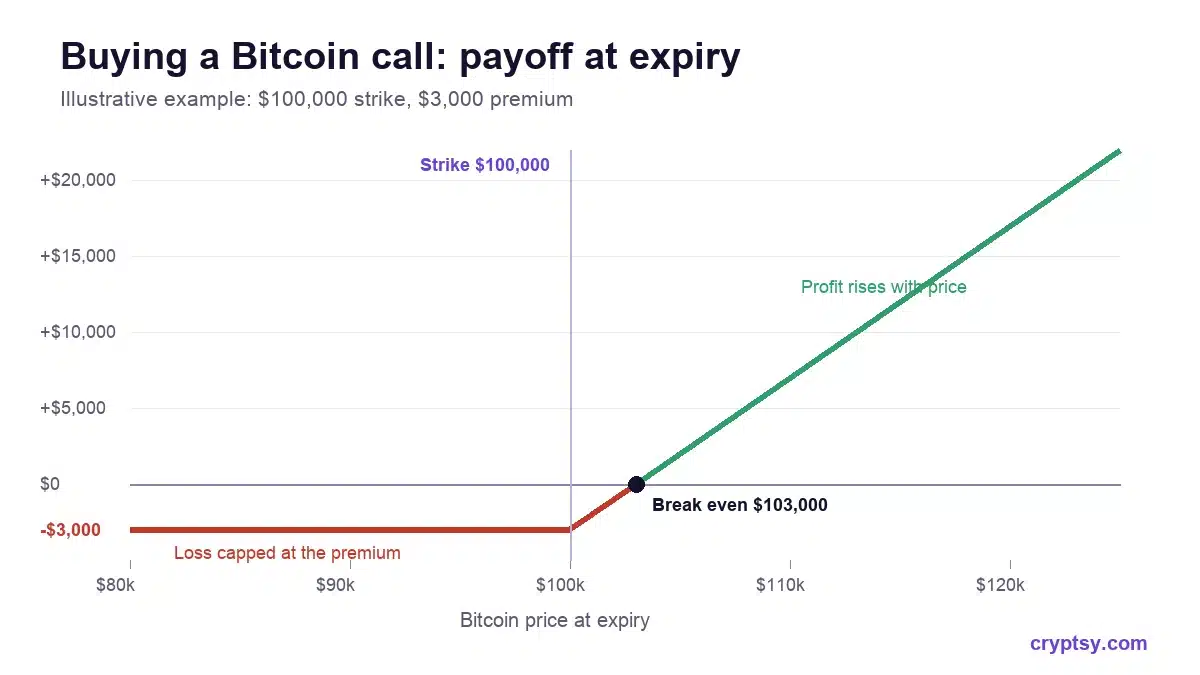
Notice the middle rows. Bitcoin can rise 11% and you still lose everything you paid. Being right about direction is not enough. You have to be right about how far and how fast.
Where can you trade crypto options?
| Venue | What you trade | Contract size | How you access it |
|---|---|---|---|
| Deribit | Bitcoin and Ether options, European style | Minimum order 0.1 BTC or 1 ETH | Crypto exchange account |
| CME | Options on Bitcoin and Micro Bitcoin futures | Standard contract 5 BTC, micro contract 0.1 BTC | Futures broker |
| Nasdaq (IBIT options) | Options on iShares Bitcoin Trust shares | Listed equity options | Stock broker with options approval |
Deribit
Deribit is where most crypto options trade. Coinbase bought it on August 14, 2025, and describes it in its annual report as “the global leader in crypto options trading by volume and open interest”.
All Deribit options are European style. The fee is 0.03% of the underlying per contract, capped at 12.5% of the option’s price. On one Bitcoin at $90,000 that works out to $27. Deribit restricts some countries, so read its terms before you sign up.
CME
CME lists options on its Bitcoin futures. A standard Bitcoin futures contract covers five bitcoin. The Micro contract covers one-tenth of one bitcoin, which brings the cost within reach of smaller accounts. You trade these through a futures broker, and the market is regulated in the US.
Options on spot Bitcoin ETFs
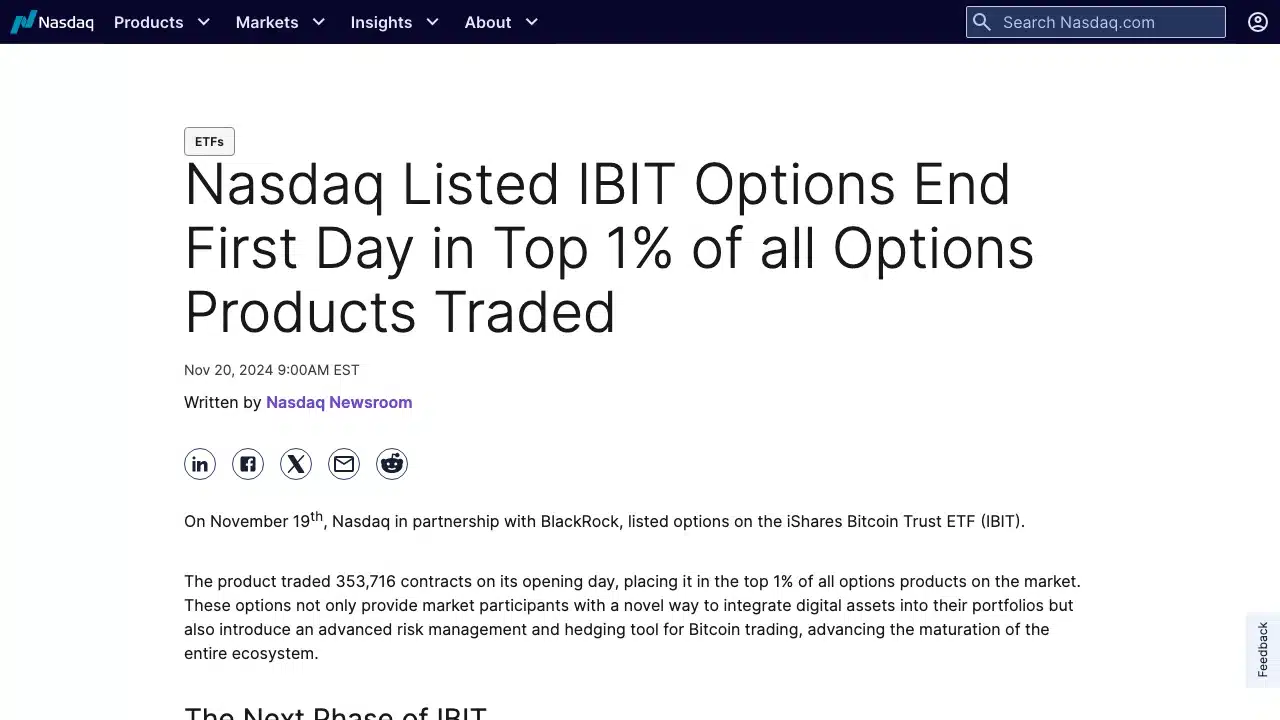
This is the easiest route for US investors who already trade stocks. Nasdaq listed options on the iShares Bitcoin Trust on November 19, 2024. They traded 353,716 contracts on the first day, which Nasdaq said placed them in the top 1% of all options products.
Which coins have options?
Bitcoin and Ether, mostly. They have the deepest order books and the tightest spreads. Options on smaller coins exist on some exchanges, but thin trading means wide spreads, and a wide spread is a cost you pay twice: once getting in, once getting out.
If you are new, stay with Bitcoin or Ether until you know how the contracts behave.
Four basic options strategies
| Strategy | What you do | When it helps | Worst case |
|---|---|---|---|
| Long call | Buy a call | You expect a strong rise | Lose the premium |
| Long put | Buy a put | You expect a fall, or want to hedge | Lose the premium |
| Protective put | Hold the coin and buy a put | You want a floor under your holdings | Lose the premium, plus the drop to the strike |
| Covered call | Hold the coin and sell a call | You expect a flat market and want income | Miss gains above the strike |
Selling options without owning the coin is a different matter. A seller of an uncovered call has no ceiling on losses, because the price has no ceiling. Leave that to professionals.
Want simpler ways to bet on falling prices? Our guide on how to short crypto in the USA covers them, and crypto futures strategies explains the nearest alternative to options.
Are crypto binary options the same thing?
No. A binary option pays a fixed amount or nothing. The CFTC and SEC call them “all-or-nothing options” in a joint investor alert, and note that a binary option “does not give the holder the right to purchase or sell the underlying asset”.
The same alert warns that much of the binary options market “operates through Internet-based trading platforms that are not necessarily complying with applicable U.S. regulatory requirements”. Reported problems include platforms refusing to credit accounts, denying reimbursement and manipulating software to generate losing trades.
If a site offers crypto binary options with no mention of a US regulator, walk away.
How to start trading crypto options
- Learn the payoff math first. Work through a few examples like the one above.
- Pick a venue you are allowed to use from your country.
- Start with buying, not selling. Your loss is capped at the premium.
- Choose Bitcoin or Ether and an expiry at least a few weeks out.
- Size small. Treat the premium as money already spent.
- Decide before you buy when you will take profit or let it expire.
New to derivatives altogether? Read our leverage and margin guide and crypto trading for beginners first.
What to watch out for
- Time decay. An option loses value every day it gets closer to expiry, even if the price does not move.
- Volatility pricing. Premiums rise when the market is nervous. You can be right on direction and still overpay.
- Wide spreads. Outside Bitcoin and Ether, the gap between buy and sell prices can be large.
- Selling risk. Option sellers can lose far more than the premium they collect.
- Unregulated platforms. Check who regulates the venue before you deposit.
Frequently Asked Questions
What is crypto options trading?
Crypto options trading is buying or selling contracts that give the right, but not the obligation, to buy or sell a cryptocurrency at a set price by a set date. The buyer pays a premium for that right.
Can you trade crypto options in the US?
Yes. US investors can trade options on CME Bitcoin futures through a futures broker, and options on spot Bitcoin ETFs such as IBIT through a stock broker with options approval.
How much can I lose buying a crypto option?
The premium you paid, and no more. Selling options is different, because a seller’s losses can be much larger than the premium collected.
What are Deribit’s options fees?
Deribit charges 0.03% of the underlying per options contract, capped at 12.5% of the option’s price.
When did Bitcoin ETF options start trading?
Options on the iShares Bitcoin Trust (IBIT) began trading on Nasdaq on November 19, 2024, with 353,716 contracts traded on the first day.
Are crypto binary options safe?
They carry high risk. The CFTC and SEC have issued a joint investor alert about fraud on binary options platforms, many of which do not comply with US rules.
Last updated: October 6, 2026. Sources: Coinbase 2025 annual report, Deribit, CME Group, Nasdaq and the CFTC/SEC investor alert on binary options.




















