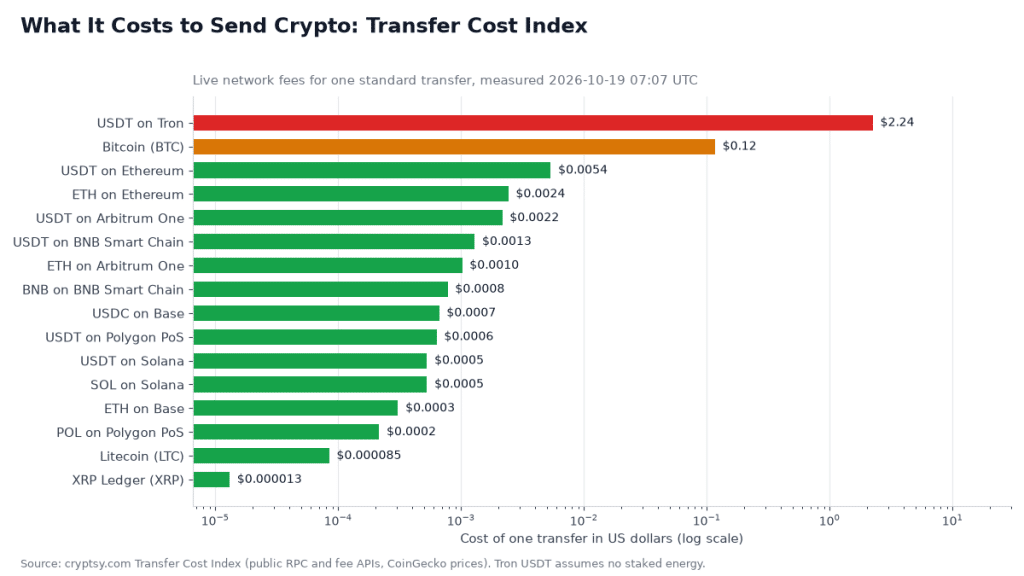
Sending crypto now costs less than a cent on most networks, with one big exception: moving USDT on Tron, the network many people use for stablecoins, cost about $2.24 per transfer in our 19 October 2026 measurement. That is roughly 4,200 times the cost of the same USDT transfer on Solana and about 400 times the cost on Ethereum. A Bitcoin payment cost about $0.12.
The Cryptsy Transfer Cost Index measures what one standard transfer costs on 10 major networks, using live data from each network’s own public endpoints rather than estimates or exchange price lists. This edition was measured on 19 October 2026 at 07:07 UTC.
Key Findings on Crypto Transfer Fees
- USDT on Tron was the most expensive transfer measured, at about $2.24 for a wallet without staked energy (6.77 TRX).
- USDT on Solana cost about $0.0005, roughly 4,200 times cheaper than on Tron.
- Ethereum mainnet was cheap: about $0.0024 to send ETH and $0.0054 to send USDT, with gas near 0.05 gwei.
- A Bitcoin payment cost about $0.12 at a fee rate of 1 satoshi per virtual byte.
- XRP and Litecoin were the cheapest, at about $0.000013 and $0.000085 per payment.
- Layer 2 networks stayed below a fifth of a cent: USDC on Base cost about $0.0007 and USDT on Arbitrum One about $0.0022.
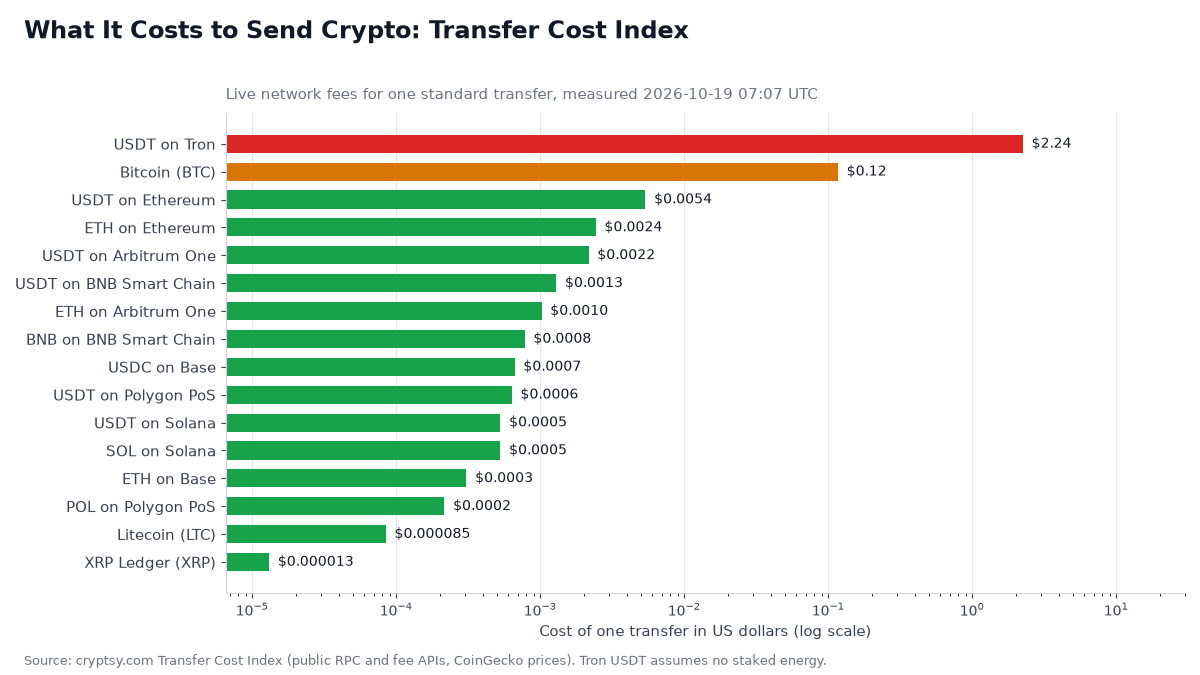
Crypto Transfer Fees by Network: Full Results
Each row is the network fee for one standard transfer at the moment of measurement, converted to US dollars with CoinGecko prices taken in the same run. Exchange withdrawal fees are not included.
| Network | Transfer | What was measured | Fee (native) | Fee (USD) |
|---|---|---|---|---|
| Tron | USDT token transfer (no staked energy) | 64,285 energy at 100 sun + 345 B bandwidth | 6.774 TRX | $2.24 |
| Bitcoin | BTC payment | 1 sat/vB x 141 vB | 0.00000141 BTC | $0.12 |
| Tron | TRX transfer (daily free bandwidth used up) | ~268 B at 1000 sun/B | 0.268 TRX | $0.09 |
| Ethereum | USDT token transfer | 46,455 gas at 0.04758 gwei | 0.00000221 ETH | $0.0054 |
| Ethereum | ETH transfer | 21,000 gas at 0.04758 gwei | 0.000001 ETH | $0.0024 |
| Arbitrum One | USDT token transfer | 44,541 gas at 0.02001 gwei | 0.00000089 ETH | $0.0022 |
| BNB Smart Chain | USDT token transfer | 34,802 gas at 0.05103 gwei | 0.00000178 BNB | $0.0013 |
| Arbitrum One | ETH transfer | 21,000 gas at 0.02001 gwei | 0.00000042 ETH | $0.0010 |
| BNB Smart Chain | BNB transfer | 21,000 gas at 0.05103 gwei | 0.00000107 BNB | $0.0008 |
| Base | USDC token transfer | 45,415 gas at 0.006 gwei | 0.00000027 ETH | $0.0007 |
| Polygon PoS | USDT token transfer | 61,696 gas at 110.5 gwei | 0.0068166 POL | $0.0006 |
| Solana | SOL transfer | 5,000 lamports base + median priority 0 µL/CU | 0.000005 SOL | $0.0005 |
| Solana | USDT token transfer (recipient account exists) | same signature fee as SOL | 0.000005 SOL | $0.0005 |
| Base | ETH transfer | 21,000 gas at 0.006 gwei | 0.00000013 ETH | $0.0003 |
| Polygon PoS | POL transfer | 21,000 gas at 110.5 gwei | 0.00232023 POL | $0.0002 |
| Litecoin | LTC payment | 1 sat/vB x 141 vB | 0.00000141 LTC | $0.000085 |
| XRP Ledger | XRP payment | base fee 1e-05 XRP x load 1 | 0.00001 XRP | $0.000013 |
Prices used: BTC $82,816, ETH $2,430.47, SOL $105.74, BNB $727.53, TRX $0.3314, XRP $1.31, LTC $60.01, POL $0.0930.
Why USDT Transfer Fees on Tron Cost More
Tron does not charge gas the way Ethereum does. Smart contract calls, including USDT transfers, consume energy, and simple data use consumes bandwidth. In this run a USDT transfer between two existing holders used 64,285 energy, and the network’s energy price was 100 sun (0.0001 TRX) per unit. A wallet with no energy of its own burns TRX to cover it, which came to about 6.77 TRX including bandwidth.
That figure is the ceiling, not what every user pays. Wallets that stake TRX receive energy and can send USDT for little or nothing, and some services rent out energy. Sending to an address that has never held USDT also uses more energy than sending to an existing holder.
Ethereum and Layer 2 Transfer Fees
Ethereum fees were low when we measured: a plain ETH transfer uses a fixed 21,000 gas, and the network’s base fee plus the median priority fee came to about 0.05 gwei. A USDT transfer used 46,455 gas. Fees on Ethereum rise sharply when demand spikes, so these numbers are a calm-market reading.
Layer 2 networks were cheaper still. On Base, an OP Stack network, the fee includes a small charge for posting data to Ethereum, which we read from the network’s own fee oracle; it added well under a millionth of a dollar. Arbitrum One builds that cost into its gas estimate.
Bitcoin, Litecoin and XRP Transaction Fees
Bitcoin and Litecoin price fees per virtual byte of transaction data. Both networks were quiet, with a recommended rate of 1 satoshi per virtual byte, so a typical 141-byte payment cost 141 satoshis: about $0.12 on Bitcoin and $0.000085 on Litecoin. The XRP Ledger charged its base fee of 0.00001 XRP with no extra load.
Solana Transfer Fees
Solana charges a base fee of 5,000 lamports (0.000005 SOL) per signature, plus an optional priority fee. The median priority fee was zero when we measured, so a SOL or USDT transfer cost 0.000005 SOL, about $0.0005. Sending a token to a wallet that has no account for that token yet adds a one-time rent deposit of about 0.002 SOL.
Network Fees vs. Exchange Withdrawal Fees
The fees above are what the blockchain charges. When you withdraw from an exchange, the exchange sets its own fee, which is often a flat amount per coin and can be much higher than the network fee. Our guides to Kraken fees, Gemini withdrawal fees and Crypto.com withdrawal fees list what each platform charges, and our comparison of low-fee crypto exchanges ranks the cheaper options.
The practical takeaway: before you send stablecoins, check which networks both the sender and the receiver support. Picking Solana, Polygon, Base or BNB Smart Chain over Tron or Ethereum mainnet can cut the network cost to a fraction of a cent, as long as the receiving wallet or exchange supports that network.
How We Measured Crypto Transfer Fees
- Bitcoin and Litecoin: recommended fee rates from mempool.space and litecoinspace.org, multiplied by 141 virtual bytes, the typical size of a one-input, two-output native SegWit payment.
- Ethereum, Arbitrum One, Base, Polygon PoS and BNB Smart Chain: next-block base fee plus the median priority fee of the last 10 blocks from each network’s public RPC. Native transfers use 21,000 gas. Token transfers use the median gas estimate for real transfers between current holders found in the latest blocks.
- Base: the Ethereum data fee comes from the network’s GasPriceOracle contract.
- Solana: protocol base fee plus the median recent priority fee.
- Tron: energy used by a real USDT transfer, estimated on TronGrid, multiplied by the chain’s energy price, plus bandwidth.
- XRP Ledger: validated ledger base fee and load factor from a public rippled server.
- Prices: CoinGecko, taken in the same run.
Fees change by the minute, so every figure is a snapshot taken on 19 October 2026 at 07:07 UTC. We re-measure monthly with the same method.
Use the Crypto Transfer Cost Index Data
You are welcome to cite these figures and republish the chart, with credit to Cryptsy and a link to this page. Suggested citation: Cryptsy Transfer Cost Index, October 2026, cryptsy.com/crypto-transfer-fees/. Journalists who need the raw numbers for a story can reach us through our contact page.
Frequently Asked Questions
What is the cheapest crypto to send?
In our 19 October 2026 measurement, an XRP payment was the cheapest transfer at about $0.000013, followed by Litecoin at about $0.000085. Among stablecoin transfers, USDT on Solana and on Polygon each cost well under a tenth of a cent.
How much does it cost to send USDT?
It depends on the network. On 19 October 2026 a USDT transfer cost about $0.0005 on Solana, $0.0006 on Polygon, $0.0013 on BNB Smart Chain, $0.0054 on Ethereum and about $2.24 on Tron for a wallet without staked energy.
Why is sending USDT on Tron expensive?
Tron charges for smart contract calls in energy. A USDT transfer used 64,285 energy at 100 sun each, so a wallet with no staked TRX burns about 6.77 TRX per transfer. Wallets that stake TRX for energy, or rent it, pay far less.
How much does a Bitcoin transaction cost right now?
At the time of measurement the network fee rate was 1 satoshi per virtual byte, so a typical 141 vB native SegWit payment cost 141 satoshis, about $0.12. Bitcoin fees rise quickly when the mempool is busy.
Are exchange withdrawal fees the same as network fees?
No. Exchanges set their own withdrawal fees, which are often a flat amount per coin and can be far higher than the network fee shown here. Check the exchange’s fee page before you withdraw.
How often is the Transfer Cost Index updated?
We re-measure the index with the same method each month and update the date at the top of the page. Fees can change minute to minute, so treat each figure as a snapshot.