Polymarket is a prediction market where you buy and sell shares in the outcome of real events, priced between $0.00 and $1.00. If the outcome you hold happens, each share pays $1.00 in USDC. If it does not, the share is worth nothing. The price in between is the market’s estimate of the odds.
This guide covers how the prices work, what it costs, how markets are settled and who is allowed to trade, using Polymarket’s own help center and documentation.
Key Takeaways
- Polymarket is a prediction market where shares trade between $0.00 and $1.00.
- A winning share pays out $1.00 in USDC. A losing share pays nothing.
- You trade against other users, not against a house.
- Only takers pay fees. Geopolitics markets have no fee at all.
- The international site is close-only in the US. Polymarket US is a separate, CFTC-regulated platform.
What Is Polymarket?
Polymarket describes itself as the world’s largest prediction market. You trade on questions with a clear answer by a set date, such as who wins an election or a final. Each question has YES and NO shares.
The mechanics are simple. Every pair of one YES and one NO share is backed by $1.00 of USDC. Shares are created when two people on opposite sides agree on prices that add up to $1.00. When the event is decided, the correct side is paid $1.00 a share.
There is no bookmaker. Polymarket’s help center says: “Polymarket is not the house. All trades happen peer-to-peer.” The other side of your trade is another user.
How Do Polymarket Prices Work?
Price equals probability. A YES share at 18 cents means the market puts the chance at 18%. Polymarket does not set those prices. Supply and demand do, the same way a stock price is set.
The number shown on a market is the midpoint between the best bid and the best ask in the order book. Polymarket’s example: a 34 cent bid and a 40 cent ask show as 37%. If that gap is wider than 10 cents, the last traded price is shown instead.
A worked example
Polymarket’s help center uses a basketball market. Say YES shares on a team winning the title trade at 18 cents, and you think the true chance is higher.
- You buy 100 YES shares at $0.18. Cost: $18.
- The team wins. Each share pays $1.00. You receive $100, a profit of $82 before any fee.
- The team loses. The shares are worthless. You lose the $18.
- The odds move to 30% before the final. You can sell at about $0.30 a share for $30, without waiting for the result.
That last option is what separates a market from a bet slip. You can sell at any time before resolution, provided someone is willing to buy.
What Fees Does Polymarket Charge?
Polymarket charges a taker fee on certain markets. Makers, the traders whose limit orders sit in the order book, are never charged. There are no Polymarket fees to deposit or withdraw USDC, though a service you use on the way in or out, such as Coinbase or MoonPay, may charge its own.
The fee is not a flat percentage. Polymarket’s documentation gives this formula, where C is the number of shares and p is the share price:
fee = C x feeRate x p x (1 – p)
The rate depends on the market’s category. These were the published rates on October 8, 2026:
| Market category | Taker fee rate | Maker fee | Maker rebate |
|---|---|---|---|
| Crypto | 0.07 | 0 | 20% |
| Sports | 0.05 | 0 | 15% |
| Economics, Culture, Weather, Other | 0.05 | 0 | 25% |
| Finance, Politics, Mentions, Tech | 0.04 | 0 | 25% |
| Geopolitics | 0 | 0 | None |
Because of the p x (1 – p) term, the fee is highest when a market is a coin flip and shrinks toward the extremes. It is also symmetric: a trade at 30 cents pays the same dollar fee as a trade at 70 cents.
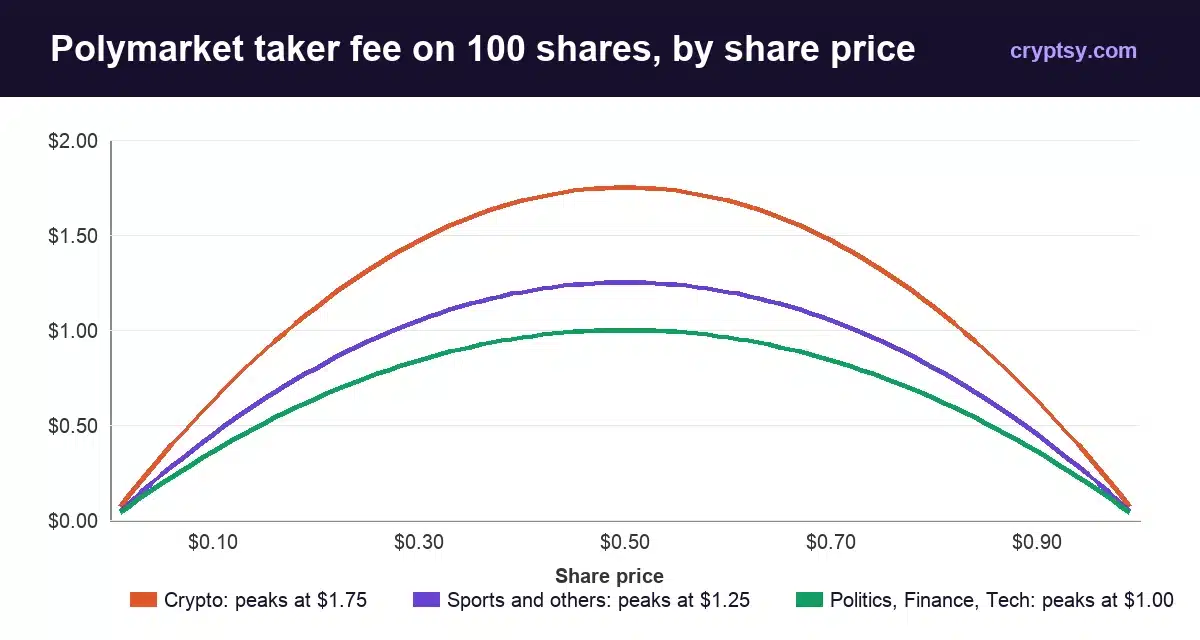
Polymarket’s own table for a crypto market shows the shape. Buying 100 shares costs:
| Share price | Trade value | Taker fee |
|---|---|---|
| $0.10 | $10 | $0.63 |
| $0.30 | $30 | $1.47 |
| $0.50 | $50 | $1.75 |
| $0.70 | $70 | $1.47 |
| $0.90 | $90 | $0.63 |
Run the same formula on other categories and 100 shares at 50 cents costs $1.25 in a sports market and $1.00 in a politics market. In a geopolitics market it costs nothing.
The fees collected fund a Maker Rebates Program, which Polymarket says is paid out daily to market makers.
How Do You Deposit?
Each Polymarket account has a fixed crypto deposit address. You pick a token and a network, copy the address shown in your profile and send funds to it. The address differs by network, so your Solana or Bitcoin address is not the same as your Polygon or EVM address.
- Minimums apply. Polymarket gives $20 on Ethereum and $3 on Solana as examples. Smaller deposits stay pending until the total reaches the minimum.
- Test first. Polymarket suggests sending a small amount before a large one.
- Check the network twice. A transfer sent to the wrong chain or address cannot be reversed. Polymarket has an on-chain recovery tool for some cases.
How Are Markets Resolved?
Every market has written rules, shown under its order book. When the result is clear, the market is resolved according to those rules, through the UMA Optimistic Oracle, a smart-contract system.
- Someone proposes an outcome and posts a bond in USDC.e. Polymarket’s help center puts the bond at $750.
- A challenge period of 2 hours begins. Anyone who disagrees can dispute the proposal.
- If nobody disputes, the outcome stands. The proposer gets the bond back plus a reward.
- If it is disputed, the question goes to UMA’s dispute resolution process.
Once resolved, winning shares pay $1.00 each, losing shares become worthless and trading stops. A proposer who is wrong, or too early, loses the whole bond.
For traders the lesson is to read the rules before buying. They define what counts as the event and how it is decided.
Who Can Use Polymarket?
This is where most confusion sits. Polymarket operates through separate legal entities, and the international site restricts many countries. Its documentation sorts them into groups.
| Status on the international site | What it means | Examples |
|---|---|---|
| Blocked completely | No new orders, and positions cannot be closed | Iran, Syria, Cuba, North Korea, and the Crimea, Donetsk and Luhansk regions |
| Close-only (site and API) | You can close positions but not open new ones | United States, United Kingdom, France, Germany, Italy, Australia, New Zealand, Singapore, Brazil, Poland, Belgium, and the Canadian provinces of Ontario, British Columbia, Alberta and Quebec |
| Close-only (site only) | Close-only on the website | Ireland, Japan, Netherlands, South Korea, and Malta for sports markets |
The lists are longer than this and they change. Check Polymarket’s geographic restrictions page for your own country before you deposit anything.
Is Polymarket legal in the US?
The international site is close-only for the United States. Some background: on January 3, 2022, the Commodity Futures Trading Commission ordered Polymarket’s operator, Blockratize, Inc., to pay a $1.4 million civil penalty. The charge was offering off-exchange event-based binary options without being a registered exchange. Polymarket was also ordered to wind down markets that did not comply.
There is now a separate US platform. Polymarket US, at polymarket.us, states that it is “operated by QCX LLC d/b/a Polymarket US, a CFTC-regulated Designated Contract Market.” It is a separate venue from the international site.
Polymarket vs a Sportsbook
| Polymarket | Traditional sportsbook | |
|---|---|---|
| Who you trade against | Other users | The bookmaker |
| How the price is set | Supply and demand in an order book | Odds set by the operator |
| Getting out early | Sell your shares at the market price, if there is a buyer | Only if a cash-out is offered |
| How it earns | Taker fees on certain markets | A margin built into the odds |
| Settlement | Written market rules, resolved through the UMA oracle | The operator’s own rules |
What Are the Risks?
- You can lose your whole stake. A share that resolves the wrong way is worth zero.
- Liquidity is not guaranteed. You can only sell early if someone will buy. Small markets can have wide gaps between bid and ask.
- Rules decide the outcome, not headlines. A market can resolve in a way that surprises people who did not read the wording.
- Access depends on where you live. Being placed in close-only mode means you can exit but not trade.
- A crowd can be wrong. A price is the market’s estimate, and estimates miss.
This is not financial advice. Prediction markets are a form of trading with real money at stake. If betting stops being fun or you are chasing losses, stop and seek help.
If you plan to fund an account from an exchange, our Kraken fees guide and Coinbase fees guide show what it costs to buy and withdraw.
Frequently Asked Questions
What is Polymarket?
Polymarket is a prediction market where users trade shares in the outcomes of real events. Shares are priced between $0.00 and $1.00, and each winning share pays $1.00 in USDC.
How does Polymarket make money?
It charges a taker fee on certain markets, calculated as shares times a category rate times price times one minus price. Makers pay nothing and geopolitics markets carry no fee.
Is Polymarket legal in the US?
The international site is close-only for US users. A separate platform, Polymarket US, says it is operated by QCX LLC, a CFTC-regulated Designated Contract Market.
Can you sell Polymarket shares before the event ends?
Yes. You can sell at any time before the market resolves, as long as there is a buyer for your shares.
How are Polymarket markets resolved?
Through the UMA Optimistic Oracle. Someone proposes an outcome with a bond, a 2-hour challenge period follows, and disputed proposals go to UMA’s dispute process.
Are you betting against Polymarket?
No. Polymarket says it is not the house. Every trade is matched with another user, and prices come from supply and demand.
Sources
- Polymarket Help Center, What is Polymarket
- Polymarket Help Center, Is Polymarket The House?
- Polymarket Help Center, How Are Prices Calculated?
- Polymarket Help Center, How Are Prediction Markets Resolved?
- Polymarket Help Center, How to Deposit
- Polymarket Documentation, Fees
- Polymarket Documentation, Geographic Restrictions
- Polymarket US
- CFTC, press release 8478-22 (January 3, 2022)