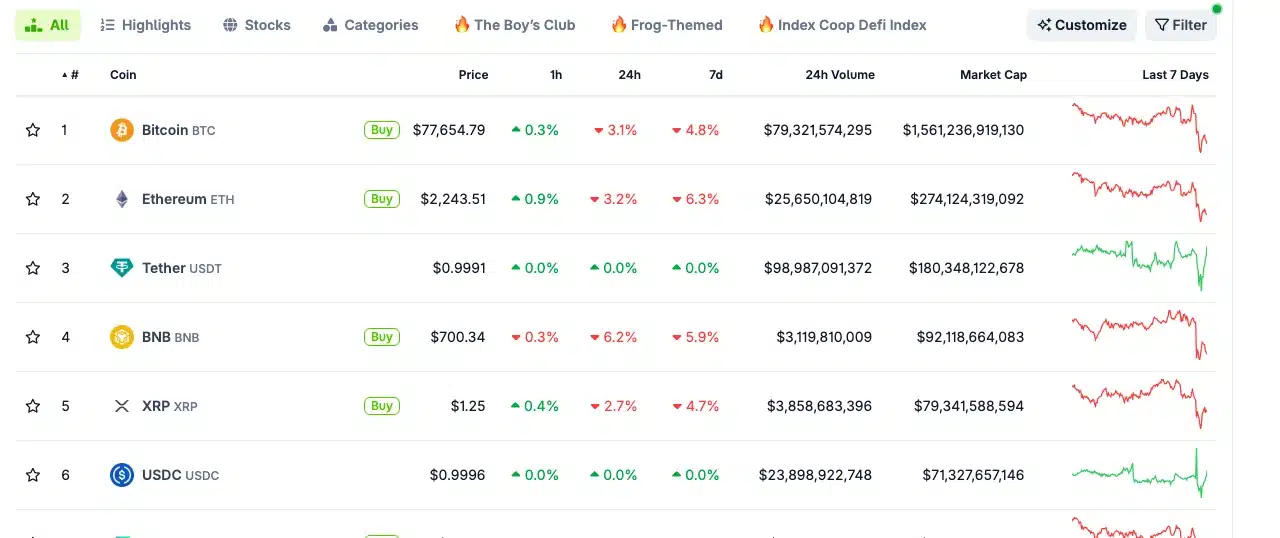
The best cryptocurrencies to invest in for most people are still Bitcoin and Ethereum, with a smaller slice in large, liquid altcoins such as Solana, XRP and BNB. Everything further down the list is a higher-risk bet. Prices below are from CoinGecko on October 30, 2026.
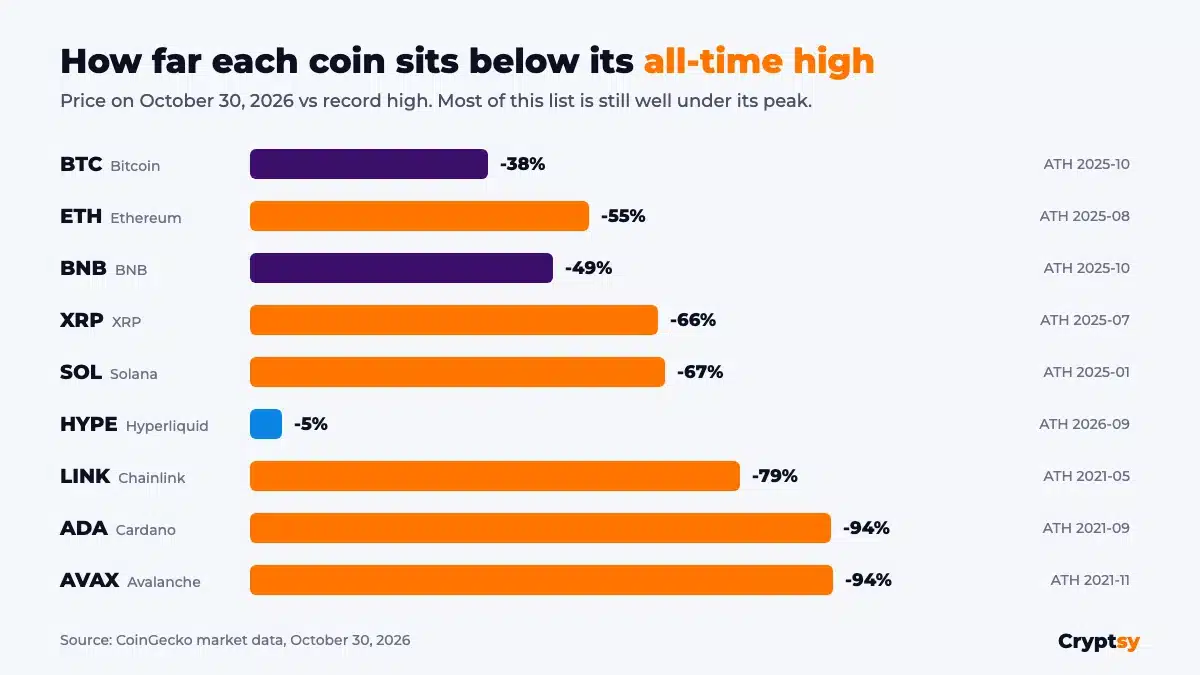
One number frames the whole market right now: Bitcoin is about 38% below its October 2025 record and down 29% over twelve months. Most altcoins have fallen further.
This is not financial advice. Crypto can lose most of its value quickly. Only invest money you can afford to lose.
Key takeaways
- Bitcoin ($77,668) and Ethereum ($2,244) make up the core. Bitcoin alone is 60% of the whole crypto market by value.
- Large caps (BNB, XRP, Solana, TRON) add more upside and more risk.
- Higher-risk picks (Hyperliquid, Chainlink, Cardano, Avalanche) can move 50% or more in a month, up or down.
- Eight of the ten coins below are lower than a year ago. The exceptions are TRON (+15%) and Hyperliquid (+93%).
- Buy on a regulated exchange, then move long-term holdings to a wallet you control.
The 10 cryptocurrencies at a glance
| Coin | Risk tier | Price | Market cap | Rank | 1 year | From all-time high |
|---|---|---|---|---|---|---|
| Bitcoin (BTC) | Core | $77,668 | $1,562B | #1 | -29% | -38% |
| Ethereum (ETH) | Core | $2,244 | $274B | #2 | -42% | -55% |
| BNB (BNB) | Large cap | $701 | $92B | #4 | -37% | -49% |
| XRP (XRP) | Large cap | $1.25 | $79B | #5 | -51% | -66% |
| Solana (SOL) | Large cap | $96.87 | $57B | #7 | -50% | -67% |
| TRON (TRX) | Large cap | $0.340 | $32B | #8 | +15% | -21% |
| Hyperliquid (HYPE) | Higher risk | $92.92 | $22B | #10 | +93% | -5% |
| Chainlink (LINK) | Higher risk | $11.09 | $8.5B | #17 | -38% | -79% |
| Cardano (ADA) | Higher risk | $0.194 | $7.3B | #18 | -69% | -94% |
| Avalanche (AVAX) | Higher risk | $8.57 | $3.8B | #29 | -56% | -94% |
Core holdings: Bitcoin and Ethereum
1. Bitcoin (BTC): $77,668
Bitcoin is the default first position for a reason. Supply is capped at 21 million coins, and the April 2024 halving cut new issuance to 3.125 BTC per block. US spot Bitcoin ETFs have traded since January 2024, so the same asset you buy on an exchange is held by funds and public companies.
The case for buying now is simple: it is about 38% below its October 2025 high of $126,080. The case against is that it has been lower over the past year, and nothing guarantees it returns to the record.
2. Ethereum (ETH): $2,244
Ethereum is the largest smart-contract network, home to most DeFi activity and a big share of stablecoin settlement. US spot Ether ETFs launched in July 2024. You can also stake ETH for a yield on top of price exposure, although liquid staking rates are low single digits.
ETH has had a harder year than Bitcoin, down 42%, and sits 55% under its August 2025 peak. Some investors see that gap as value. Others see a network losing activity to cheaper chains.
Large caps: more upside, more risk
3. BNB (BNB): $701
BNB powers BNB Chain and gives fee discounts on Binance. Its value is tied closely to Binance’s business. US residents cannot use the main Binance exchange; Binance.US is a separate company and is not available in every state.
4. XRP (XRP): $1.25
XRP is built for fast payments, settling in seconds for a fraction of a cent. Ripple’s long legal fight with the SEC ended in 2025, and the company also issues the RLUSD stablecoin. XRP is still 66% below its July 2025 high and down 51% over the year, so the market has not yet rewarded the legal win.
5. Solana (SOL): $96.87
Solana is the busiest high-speed chain for trading and consumer apps, with very low fees. It is also one of the most volatile large caps: down 19% in the past 30 days, down 50% over the year and 67% from its January 2025 record.
6. TRON (TRX): $0.340
TRON is the least exciting coin on this list and that is partly the point. It carries more USDT than any other blockchain, which makes it core plumbing for stablecoin payments. TRX is up 15% over twelve months, far steadier than most large caps.
Higher-risk picks
7. Hyperliquid (HYPE): $92.92
Hyperliquid runs one of the largest on-chain exchanges for perpetual futures, and the protocol uses trading fees to buy back HYPE. It is the best performer here over the year (+93%), and it set a new high in September 2026. That strength is also the risk: a coin near its peak has further to fall, and its value depends on one exchange keeping its users.
8. Chainlink (LINK): $11.09
Chainlink supplies price feeds and cross-chain messaging to a large share of DeFi apps. The technology is widely used, but the token still trades 79% below its 2021 high.
9. Cardano (ADA): $0.194
Cardano has a loyal community and a research-led approach, but adoption has lagged. ADA is 94% below its 2021 high and down 69% in a year. Buying it today is mostly a recovery bet.
10. Avalanche (AVAX): $8.57
Avalanche lets companies and projects launch their own custom chains. Like Cardano, it is 94% below its 2021 peak, and it lost another 23% in the past month. Big swings in both directions are normal at this size.
Coins that dropped off this list since our earlier version: Polygon (now #74), Arbitrum (#70) and Polkadot (#57) are down 53%, 47% and 69% over the year. For a wider look at the altcoin market, see our top 10 altcoins right now.
How to build a position without overthinking it
- Start with the core. Many investors put most of a crypto allocation in Bitcoin and Ethereum and treat everything else as satellite bets.
- Size each bet so a 90% drop would not hurt you. Cardano and Avalanche show that large, well-known coins can lose that much.
- Buy in stages. Regular fixed purchases (dollar-cost averaging) remove the pressure of picking the bottom.
- Ignore anything that promises returns. Presales and “guaranteed” yields are where most retail losses happen.
Where to buy and how to store it
Use a regulated exchange that serves your state, and check the real fee before you trade. For example, Kraken’s published spot fee for accounts trading under $2,500 a month is 0.40% for makers and 0.80% for takers, falling as volume rises. Simple “buy” buttons in exchange apps usually cost more than the advanced trading screen. Our low-fee exchange comparison covers the main options.
Anything you plan to hold for years belongs in a wallet you control, not on the exchange. Our Bitcoin cold storage guide explains hardware wallets and seed backups step by step.
How to invest in cryptocurrency: step by step
If you have never bought cryptocurrencies before, the process takes about an hour, most of it spent on identity checks. These are the steps most US investors follow:
- Pick a regulated exchange or brokerage platform that serves your state. Coinbase and Kraken are two of the largest US crypto exchanges, and some stock brokerages also sell Bitcoin and Ethereum.
- Verify your identity. US platforms are required to check ID before you can buy, so have a driver’s license or passport ready.
- Fund the account in US dollars or another fiat currency by bank transfer. Card purchases are faster but usually cost more.
- Buy your core position first, usually Bitcoin (BTC) and Ethereum (ETH), then add smaller amounts of the altcoins you have researched.
- Set up recurring buys if you plan to invest a fixed amount every week or month.
- Move long-term holdings to your own wallet and write down the recovery phrase on paper or steel.
- Keep records of every transaction: each purchase, sale and swap matters at tax time.
What makes a cryptocurrency worth investing in?
CoinGecko tracks more than 22,000 coins, but value is concentrated at the top. On October 30, 2026, Bitcoin was about 60% of the whole crypto market and Ethereum about 11%. Most other cryptocurrencies share what is left of the market. Before you invest in any coin outside that pair, check five things:
- Market cap and trading volume. Large, liquid coins are easier to buy and sell without moving the price. A tiny coin can be hard to exit when the market turns.
- What the token is used for. Paying transaction fees (ETH, SOL, TRX), settling cross-border payments (XRP), securing decentralized finance apps (LINK) or sharing protocol revenue (HYPE) gives a token demand from real users, not just speculation.
- Supply and unlocks. Check the maximum supply and how many tokens are still to be released. Large unlocks for early investors can push the price down.
- Track record. Coins that have survived several market cycles, outages and legal fights have shown they can last. Newer coins have not.
- Where you can trade it. If a coin is only listed on small offshore exchanges or a few decentralized exchanges, that is a warning sign for US investors.
Blockchain technology on its own is not a reason to buy. Plenty of cryptocurrencies run on working technology and still lost most of their market value, as the 2021 high points in the table above show. The investor question is whether the token captures value when the network is used.
Crypto ETFs and crypto stocks: investing without holding coins
You do not have to hold coins directly to get crypto exposure. US spot Bitcoin ETFs have traded since January 2024 and spot Ether ETFs since July 2024, so investors can buy them in an ordinary brokerage or retirement account like any stock. That brought Bitcoin into traditional finance. You pay an annual fund fee instead of exchange trading fees, and you never manage a wallet or recovery phrase.
Crypto-linked stocks are another route. Coinbase (COIN) has been listed on Nasdaq since April 2021, and some public companies hold Bitcoin on their balance sheets. These stocks tend to move with the crypto market, often more sharply, and also carry ordinary business risk. An ETF tracks the coin. A stock tracks a company.
| Route | What you own | Costs | Best for |
|---|---|---|---|
| Buy coins on an exchange | The cryptocurrency itself | Trading fees, spread | Investors who want to self-custody or use crypto |
| Spot Bitcoin or Ether ETF | Fund shares that hold the coin | Annual fund fee | Brokerage and retirement accounts |
| Crypto stocks | Shares in a company | Stock trading costs | Investors comfortable with business risk on top of crypto risk |
Cryptocurrencies to avoid
- Coins pushed by influencers or paid ads promising a 10x or 100x return.
- Presales and new token launches with no trading history and large allocations held by insiders.
- Memecoins you cannot explain. Most memecoin tokens have no payment or finance use. Dogecoin is the exception that lasted, and even it trades about 90% below its 2021 high.
- Anything offered on an unlicensed platform or through a stranger who contacted you first. Investment scams often start with a friendly message and ask users to pay in a digital currency that cannot be reversed.
Taxes
In the US, the IRS treats crypto as property. Selling, swapping one coin for another, or spending crypto can each create a taxable gain or loss. Starting with 2025 transactions, US brokers report crypto sales to the IRS on Form 1099-DA, so keep your own records too. Our crypto tax guide goes deeper.
Frequently Asked Questions
What is the best cryptocurrency to invest in right now?
For most people, Bitcoin, then Ethereum. Bitcoin is the largest and most widely held crypto asset, priced at $77,668 on October 30, 2026. Smaller coins can rise faster but carry much higher risk.
Is it too late to buy Bitcoin?
Nobody knows the future price. On October 30, 2026 Bitcoin traded about 38% below its October 2025 record and 29% lower than a year earlier, so buyers today pay less than at the peak, but there is no guarantee it recovers.
Which altcoin has done best over the past year?
Of the coins on this list, TRON (+15%) and Hyperliquid (+93%) were up over twelve months as of October 30, 2026. Most of the other large altcoins fell between 35% and 70%.
How much of my portfolio should be in crypto?
There is no single right number. A common rule is to keep crypto to an amount you could lose entirely without changing your life, and to hold most of it in Bitcoin and Ethereum.
Are stablecoins a good investment?
Stablecoins such as USDT and USDC are designed to stay at $1, so they do not grow in value. They are useful for moving money and earning interest, not for price gains.
How do I start investing in cryptocurrency?
Open an account on a regulated US exchange or brokerage, verify your identity, fund it by bank transfer and buy a small amount of Bitcoin or Ethereum first. Move anything you plan to hold for years to a wallet you control.
Is it better to buy a Bitcoin ETF or Bitcoin itself?
An ETF is simpler: it sits in a normal brokerage account and needs no wallet, but you pay an annual fund fee and cannot send the coins. Buying Bitcoin directly lets you hold it yourself and use it, but you are responsible for keeping it safe.
Do I pay tax on crypto gains in the US?
Yes. The IRS treats crypto as property, so selling, swapping or spending it can trigger capital gains tax. Brokers report sales on Form 1099-DA starting with 2025 transactions.