


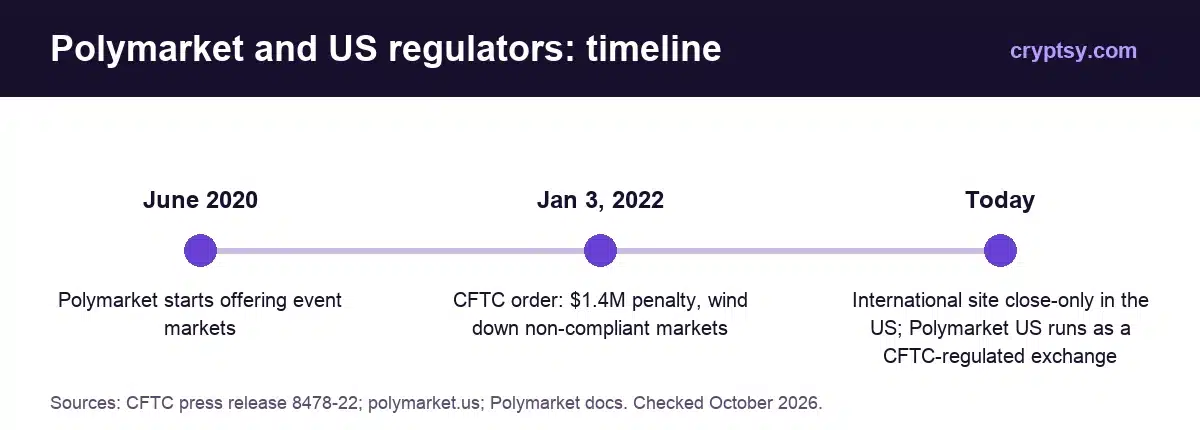
Polymarket’s $1.4 million fine came from the Commodity Futures Trading Commission (CFTC), not the SEC. On January 3, 2022, the CFTC announced that Blockratize, Inc., the company behind Polymarket, had agreed to pay a $1.4 million civil penalty for offering event-based binary options without being registered as an exchange. It also had to wind down the markets on Polymarket.com that did not comply.
Correction: an earlier version of this article said the fine came from the SEC and quoted an unnamed SEC official. Both were wrong, and the quote has been removed. The facts below come from the CFTC’s own announcement.
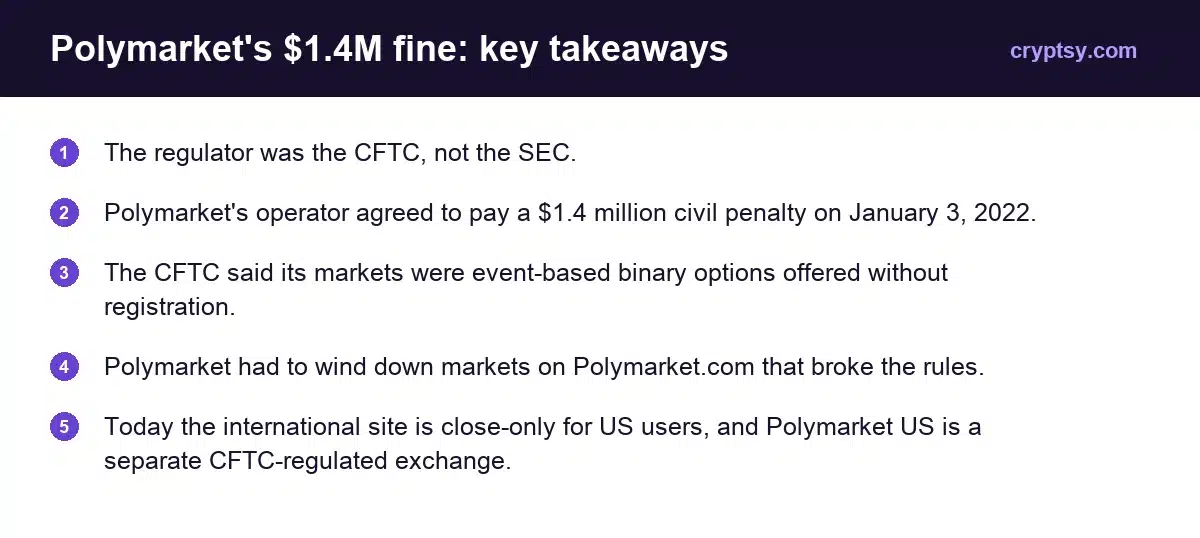
Key Takeaways
- The regulator was the CFTC, not the SEC.
- Polymarket’s operator agreed to pay a $1.4 million civil penalty on January 3, 2022.
- The CFTC said its markets were event-based binary options offered without registration.
- Polymarket had to wind down markets on Polymarket.com that broke the rules.
- Today the international site is close-only for US users, and Polymarket US is a separate CFTC-regulated exchange.
Who Fined Polymarket?
The Commodity Futures Trading Commission. It is the US regulator for futures, options and swaps, which is where the CFTC places prediction-market contracts. The Securities and Exchange Commission, which oversees stocks and securities, was not part of this case.
The respondent was Blockratize, Inc., doing business as Polymarket, a Delaware-registered company based in New York City.
What Did the CFTC Order Say?
| Item | What the CFTC announced |
|---|---|
| Date | January 3, 2022 |
| Penalty | $1.4 million civil monetary penalty |
| Charge | Offering off-exchange event-based binary options |
| Missing registration | Not designated as a contract market or registered as a swap execution facility |
| Scale | More than 900 event markets since about June 2020 |
| Required action | Wind down Polymarket.com markets that did not comply with the Commodity Exchange Act and CFTC rules |
| Penalty reduced? | Yes, for “substantial cooperation” with the investigation |
The CFTC’s reasoning was straightforward. Each Polymarket market was a pair of yes-or-no binary options tied to a future event. The agency treats those as swaps, and swaps can only be offered to the public on a registered exchange. Polymarket had no such registration.
“All derivatives markets must operate within the bounds of the law regardless of the technology used,” said Vincent McGonagle, the CFTC’s acting director of enforcement at the time.
The announcement describes the case as a settlement. It does not say whether Polymarket admitted or denied the findings.
Why Did Blockchain Not Make a Difference?
Polymarket settled trades in crypto on a blockchain, and some users assumed that put it outside US derivatives rules. The CFTC’s statement rejects that idea directly: the technology does not change the legal status of the contract. If a product works like an event contract, the same registration rules apply.
That is the lasting lesson of the case for crypto users. How a market is built matters less than what it lets people trade.
What Happened Next?
Polymarket kept operating outside the US. Its international site now publishes a list of restricted countries, and in that list the United States is close-only. US users can close existing positions on the international site but cannot open new ones.
There is now a separate US platform. Polymarket US, at polymarket.us, states that it is “operated by QCX LLC d/b/a Polymarket US, a CFTC-regulated Designated Contract Market.” In other words, US access now runs through the kind of registered exchange the 2022 order said was required.
| 2022 | Now | |
|---|---|---|
| US access | Markets offered without registration | International site close-only for US users |
| Registered US venue | None | Polymarket US, run by QCX LLC, a CFTC-regulated Designated Contract Market |
| Regulator | CFTC enforcement action | CFTC oversight of the US exchange |
What This Means for Users
- Check which Polymarket you are on. The international site and Polymarket US are separate venues with separate rules.
- Check your country first. Polymarket’s documentation lists countries that are blocked or close-only. Being close-only means you can exit but not trade.
- Registration is checkable. The CFTC tells the public to verify a firm’s registration before sending money, using the National Futures Association’s BASIC search.
For how Polymarket works, including prices, fees and how markets are resolved, read our Polymarket guide.
Frequently Asked Questions
Did the SEC fine Polymarket?
No. The $1.4 million penalty came from the Commodity Futures Trading Commission (CFTC), announced on January 3, 2022. The SEC was not part of the case.
Why was Polymarket fined $1.4 million?
The CFTC said Polymarket offered event-based binary options without being designated as a contract market or registered as a swap execution facility.
How many markets did Polymarket offer before the fine?
The CFTC said Polymarket had offered more than 900 event markets since it began operating in about June 2020.
Was Polymarket shut down?
No. It had to wind down the Polymarket.com markets that did not comply with US rules. The international site kept running and is now close-only for US users.
Can Americans use Polymarket now?
US users are close-only on the international site. A separate platform, Polymarket US, says it is operated by QCX LLC, a CFTC-regulated Designated Contract Market.




















