


Secret blockchain applications are blockchain-based systems designed to protect sensitive information while preserving useful properties such as verifiable transactions, programmable rules, and shared records. They can support private financial transactions, confidential smart contracts, restricted NFT metadata, privacy-preserving voting, healthcare data sharing, and secure AI computation.
One of the best-known examples is Secret Network, a blockchain that introduced smart contracts with encrypted inputs, outputs, and state in 2020. Its technology combines blockchain consensus with trusted execution environments (TEEs) to process sensitive information without exposing it in ordinary public transaction data. Other approaches, including zero-knowledge proofs and fully homomorphic encryption, can provide different forms of privacy.
The important distinction is that blockchain transparency and data confidentiality are not mutually exclusive. A system can make its rules or verification results public while restricting access to personal information, transaction details, or other sensitive data.
This guide explores 12 practical and emerging applications, explains the technology behind them, examines Secret Network’s role, and identifies the limitations businesses and developers should consider before adopting privacy-focused blockchain solutions.
Key Takeaways
- Private smart contracts: Confidential computing can let smart contracts process sensitive inputs and maintain encrypted state.
- Private DeFi: Privacy technologies can reduce the public exposure of financial positions, transaction amounts, and trading strategies.
- Secret NFTs and gaming: Programmable privacy can protect metadata, reveal hidden game information selectively, and enable gated digital experiences.
- Healthcare and research: Blockchain can support tamper-evident audit trails and controlled data sharing, but it does not automatically make medical records private.
- Identity and voting: Zero-knowledge proofs can verify eligibility or membership without revealing every underlying personal detail.
- Confidential AI: Trusted execution environments and other privacy technologies can help protect sensitive inputs during computation.
- Important limitations: Hardware vulnerabilities, metadata leakage, key management, regulatory obligations, performance costs, and project maturity all affect real-world suitability.
What Are Secret Blockchain Applications?
Secret blockchain applications are decentralized applications that use privacy-preserving techniques to limit the information exposed during transactions or computation.
Unlike conventional public smart contracts, which commonly expose transaction data and contract state to blockchain observers, privacy-focused applications can encrypt selected data, restrict access to particular information, or prove that a computation is valid without disclosing all its inputs.
The word secret has two related meanings in this context. It can describe confidential information processed by a blockchain application, or it can refer specifically to Secret Network and its ecosystem of privacy-focused applications.
How do private blockchain applications work?
A privacy-preserving blockchain application generally combines several components:
- Blockchain consensus: Network participants agree on the valid sequence of transactions or state changes.
- Encryption: Sensitive information is protected from unauthorized access.
- Private computation: A trusted execution environment, zero-knowledge proof system, or another cryptographic technique enables specific operations without exposing all underlying information.
- Access controls: Users or applications determine who can view particular data.
- Verification: The system provides evidence that specified rules or computations were followed.
The exact design depends on the privacy technology being used. A blockchain using trusted hardware does not provide the same guarantees as a system based on zero-knowledge proofs or fully homomorphic encryption.
1. Confidential Smart Contracts and Private Computation
Confidential smart contracts are among the most important secret blockchain applications because they enable programmable logic to work with sensitive information.
On a typical public blockchain, transaction inputs, contract calls, and stored state may be visible to anyone inspecting the network. This transparency supports independent verification, but it can reveal financial positions, business strategies, personal information, or other sensitive details.
Privacy-preserving contracts aim to retain useful verification while limiting that exposure.
How does Secret Network protect smart contract data?
Secret Network launched its mainnet in February 2020 and introduced private smart contracts later that year. Its architecture uses trusted execution environments to process encrypted inputs and state.
In simplified terms, the process works as follows:
- A user submits a transaction containing protected data.
- The network processes the required computation inside a trusted execution environment.
- The contract updates its state according to its programmed rules.
- Sensitive outputs and stored state remain encrypted where the protocol specifies.
Secret Network’s contract code is publicly available on-chain, while designated inputs, outputs, and state are encrypted. This distinction allows users to inspect the program without necessarily seeing the sensitive data it processes. The network’s official technical documentation explains these design choices.
However, confidentiality depends on correct implementation, hardware security, cryptographic key management, and the surrounding application. Developers must also account for possible information leaks through transaction patterns, public outputs, or other metadata.
Where can confidential smart contracts be useful?
- Private financial applications that process sensitive transaction details.
- Business agreements that expose results only to authorized participants.
- Applications that verify user eligibility without publishing unnecessary personal information.
- AI systems that process confidential inputs.
- Digital marketplaces that restrict access to selected information.
Confidential smart contracts are particularly useful when an application needs both programmable rules and stronger data confidentiality than a conventional public contract provides.
2. Privacy-Preserving Decentralized Finance
Decentralized finance (DeFi) allows users to trade assets, lend, borrow, and interact with financial services through blockchain-based protocols. However, public transaction histories can expose portfolio balances, trading strategies, and financial relationships.
Privacy-preserving DeFi applications seek to reduce this exposure while maintaining important security and verification properties.
What can private DeFi protect?
Depending on the protocol, privacy features may help protect:
- Transaction amounts or counterparties.
- Trading intentions and sensitive financial positions.
- Lending and borrowing information.
- The details of particular trades or automated strategies.
- Confidential calculations used to determine eligibility or risk.
For example, a trader might want to execute a strategy without revealing every intermediate transaction to competitors. A privacy-focused protocol could conceal selected trade details while still enforcing its transaction rules.
Zero-knowledge proofs can also let a user demonstrate that a transaction meets specified conditions without disclosing every underlying input. Other systems use trusted execution environments or encrypted computation.
These methods have different trade-offs. Some preserve more public verifiability than others, and not every privacy feature hides all transaction information.
Privacy does not eliminate DeFi risk
A confidential transaction can still involve a vulnerable smart contract, an insecure wallet, a malicious operator, or a poorly designed bridge. Privacy also does not guarantee regulatory compliance.
Users should evaluate audits, administrative privileges, liquidity, upgrade mechanisms, withdrawal rules, and the technology used to protect confidential information before committing funds.
3. Secret NFTs and Private Digital Ownership
Non-fungible tokens (NFTs) can represent digital collectibles, membership rights, game assets, and other unique items. Yet public NFT metadata can reveal information that creators or owners may prefer to keep private.
Secret NFTs and similar privacy-enabled digital assets introduce controls over selected metadata and content.
What makes a Secret NFT different?
A conventional NFT may expose its token identifier, ownership history, and associated metadata. Depending on the implementation, external systems may also be able to retrieve the linked image or file.
A privacy-enabled NFT can restrict access to selected information, such as:
- Exclusive artwork or media.
- Membership credentials.
- Hidden attributes in a collectible.
- Game-item properties that should remain secret until a reveal.
- Content available only to authorized owners.
For example, a blockchain game could issue a collectible whose special abilities remain hidden until the player reaches a particular stage. A membership NFT could also unlock private content without requiring the content itself to be publicly accessible.
The NFT’s public ownership or transaction records may still reveal information. Privacy depends on how token metadata, content storage, access permissions, and associated transactions are designed.
Private NFT auctions
Private auctions are another potential use case. In a conventional public auction, visible bids can influence other participants’ decisions. A privacy-preserving auction can conceal bids until the auction closes or the rules permit disclosure.
Possible techniques include commit-and-reveal schemes, encrypted computation, and zero-knowledge proofs. These methods are not interchangeable, and each has different requirements for fairness, verification, and resistance to manipulation.
Established NFT marketplaces such as OpenSea, Magic Eden, Rarible, and SuperRare provide examples of different marketplace models, but their existence should not be interpreted as proof that every marketplace supports confidential auctions. Verify the current features of any specific platform before relying on them.
4. Healthcare Data Security and Controlled Sharing
Healthcare is a promising area for privacy-preserving blockchain applications because medical records must be protected while remaining accessible to authorized professionals and patients.
Blockchain can provide tamper-evident records of data access, consent changes, and information exchanges. Privacy technologies can complement these records by limiting who can inspect the underlying medical information.
How can blockchain protect electronic health records?
A healthcare system might use blockchain to record an audit trail when a hospital requests access to a patient’s medical information. The actual records could remain encrypted in a secure database or other off-chain storage system.
A typical architecture may include:
- Encrypted medical records stored outside the blockchain.
- A blockchain record containing selected hashes, permissions, or audit events.
- Access-control mechanisms that authenticate patients and authorized providers.
- Cryptographic tools that protect data during sharing or computation.
- Procedures for revoking access, correcting records, and responding to security incidents.
This design avoids placing large volumes of sensitive medical information directly on a permanent public ledger.
What are the potential benefits?
- Data integrity: Tamper-evident records can help reveal unauthorized changes.
- Auditability: Organizations can track selected access and permission events.
- Interoperability: Shared protocols can help different healthcare organizations coordinate data exchange.
- Research collaboration: Authorized researchers may be able to use protected datasets under controlled conditions.
- Patient control: Consent-management systems can help patients manage certain access permissions.
These benefits depend on implementation. Blockchain does not automatically encrypt every medical record, prevent every cyberattack, or make a system compliant with healthcare privacy laws.
A 2026 systematic review of blockchain-based electronic health record research identified continuing challenges involving scalability, key management, interoperability, regulatory compliance, and the maturity of real-world implementations. Many proposed systems remain prototypes or pilots rather than widely deployed clinical infrastructure. See the 2026 review in BMC Medical Informatics and Decision Making.
Blockchain in pharmaceutical supply chains
Pharmaceutical supply chains offer a related use case. Shared records can help organizations trace products through manufacturing, distribution, and delivery.
For example, a pharmaceutical company could record product identifiers, custody changes, and shipment events on a permissioned blockchain. Authorized participants could use those records to investigate discrepancies or identify suspicious products.
The limitation is that a blockchain cannot independently prove that a physical product is genuine. Reliable product identifiers, inspections, secure sensors, and trustworthy data entry remain essential.
5. Confidential Research and Intellectual Property Management
Research institutions and businesses routinely handle unpublished findings, proprietary designs, experimental data, and confidential commercial information.
Blockchain can help establish a timestamped record of a document or research result. Privacy technologies can restrict access to the underlying material while allowing selected parties to verify that a record corresponds to a particular version.
How can blockchain support intellectual property?
Potential applications include:
- Recording evidence that a digital document existed at a particular time.
- Tracking licensing agreements and authorized usage.
- Maintaining an auditable history of research-data access.
- Coordinating data sharing among research partners.
- Automating selected licensing or royalty-payment conditions.
A researcher, for example, could calculate a cryptographic hash of a research document and record the hash on a blockchain. Later, the researcher could hash the document again and compare the result to help demonstrate that the file matches the previously recorded version.
This does not automatically establish legal ownership, prove who originally created the document, or guarantee admissibility in court. Those questions depend on supporting evidence and applicable law.
Confidential biotechnology research
Biotechnology collaborations may involve commercially sensitive experiments or datasets derived from human participants. A privacy-preserving system could help organizations record consent, access requests, and data-sharing events while keeping the underlying information in appropriately secured storage.
The primary design challenge is to provide accountability without unnecessarily exposing research participants or confidential discoveries.
6. Supply Chain Transparency and Product Tracking
Supply chains often involve manufacturers, shipping companies, distributors, regulators, and retailers that operate separate record systems.
A blockchain can give authorized participants a shared history of product movements and recorded events. Privacy controls can limit which commercial details each participant sees.
Practical applications
- Food traceability: Record harvest, processing, transportation, and distribution events.
- Pharmaceutical tracking: Maintain records of product custody and verification.
- Manufacturing: Track components and quality-control milestones.
- Logistics: Record shipping events and selected delivery conditions.
- Automated compliance: Trigger alerts or contract actions when recorded conditions are not met.
Consider a shipment of temperature-sensitive medicine. A sensor could submit temperature readings to a system that records relevant events. If the shipment exceeds a defined temperature threshold, a smart contract might flag the shipment for inspection.
The blockchain can preserve the submitted event history, but it cannot guarantee that the sensor was accurate or that the initial data was honest. Hardware security, data validation, and operational controls are still necessary.
7. Privacy-Preserving Voting and Governance
Online voting systems must balance ballot secrecy with the ability to verify that an election was conducted correctly.
Blockchain can record election-related events, while cryptographic techniques can help protect individual votes and verify aspects of the tally.
How can secret voting work?
A privacy-preserving voting system may use cryptographic commitments, zero-knowledge proofs, encrypted ballots, and a verifiable tallying mechanism.
For example, a decentralized organization could allow eligible members to vote on a proposal without publishing each person’s choice. The system could then provide evidence that the final tally follows the defined rules.
This can be useful for:
- Decentralized autonomous organization (DAO) governance.
- Confidential shareholder or member polls.
- Online community decisions.
- Certain institutional voting experiments.
However, putting votes on a blockchain does not automatically create a secure election. Voter authentication, coercion resistance, ballot secrecy, software security, accessibility, and independent audits remain important.
High-stakes public elections require substantially stronger safeguards than many blockchain governance polls. A blockchain-based voting prototype should not be treated as a proven replacement for established election infrastructure without appropriate testing and independent evaluation.
8. Zero-Knowledge Proofs and Private Verification
Zero-knowledge proofs allow one party to demonstrate that a statement is true without revealing all the information used to establish it.
They are an important foundation for privacy-preserving blockchain applications because they can separate verification from disclosure.
What can zero-knowledge proofs do?
A user might prove that:
- They satisfy an age requirement without publishing their full birth date.
- They belong to an eligible group without identifying their specific membership record.
- A transaction satisfies specified rules without revealing every private input.
- A computation was performed according to a defined procedure.
Zero-knowledge proofs are also used in blockchain scaling systems. A rollup can submit a cryptographic proof that a batch of transactions follows specified rules, reducing the need for the base chain to repeat every computation.
Privacy and scalability are related but different goals. A zero-knowledge rollup may improve transaction processing without hiding every transaction detail. Likewise, a privacy-focused application may use zero-knowledge proofs without functioning as a scaling solution.
Ethereum’s privacy documentation describes applications including private voting, selective disclosure, and privacy-preserving transactions.
What happened to zkBNB?
zkBNB was a zero-knowledge rollup project developed for the BNB Chain ecosystem. Its official GitHub repository is now archived and states that it is no longer actively maintained.
The broader technology behind zero-knowledge proofs remains relevant, but zkBNB’s archived status is a reminder that individual implementations can be discontinued even when their underlying technical approach continues to be developed elsewhere.
Developers evaluating a project should verify its current maintenance status, security reviews, deployment activity, and official documentation rather than assuming that a once-announced roadmap remains active.
9. Decentralized Identity and Selective Disclosure
Digital identity systems help users demonstrate who they are or prove that they meet specific eligibility requirements.
Traditional identity verification often requires a user to share more personal information than a particular service actually needs. Privacy-preserving identity tools aim to reduce unnecessary disclosure.
How does blockchain-based identity work?
A decentralized identity system may combine cryptographically verifiable credentials, digital signatures, decentralized identifiers, and zero-knowledge proofs.
For example, a user seeking access to an age-restricted service might prove that they meet the minimum age requirement without revealing their full date of birth or identity document.
A professional could also present a verifiable qualification to an employer without requiring every credential to be stored in a centralized account controlled by the employer.
Blockchain may help coordinate public identifiers, credential status, or verification records, but sensitive personal data generally should not be placed directly on a public ledger.
Important privacy limitations
A decentralized identity system still needs secure recovery procedures, reliable credential issuers, protection against account takeover, and a clear approach to revocation.
Public identifiers can also become linkable across services. Even if a credential contains no obvious personal information, repeated use of the same identifier may allow observers to infer a user’s activities.
Good identity design therefore includes privacy at the application, network, and user-experience levels—not just at the blockchain level.
10. Private Messaging and Decentralized Communication
Privacy-focused messaging systems aim to protect the content and metadata of communications while reducing reliance on a single service provider.
Blockchain can support identity, payments, access permissions, or application coordination. Encryption is still responsible for protecting message contents.
Can blockchain make messaging private?
A blockchain alone is not an encrypted messaging system. Public transaction records can expose sender addresses, timestamps, and interaction patterns, even when the message itself is encrypted elsewhere.
A privacy-focused messaging architecture may combine:
- End-to-end encryption for message contents.
- Decentralized or distributed storage.
- Cryptographic identity and authentication.
- Access controls for shared information.
- Blockchain records for selected permissions or payments.
This architecture can reduce some forms of centralized control, but it introduces its own trade-offs involving usability, metadata exposure, backups, account recovery, and network availability.
For ordinary messaging, users should verify that a product actually implements end-to-end encryption and understand what information its operators can still collect. Claims that a platform is decentralized do not, by themselves, establish that it is private.
11. Confidential AI and Private Data Processing
Confidential AI is an emerging application area in which organizations want to use AI models without unnecessarily exposing proprietary data, personal information, or sensitive prompts to infrastructure providers.
Privacy-preserving blockchain infrastructure can help coordinate access, payments, verification, and computation. Trusted execution environments can protect selected workloads, while other technologies may support different confidentiality requirements.
What is confidential AI?
Confidential AI combines privacy and security techniques with machine-learning workloads. Depending on the architecture, it can protect input data, model parameters, intermediate computation, or output access.
Potential use cases include:
- Processing sensitive business documents.
- Running AI workloads on confidential datasets.
- Protecting selected model inputs from infrastructure operators.
- Verifying aspects of a computation or execution environment.
- Coordinating access to AI services through programmable rules.
No single technology guarantees complete confidentiality. Organizations must consider model behavior, prompt logging, output leakage, access control, hardware vulnerabilities, and the treatment of data outside the protected execution environment.
Secret Network’s 2026 development direction
Secret Network’s 2026 roadmap places emphasis on adoption and ecosystem growth for SecretAI and SecretVM, its confidential AI and virtual-machine services.
This is an important development in the project’s direction. It broadens the relevance of its confidential-computing technology beyond conventional blockchain applications.
However, a published roadmap is not proof that every proposed feature has shipped or achieved commercial adoption. Organizations should confirm current product availability, deployment requirements, security documentation, and independently verifiable performance before selecting a service.
12. Environmental Monitoring and Sustainability Tracking
Environmental projects depend on reliable information about activities such as product sourcing, emissions, resource use, and sustainability claims.
Blockchain can help preserve a shared record of reported events and make it easier for participants to audit changes. Privacy controls may be necessary when commercial data or sensitive locations should not be publicly disclosed.
Where can blockchain help?
- Tracking the origin and custody of products.
- Recording selected environmental monitoring events.
- Coordinating renewable-energy transactions.
- Maintaining audit trails for sustainability reporting.
- Sharing verification records across organizations.
For example, a supply chain could record the origin and movement of a product while restricting commercially sensitive supplier information to authorized participants.
The core limitation is the reliability of the original data. If a sensor is compromised or an organization submits a false environmental claim, blockchain immutability can preserve that false information rather than correct it.
Environmental applications therefore need reliable measurements, trusted verification processes, and independent audits. A blockchain record is evidence of what was recorded, not automatic proof that the underlying environmental claim is true.
Secret Network vs. Other Privacy Technologies
Secret Network is one example of privacy-preserving blockchain architecture, but it is not the only way to build confidential applications.
Different technologies address different requirements.
| Technology | Primary purpose | Key consideration |
|---|---|---|
| Trusted execution environments (TEEs) | Protect computation inside hardware-isolated environments | Security depends partly on hardware, implementation, and attestation |
| Zero-knowledge proofs | Prove statements without disclosing all underlying information | Proof design, public inputs, and metadata affect privacy |
| Fully homomorphic encryption (FHE) | Compute directly on encrypted data | Performance and implementation complexity can be significant |
| Multiparty computation (MPC) | Distribute computation across participants so no single participant needs all private inputs | Coordination, security assumptions, and communication costs matter |
| Conventional encryption | Protect data from unauthorized reading | Data generally must be decrypted for ordinary computation unless combined with other techniques |
These technologies can also be combined. For example, an application might use encrypted storage, zero-knowledge proofs for eligibility checks, and a trusted execution environment for a computation that would otherwise expose sensitive information.
The right choice depends on the threat model, performance requirements, trust assumptions, and information that must remain confidential.
What Are the Main Challenges Facing Secret Blockchain Applications?
Privacy-preserving blockchain systems can offer valuable capabilities, but they also introduce engineering, operational, and regulatory challenges.
1. Hardware and implementation security
Systems based on trusted execution environments rely partly on hardware security features and their correct implementation. Side-channel attacks, configuration mistakes, vulnerabilities, or weaknesses in attestation can undermine confidentiality.
A TEE should not be described as an environment that makes information impossible to access under all circumstances.
2. Metadata leakage
Encrypted data can still reveal information through transaction timing, public wallet addresses, access patterns, network traffic, or application behavior.
Developers must evaluate the entire data flow rather than focusing exclusively on encryption.
3. Scalability and operating costs
Confidential computation, cryptographic proofs, and secure key management can increase processing requirements. Some systems may have higher latency or more complex infrastructure than conventional public smart contracts.
Benchmarking should reflect realistic workloads rather than theoretical performance claims.
4. Interoperability
Connecting confidential applications to public blockchains, wallets, bridges, or external services may introduce new trust assumptions.
A private computation can lose some of its privacy benefits if sensitive details are exposed when assets or data cross into another system.
5. Regulation and data governance
Privacy does not eliminate legal obligations. Healthcare, finance, identity, and other regulated applications may need to meet rules concerning consent, data retention, access, reporting, and deletion.
An immutable ledger can create particular difficulties when personal information must be corrected or erased. This is one reason many proposed healthcare systems store sensitive records off-chain and use the blockchain for selected verification and audit functions.
6. Adoption and project maturity
Technical capability does not guarantee adoption. Projects need reliable software, documentation, developers, users, funding, governance, and ongoing security maintenance.
Before deploying a privacy-focused blockchain, organizations should confirm that the particular product is actively maintained and appropriate for the intended use.
Quantum Computing and the Future of Blockchain Privacy
Quantum computing is relevant to blockchain privacy because sufficiently capable quantum computers could threaten some widely used cryptographic systems.
In August 2024, the US National Institute of Standards and Technology finalized three post-quantum cryptography standards: FIPS 203, FIPS 204, and FIPS 205. These standards cover a key-establishment mechanism and digital-signature algorithms designed to resist attacks from future quantum computers. See the official NIST announcement.
This does not mean that quantum computers can currently break every blockchain or that every blockchain needs an immediate replacement of all its cryptography. The practical response is to assess cryptographic dependencies, migration requirements, key lifetimes, and the sensitivity of stored data.
Privacy-focused applications may be particularly concerned about information that could be collected today and decrypted in the future. Organizations handling long-lived sensitive information should consider post-quantum migration as part of a broader security strategy.
Is Secret Network a Good Investment?
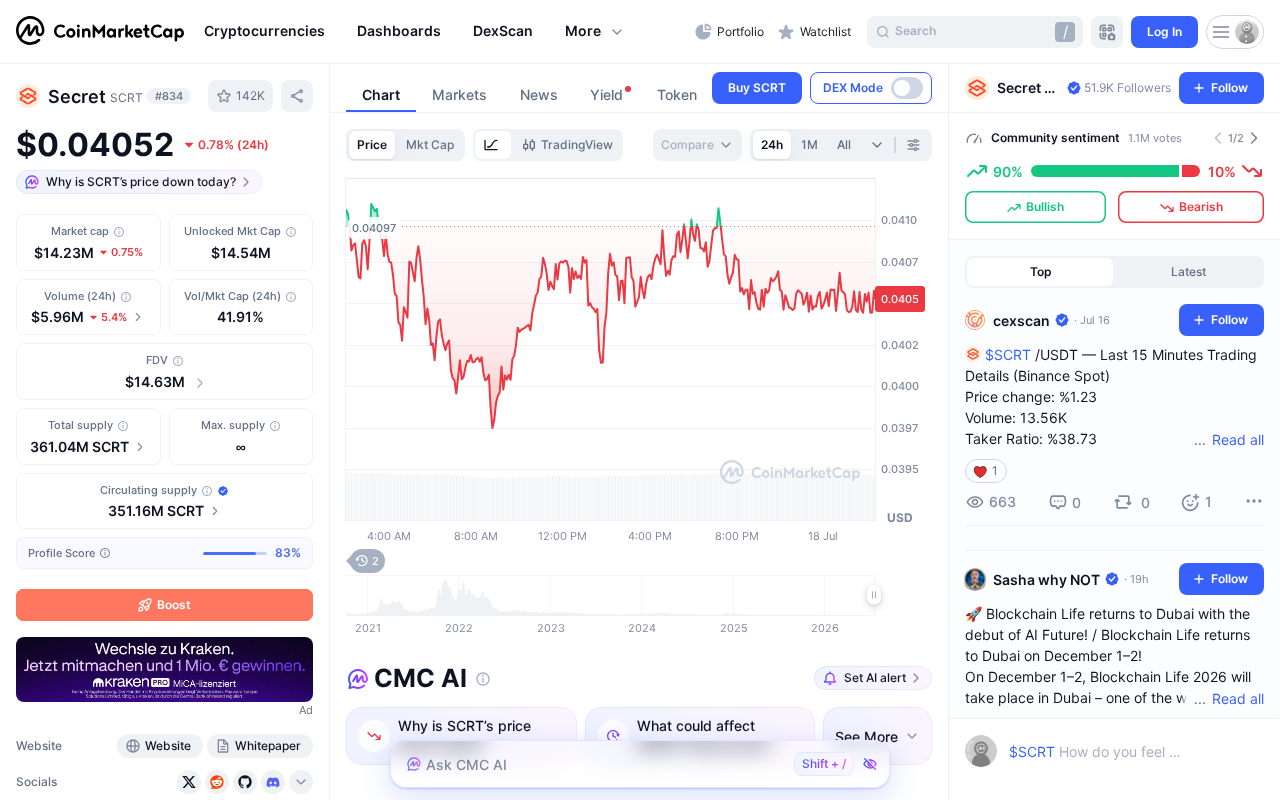
Secret Network’s native token, SCRT, is associated with network fees, staking, and governance. Its market value is separate from the technical usefulness of confidential computing.
Whether SCRT is a suitable investment depends on an individual’s financial circumstances, risk tolerance, valuation assumptions, and assessment of the project’s long-term adoption.
Potential considerations include:
- Whether the network and its applications attract sustained usage.
- The quality and maintenance of the underlying technology.
- Competition from other privacy-focused blockchain and confidential-computing systems.
- Token supply, staking economics, liquidity, and market conditions.
- Governance decisions and the ability of the project to deliver on its roadmap.
The project’s 2026 emphasis on SecretAI and SecretVM is relevant to evaluating its strategy, but it does not guarantee adoption, revenue, or token-price appreciation.
SCRT is a volatile cryptocurrency, and investors can lose some or all of their investment. A roadmap, a technology announcement, or an optimistic price forecast should not be treated as evidence of future returns.
For current market information, consult an established market-data provider such as CoinMarketCap, and verify its reported prices, market capitalization, and trading volume against additional sources where appropriate. Market data can change rapidly and should be checked at the time of any investment decision.
Frequently Asked Questions About Secret Blockchain Applications
What are secret blockchain applications?
Secret blockchain applications are applications that use privacy-preserving technologies to restrict the exposure of sensitive data while supporting verifiable blockchain operations. Examples include confidential smart contracts, private financial transactions, restricted NFT metadata, and privacy-preserving identity verification.
What is Secret Network?
Secret Network is a privacy-focused blockchain launched in 2020. It supports smart contracts that encrypt designated inputs, outputs, and state, using trusted execution environments to perform confidential computation. Its native token is SCRT.
How does confidential computing work on Secret Network?
Secret Network uses trusted execution environments to process data inside protected hardware-isolated environments. Designated transaction inputs and contract state are encrypted, while the contract’s program code remains publicly inspectable. Security depends on the protocol, implementation, hardware, and key-management design.
What is the difference between Secret Network and a regular public blockchain?
A conventional public blockchain generally makes transaction data and contract state visible to observers. Secret Network is designed to keep selected contract inputs, outputs, and state encrypted while allowing the network to execute contracts and reach consensus.
The precise privacy guarantees depend on the application and the information it intentionally exposes.
Can blockchain protect medical records?
Blockchain can support audit trails, access coordination, and tamper-evident records for healthcare systems. Sensitive medical records are often better stored in encrypted off-chain systems, with blockchain used for selected permissions or verification data. Privacy, security, and regulatory compliance still require additional controls.
Are Secret NFTs completely anonymous?
Not necessarily. Secret NFTs can support private metadata and restricted content access, but public token records, wallet addresses, transaction patterns, and external storage may reveal information. Privacy depends on the specific token design and the surrounding application.
What is the difference between zero-knowledge proofs and confidential computing?
Zero-knowledge proofs allow a system to prove a statement without revealing all the information used to establish it. Confidential computing protects data during computation, commonly through a trusted execution environment. They address related but different problems and can be combined.
Can secret blockchain applications be used for voting?
Yes. Privacy-preserving blockchain systems can support confidential ballots and verifiable tallies. However, secure voting also requires reliable voter authentication, protection against coercion, independent auditing, and strong operational safeguards. Blockchain alone does not guarantee election integrity.
What is SecretAI?
SecretAI is part of Secret Network’s confidential AI direction. It is intended to support AI workloads with privacy-focused infrastructure. The precise guarantees and available features depend on the service and its implementation, so users should review current technical documentation before deploying sensitive workloads.
Is zkBNB still active?
The official zkBNB GitHub repository is archived and states that the project is no longer actively maintained. Zero-knowledge proofs remain relevant across the wider blockchain ecosystem, but developers should not assume that an archived implementation is suitable for new production deployments.
What are the biggest risks of privacy-focused blockchains?
Important risks include hardware vulnerabilities, metadata leakage, compromised keys, smart-contract bugs, cross-chain exposure, regulatory conflicts, performance costs, and insufficient project maintenance. A privacy-focused design can reduce particular risks but cannot eliminate every security or privacy threat.
Will confidential computing replace public blockchains?
Not necessarily. Public blockchains provide transparency and independently verifiable records, while confidential computing protects selected data during processing. Many future applications may combine public verification with private computation rather than replacing one model with the other.
Conclusion: Why Secret Blockchain Applications Matter
Secret blockchain applications expand what blockchain technology can do by addressing a fundamental limitation of transparent ledgers: sensitive information is not always suitable for public disclosure.
Confidential smart contracts can protect selected inputs and state. Privacy-preserving DeFi can reduce exposure of financial activity. Secret NFTs can restrict metadata access, while zero-knowledge proofs can verify eligibility without revealing unnecessary personal details. Healthcare, identity, research, supply chains, and confidential AI also offer potential applications.
Secret Network demonstrates one approach through encrypted smart contracts and trusted execution environments. Other technologies, including zero-knowledge proofs, multiparty computation, and fully homomorphic encryption, provide alternative or complementary ways to protect information.
The most important consideration is not whether an application calls itself private or decentralized. It is whether its architecture provides the required confidentiality, verifiability, security, and regulatory safeguards under realistic conditions.
As the ecosystem develops, the strongest applications will be those that demonstrate measurable utility, transparent security assumptions, reliable maintenance, and a clear explanation of what information remains visible.